Table of Contents
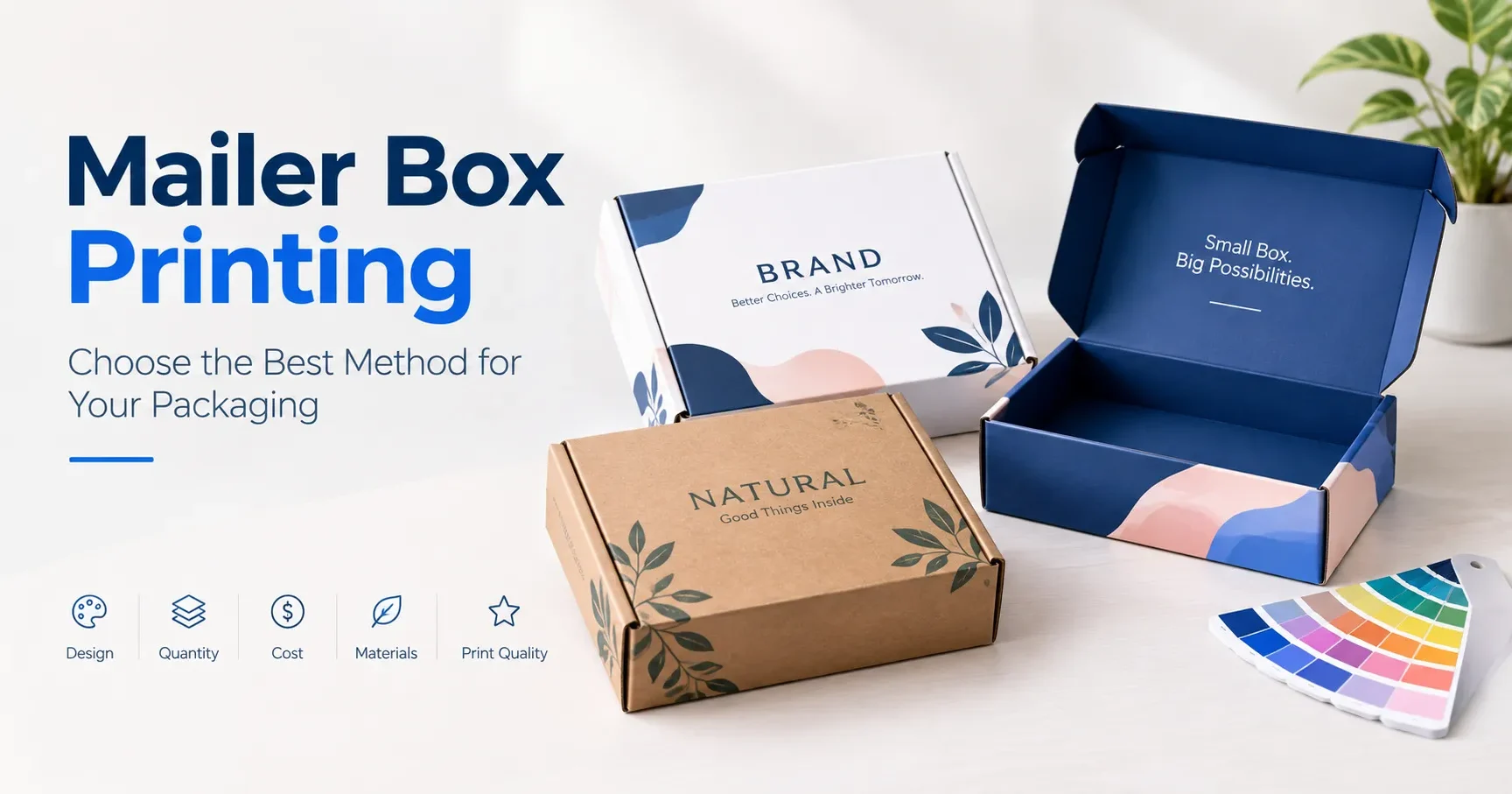
Mailer Box Printing: How to Choose the Right Printing Method for Your Custom Packaging
9. 9 月, 2026Last Updated: September 9, 2026 | By the Esion Package Team
Hi, I’m a packaging engineer at Esion Package, and I have spent more than 15 years working with brands on custom packaging projects. During that time, I have seen many buyers focus on one simple question: “Can you print on this mailer box?”
The answer is usually yes. The more important question is whether the chosen mailer box printing method is actually right for the product, artwork, order quantity, budget, and brand positioning.
A printing method that works well for a large-volume shipping project may be unnecessarily expensive for a smaller launch. Likewise, a simple printing solution may not reproduce detailed artwork or brand colors as accurately as expected.
This guide explains how printing on mailer boxes works, what options are commonly available, and how to compare them before placing an order. By the end, you should have a clearer idea of which printing approach fits your project and what information to prepare before requesting a quotation.
If you are still deciding on the box structure itself, you can also explore our Custom Mailer Boxes product page before selecting a printing method.
What Is Mailer Box Printing and Why Does the Printing Method Matter?
The printing method affects much more than the appearance of a box. It can influence production cost, color quality, minimum order quantity, production efficiency, and the overall consistency of your packaging.
For this reason, custom mailer box printing should be considered as part of the packaging development process rather than an afterthought added once the box structure has already been finalized.
What Can Be Printed on a Mailer Box?
Modern printed mailer packaging can include much more than a company logo. Depending on the selected material and production method, brands may print artwork on the outside, inside, or both sides of the box.
Common printed elements include:
- Brand logos and taglines
- Product illustrations
- Full-color graphics
- Patterns and decorative artwork
- Product information
- Promotional messages
- QR codes
- Social media information
- Instructions or welcome messages inside the box
The key is to decide what the packaging actually needs to communicate. A shipping box with a small logo has very different printing requirements from a subscription box designed to create a memorable unboxing experience.
Why Do Corrugated Mailer Boxes Require Different Printing Considerations?
Mailer boxes are commonly made from corrugated board, which gives them the strength needed for shipping and product protection. However, corrugated material also creates different printing considerations compared with smooth paperboard.
The surface texture, paper liner, material color, and printing process can all affect how the final artwork appears.
For example, a detailed design printed on a white, smooth surface may look different when reproduced directly on natural kraft material. Fine details, gradients, and highly saturated colors may also require a different printing approach than a simple one-color logo.
This is why packaging buyers should consider the box material and printing process together rather than treating them as two completely separate decisions.
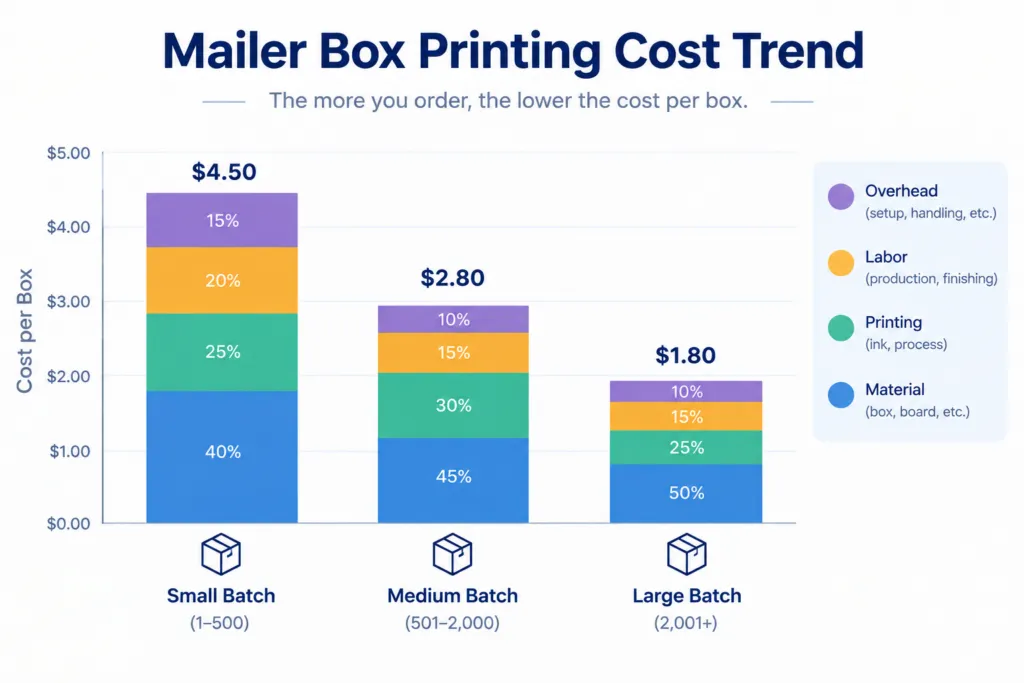
How Does Printing Influence Packaging Cost?
Printing cost is not determined by the number of colors alone. Several production factors can influence the final price, including the box dimensions, order quantity, artwork coverage, printing process, material, and any additional finishing requirements.
A more complex design is not automatically the wrong choice. However, the design should justify the additional production requirements.
The best approach is to evaluate the total packaging objective. If a mailer box is primarily used for transportation, a simple printed design may be sufficient. If the packaging plays an important role in customer experience or retail presentation, investing more in print quality may make sense.
Common Printing Methods for Mailer Boxes
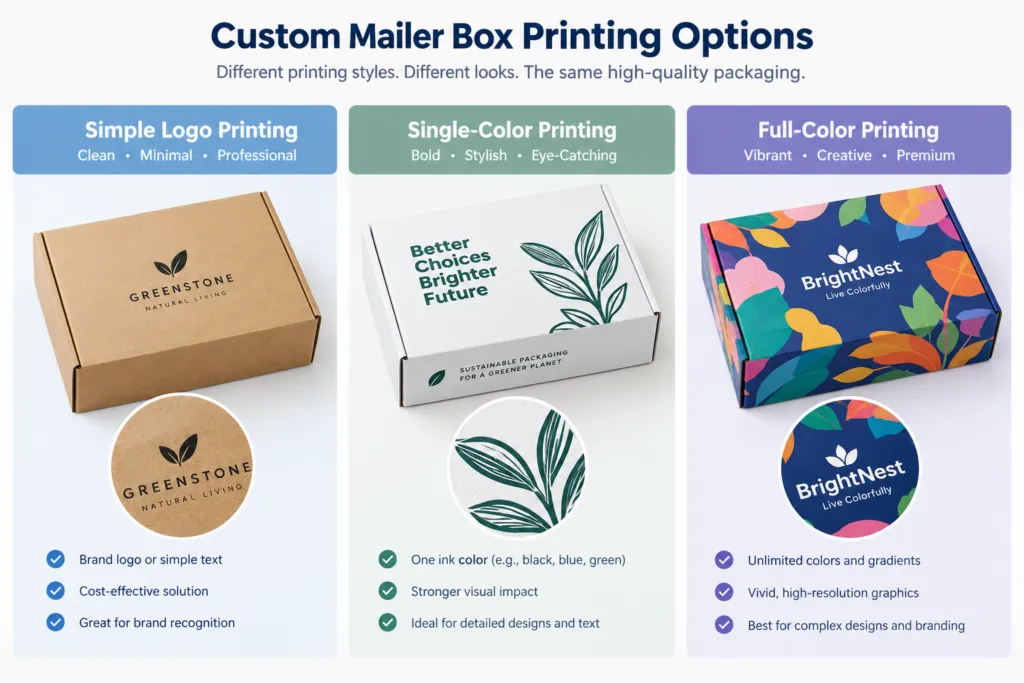
There is no single best method for all printed packaging boxes. The right option depends on what you want to print and how many boxes you plan to order.
Understanding the main differences can help prevent a common purchasing mistake: choosing a printing method based only on the initial unit price.
Flexographic Printing for Mailer Boxes
Flexographic printing is commonly used for high-volume corrugated packaging projects, especially when the artwork is relatively simple.
It can be a practical option for designs such as logos, text, basic graphics, and limited-color artwork.
For large orders, production efficiency can make this method attractive. However, buyers should carefully consider whether their artwork requires highly detailed graphics, photographic images, or precise color reproduction.
Flexographic printing is generally most appropriate when packaging requirements prioritize efficient production and consistent reproduction of relatively simple designs.
Digital Printing for Custom Mailer Boxes
Digital printing can be particularly useful for shorter runs, product launches, promotional packaging, and projects requiring more flexible customization.
One advantage is the ability to produce detailed, full-color artwork without relying on the same traditional setup process associated with some other printing methods.
This can make digital printing a practical choice when brands want to test a packaging design or produce multiple artwork variations without committing immediately to a very large order.
For businesses looking for custom printed mailer boxes in relatively smaller quantities, digital printing may offer a useful balance between customization and production flexibility.
Offset Printing for Premium Mailer Boxes
Offset printing is often selected when the artwork requires a high level of detail and visual quality.
In many corrugated packaging applications, the design is first printed onto a paper sheet, which is then laminated or mounted onto the corrugated board before the packaging is converted into its final box structure.
This approach can be suitable for detailed illustrations, photographic artwork, and premium brand packaging.
However, the production process is more complex than simply printing directly onto the corrugated board. Buyers should therefore evaluate whether the visual requirements of the project justify the additional production steps.
When Is Screen Printing Used for Mailer Boxes?
Screen printing can be useful for certain specialized packaging requirements, particularly when a project requires distinctive ink coverage or specific visual effects.
It is not necessarily the default choice for every custom mailer box project, but it can be considered when the design or material creates requirements that are better addressed through a specialized process.
The most practical approach is to provide the packaging supplier with the artwork, quantity, and intended application before deciding which process should be used.
How Should You Choose the Right Mailer Box Printing Method?
The right choice usually comes from balancing four factors: order quantity, artwork complexity, color requirements, and budget.
Looking at only one of these factors can result in a solution that appears inexpensive at first but does not meet the actual packaging requirements.
How Does Order Quantity Affect Your Printing Choice?
Order quantity can significantly influence which printing process makes the most commercial sense.
Some production methods require more preparation before mass production begins. Those initial costs may be distributed more efficiently across a large order. Other methods offer greater flexibility for smaller quantities.
For example, a 500-box product launch and a 10,000-box repeat order may require different printing solutions. For smaller quantities, flexibility and lower setup requirements are often more important. At higher volumes, even a small reduction in unit cost can have a noticeable impact on the total packaging budget.
For this reason, buyers should avoid asking only, “What is the cheapest printing method?”
A better question is:
Which printing method provides the best balance between setup requirements, unit cost, and final visual quality for my order quantity?
A short-term packaging launch and an ongoing high-volume product line may require completely different solutions.
How Complex Is Your Packaging Artwork?
Simple artwork is generally easier to reproduce than highly detailed graphics.
Before choosing a printing process, consider whether your design contains:
- A single-color logo
- Multiple solid colors
- Fine lines and small text
- Detailed illustrations
- Gradients
- Full-color photography
The more detailed the artwork becomes, the more important it is to evaluate how accurately the selected process can reproduce it on the chosen packaging material.
How Important Is Exact Brand Color Matching?
Color consistency can be particularly important for established brands that use specific colors across multiple marketing materials.
However, buyers should understand that the final appearance of a color can be influenced by several factors, including the printing process, ink system, paper surface, and material color.
A color printed on white packaging material may not look identical when printed on natural kraft board.
When precise brand colors are important, communicate this requirement clearly during the packaging development stage rather than waiting until mass production has started.
What Is Your Target Packaging Budget?
The lowest-cost printing option is not always the most cost-effective solution.
For example, a premium product may lose some of its intended value if the packaging design does not reproduce well. At the same time, spending heavily on complex printing for a basic shipping carton may not provide a meaningful return.
The goal should be to match the printing investment with the role the packaging plays in your product experience.
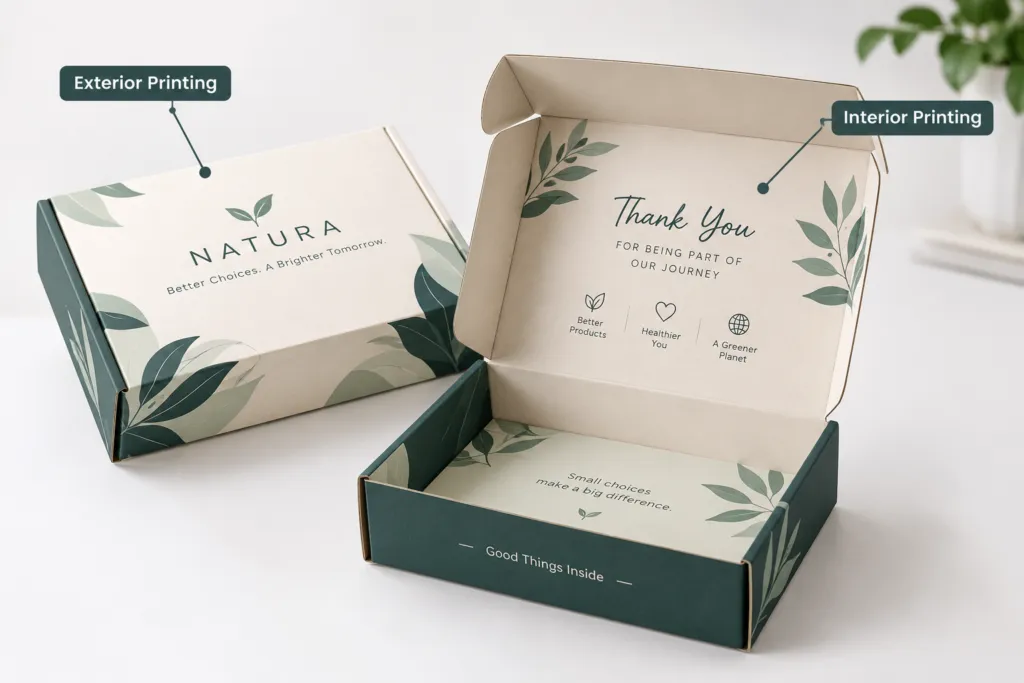
Can You Print on Both the Outside and Inside of a Mailer Box?
Yes. Both exterior and interior printing can be used to create a more complete brand experience, although additional printing areas may increase production complexity and cost.
The decision should be based on how customers interact with the packaging.
Why Is Exterior Printing Important for Brand Recognition?
The exterior of a mailer box is often the first physical touchpoint a customer has with a product.
A well-designed exterior can help create brand recognition before the package is even opened. Depending on the application, exterior printing may include a logo, brand colors, product graphics, or a simple message.
For shipping-focused packaging, a restrained design is often enough. For gift-oriented or subscription packaging, the exterior may play a larger role in the overall customer experience.
How Can Interior Printing Improve the Unboxing Experience?
Interior printing gives brands an opportunity to communicate after the customer opens the package.
This space can be used for a welcome message, product instructions, a brand story, or a simple thank-you message.
Interior printing is particularly useful when the opening experience is part of the product’s perceived value. However, it should not be added simply because it is available.
Every additional packaging element should have a purpose.
When Is Inside Printing Worth the Additional Cost?
Interior printing can be more valuable for products such as:
- Premium gifts
- Subscription boxes
- Influencer or promotional packages
- Direct-to-consumer products
- Brand-focused e-commerce packaging
For a basic transport package, it may provide less value.
The important question is whether the customer will actually notice and benefit from the additional design.
What Design Files Should You Prepare Before Printing on Mailer Boxes?
A good printing result starts with a production-ready design file. Even the right printing method cannot fully compensate for incorrect artwork preparation.
Before production begins, the box structure and artwork should be reviewed together.
Why Is the Correct Box Dieline Important?
A dieline shows how the flat packaging material will be cut, folded, and assembled into the final mailer box.
It helps designers understand where artwork should be placed and which areas should remain clear.
A properly prepared dieline typically identifies areas such as:
- Cut lines
- Fold lines
- Bleed areas
- Safe zones
- Glue areas where applicable
Ignoring these boundaries can result in logos or text being placed too close to folds or cut edges.
What File Formats Are Best for Packaging Printing?
Editable, high-quality artwork files are generally preferable for custom packaging production.
Depending on the project, common formats may include:
- Adobe Illustrator files
- Editable PDF files
- EPS files
Vector-based logos and artwork are generally useful because they can maintain clarity when scaled.
If photographs or raster images are included, they should be prepared at an appropriate resolution for the intended print size.
What Should You Check Before Approving Production?
Before approving final production, check the practical details rather than focusing only on the overall design appearance.
Review the logo placement, spelling, color settings, artwork alignment, bleed, and the readability of functional elements such as barcodes or QR codes.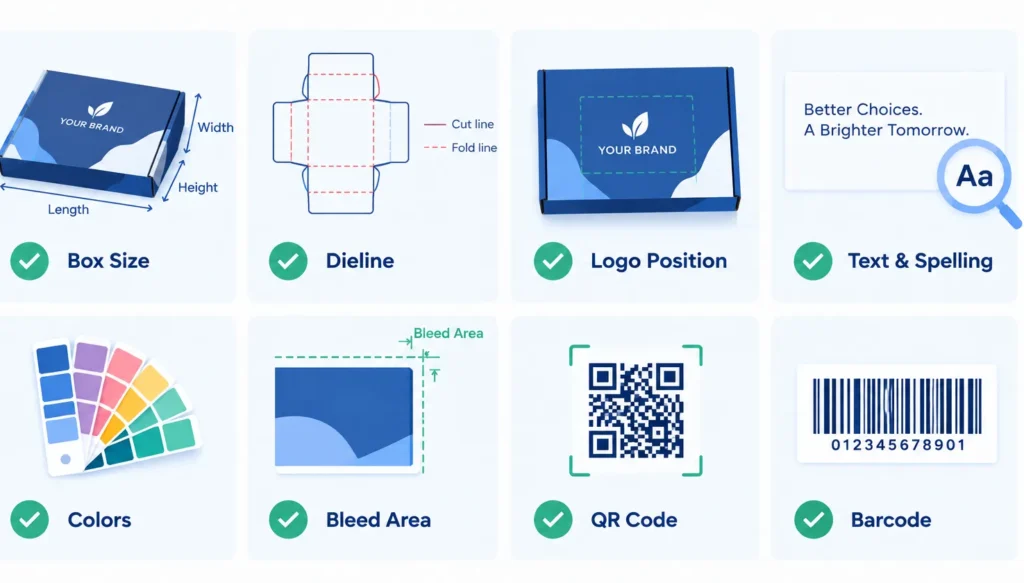
How Do Colors and Materials Affect the Final Printing Result?
The same digital artwork can produce different visual results on different packaging materials.
Material selection should therefore be considered before the final design is approved.
Kraft Material and Printing Results
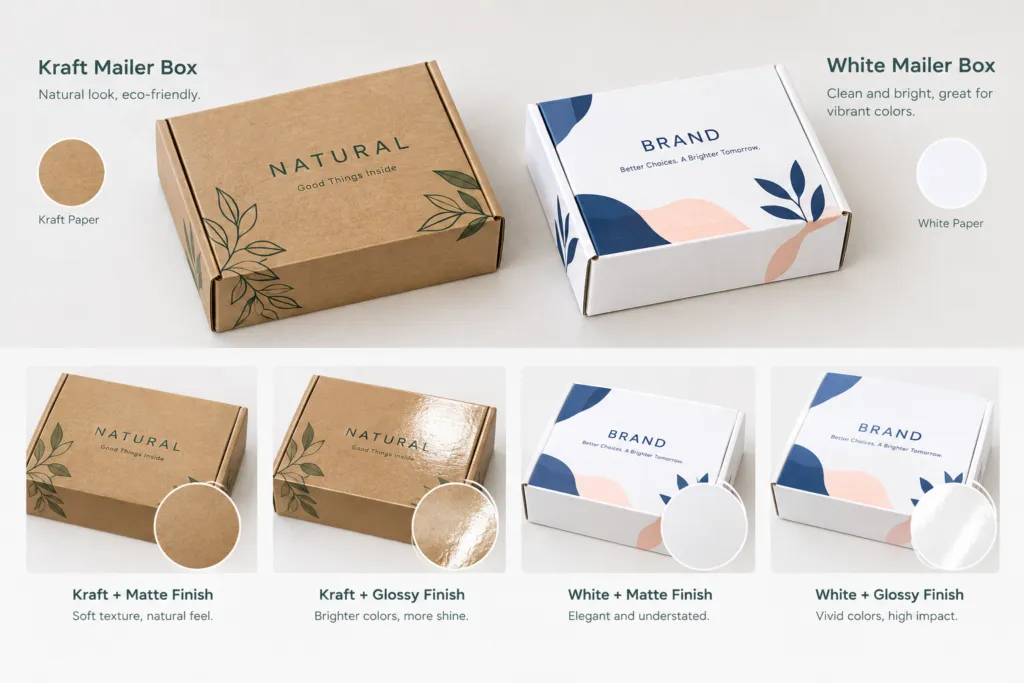
Natural kraft material has a recognizable brown background that can influence how printed colors appear. A black logo usually reproduces clearly, while light yellow, pastel, or light blue colors may appear darker on kraft material. For projects requiring finer graphics, E-flute corrugated board can also provide a relatively smoother printing surface than thicker corrugated structures.
This does not mean kraft packaging cannot be visually appealing. In fact, the natural appearance can support a particular brand style, especially when a company wants a more organic or minimal packaging presentation.
However, highly vibrant colors may not appear in exactly the same way they would on a bright white surface.
Designers should consider the material background as part of the artwork rather than assuming it is neutral.
Why Do White Mailer Boxes Show Colors Differently?
White packaging surfaces can provide a more neutral background for printed colors.
This can be useful for detailed graphics, bright brand colors, and artwork where visual consistency is particularly important.
The choice between kraft and white material should therefore consider both the functional packaging requirements and the intended visual identity.
Should You Choose a Matte or Gloss Finish?
Surface finishing can also affect how customers perceive printed packaging.
A matte finish can create a softer and more understated appearance, while a gloss finish may emphasize color and create a more reflective surface.
Neither is automatically better. The right choice depends on the brand identity and the product being packaged.
What Common Mailer Box Printing Mistakes Should Buyers Avoid?
Many printing problems begin before the production stage. Better preparation and communication can prevent unnecessary revisions, delays, and unexpected costs.
Is Choosing a Printing Method Based Only on Price a Mistake?
Yes, in many cases.
The lowest initial price may not provide the required visual result, while an unnecessarily complex process may add costs without improving the packaging in a meaningful way.
Price should be evaluated together with the expected quality and production requirements.
What Happens When Buyers Ignore the Packaging Material?
A design may look excellent on a computer screen but behave differently on a real packaging material.
Kraft board, white paper, corrugated surfaces, and different finishes can all affect the final appearance.
Material should therefore be selected early enough to influence the artwork decision.
Why Are Low-Resolution Images a Problem?
Low-resolution images can become blurred or unclear when printed.
This is particularly noticeable on large packaging panels. Supplying the highest-quality available artwork from the beginning can help reduce unnecessary production revisions.
What Can Go Wrong Without a Material Check?
A common packaging issue occurs when artwork is approved only on a digital screen. For example, a light-colored logo may look clear on a white background but lose contrast when printed on natural kraft board. Small text placed too close to fold lines can also look balanced on a flat dieline but become difficult to read after the box is assembled.
Should You Request a Proof or Sample Before Mass Production?
When visual accuracy is important, reviewing a proof or sample can help identify issues before a full production run begins.
The type of approval process may vary depending on the project, but important elements such as artwork placement, color expectations, and structural details should be confirmed as early as possible.
Can Too Many Design Elements Reduce Packaging Effectiveness?
Yes.
A packaging design does not need to use every available surface. Too much text or too many graphics can make the box harder to understand.
A clear visual hierarchy usually helps customers identify the brand and important information more quickly.
How Can Esion Package Help Simplify the Mailer Box Printing Process?
For many brands, the challenge is not simply finding a factory that can print a box. The more difficult part is coordinating the artwork, material, box structure, quantity, and production requirements into a workable packaging specification.
This is where practical packaging communication can make the purchasing process more efficient.
How Can Artwork Be Reviewed Before Production?
Before production begins, potential issues can often be identified by reviewing the artwork against the box structure.
This may include checking whether important design elements are positioned correctly and whether the artwork is suitable for the selected material and printing method.
How Can Brands Match Printing Options With Their Order Quantity?
A smaller launch order may have different production priorities from a long-term high-volume packaging program.
Esion Package can help customers discuss practical options based on the quantity and packaging requirements instead of automatically applying the same production solution to every project.
This can help reduce unnecessary setup costs or avoid selecting a process that is unsuitable for the artwork.
How Can Brands Balance Appearance and Cost?
The goal is not always to recommend the most complex packaging solution.
In many projects, a simpler structure and printing method can produce a better commercial result. In others, the packaging may need more detailed artwork because it plays a major role in brand presentation.
Working with a supplier that understands both the production process and the customer’s purchasing requirements can make these decisions easier and reduce unnecessary back-and-forth during development.
What Should You Ask a Supplier Before Ordering Printed Mailer Boxes?
A clear quotation request usually leads to a more accurate packaging proposal.
Before contacting a supplier, it helps to prepare the key information needed to evaluate the project.
What Printing Methods Are Available for My Design?
Provide the artwork and ask which production method is most suitable for the design.
The answer should consider both the visual requirements and the expected order quantity.
Is My Artwork Suitable for the Selected Material?
Ask how the chosen material may affect the printed colors and details.
This is particularly important when using natural kraft materials or highly detailed artwork.
What Is the Minimum Order Quantity?
Minimum order quantities can vary depending on the material, printing process, and project requirements.
Confirm this early so that the proposed production solution matches your purchasing plan.
Can My Brand Colors Be Matched?
If color consistency is important, provide clear brand color information during the quotation stage.
Do not assume that every color will appear identically across different materials without discussing the requirement.
Can I Review a Sample Before Mass Production?
For important packaging projects, clarify the available sample or approval process before placing the final order.
This can provide an opportunity to identify structural or visual concerns earlier in the project.
Information Needed for an Accurate Quote
A supplier can usually provide a more useful quotation when you prepare the following information:
- Box dimensions
- Required quantity
- Material preference
- Printing artwork
- Printing coverage
- Surface finishing requirements
- Delivery destination
Once you have these details ready, you can request a custom packaging quote with your specifications and artwork to receive a more accurate packaging solution.
FAQ
What is the best printing method for mailer boxes?
There is no single best option for every project. The right method depends on your order quantity, artwork complexity, material, color requirements, and budget.
Can you print directly on corrugated mailer boxes?
Yes. Direct printing is possible for many corrugated mailer box projects. However, the final print quality depends on the material, artwork, and selected printing process.
How much does custom mailer box printing cost?
The cost depends on factors such as box size, order quantity, material, printing method, number of colors, artwork coverage, and finishing requirements. Providing complete project information is the best way to receive an accurate quotation.
Can I print full-color artwork on a mailer box?
Yes. Full-color artwork can be produced using suitable printing processes. The best option will depend on your artwork, order quantity, and required print quality.
What file format should I send for custom mailer box printing?
Editable artwork files such as AI, PDF, and EPS are commonly preferred. Vector-based artwork is generally useful for logos and graphics because it can maintain clarity during production.
Conclusion: Choosing the Right Mailer Box Printing Solution
The best mailer box printing solution is not necessarily the most expensive or the most technically complex.
A successful project starts by understanding what the packaging needs to accomplish. Your artwork, box material, order quantity, budget, and brand expectations should all be considered before production begins.
Whether you need a simple branded shipping box or more detailed custom printed mailer boxes, preparing the right specifications early can make the production process more efficient and help avoid unnecessary revisions.
If you are planning a custom packaging project, the next practical step is to confirm your box dimensions, expected quantity, artwork requirements, and preferred material. You can then use that information to discuss the most suitable printing option for your project.
For buyers still evaluating the structure and customization possibilities of this packaging format, Custom Mailer Boxes is the recommended internal link anchor for returning to the main Mailer Box product page.