
Table of Contents
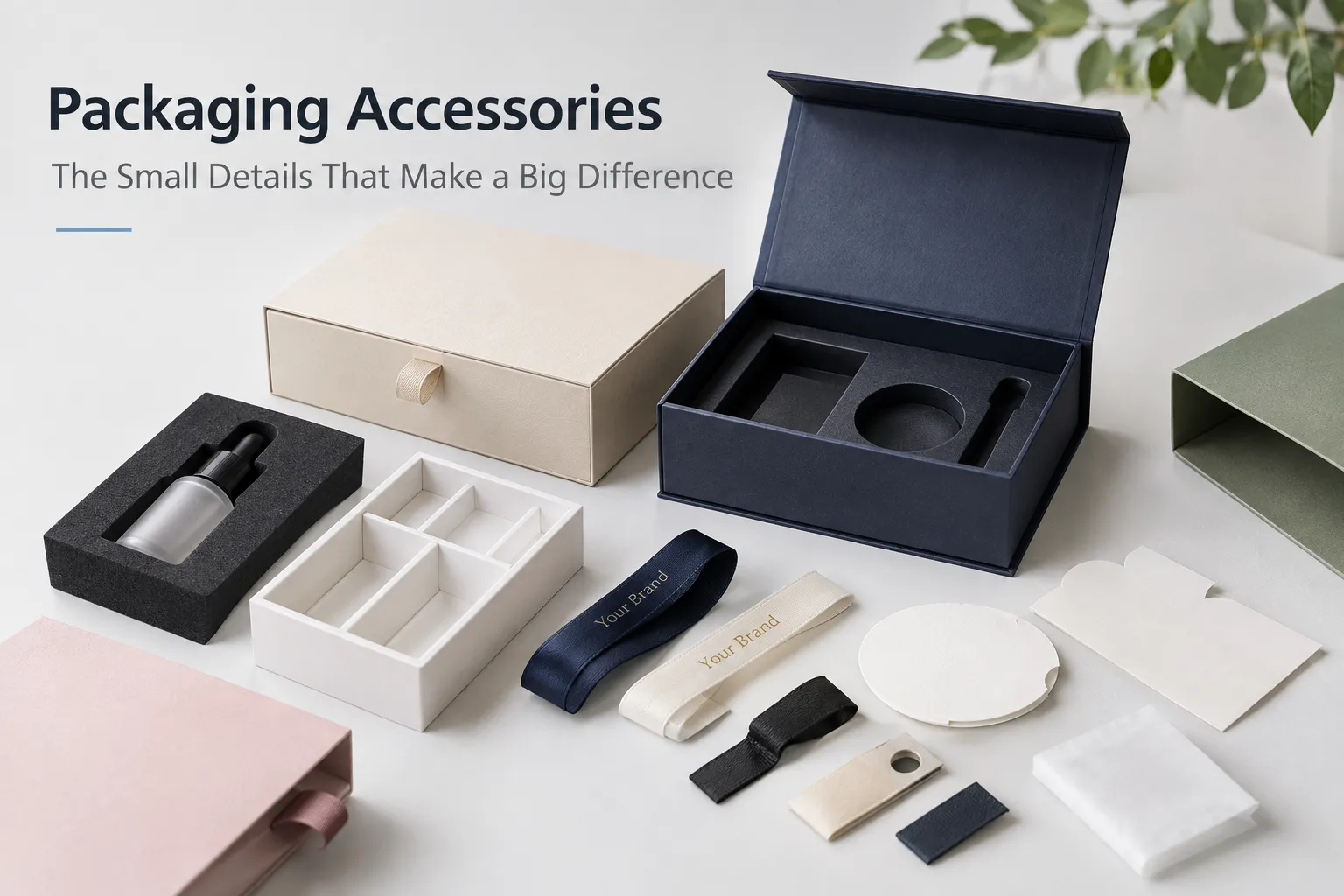
Packaging Accessories: How to Choose the Right Accessories for Your Product
2026-01-19Author: Esion Package Editorial Team
Last Updated: September 14, 2026
Packaging accessories are often treated as a secondary part of packaging, but they can have a direct impact on product protection, presentation, and the overall unboxing experience.
The right accessories help keep products securely positioned, organize multiple components, and make the package easier to open and use. The wrong configuration can lead to movement, poor fit, difficult product removal, or unnecessary material use.
This guide explains how to choose packaging accessories based on your product, packaging structure, protection requirements, and presentation goals, as well as what to check before moving into production.
What Are Packaging Accessories?
Packaging accessories are supporting components used with a package to improve product protection, organization, positioning, presentation, or usability.
Depending on the product and package structure, these components may include internal support elements, dividers, protective pieces, ribbons, pull tabs, positioning parts, and other customized components.
The important point is that packaging accessories should be selected according to the product rather than added simply because they are available. A small cosmetic product, a jewelry item, an electronic device, and a gift set can require very different internal configurations.
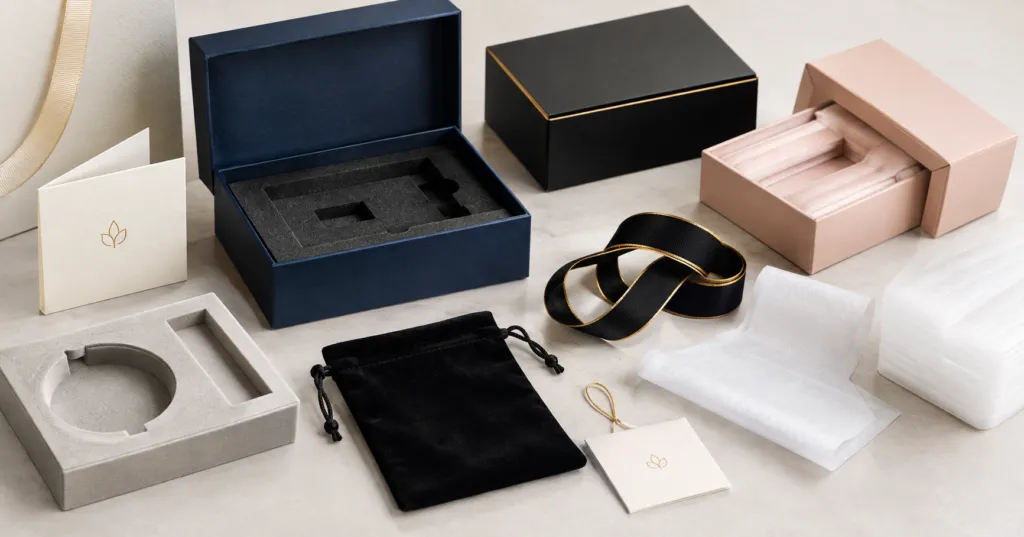
A well-designed configuration should achieve three things at the same time: keep the product stable, support the desired presentation, and allow the customer to remove the product without unnecessary effort.
How Do You Choose the Right Packaging Accessories?
The best starting point is the product itself. Before selecting any accessory, consider the product’s dimensions, weight, shape, protection requirements, and how the customer will interact with the package.
Start With Product Dimensions and Shape
Measure the product accurately, including its length, width, height, and any irregular areas that affect positioning.
For products with unusual shapes, simply designing a rectangular space around the maximum dimensions may not provide enough stability. The supporting structure should follow the product’s actual geometry where necessary.
Consider Product Weight and Protection
A lightweight product may only require basic positioning, while a heavier or more delicate product may need stronger support.
Consider:
- Product weight
- Fragile surfaces
- Movement inside the package
- Pressure points
- Expected handling during transportation
- Whether the package may be opened and closed repeatedly
The goal is not to add as much material as possible. It is to provide sufficient support without making the package unnecessarily complicated.
Think About Product Removal
Protection is only one part of the design.
If the product is held too tightly, customers may struggle to remove it. If it is too loose, the product may move during handling.
A good packaging configuration should balance stability, accessibility, and presentation.
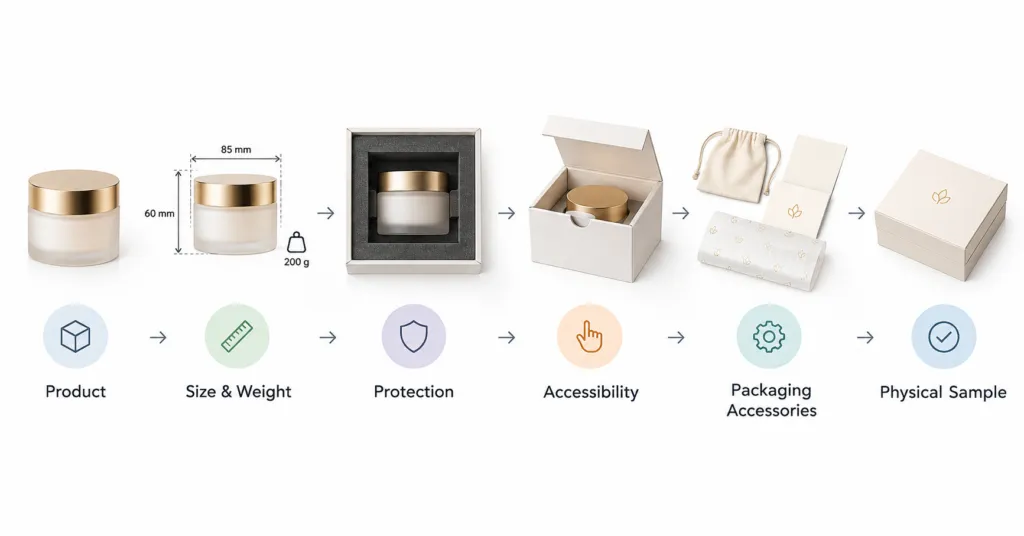
The physical sample is particularly important because dimensions on a drawing do not always show how the finished package feels in actual use.
Which Packaging Accessories Work for Different Products?
Different products create different packaging requirements, so there is no universal accessory configuration. The right choice depends on product size, fragility, quantity, and presentation.
Small and Lightweight Products
Small products often need precise positioning rather than heavy protection.
For jewelry, small cosmetics, accessories, or compact gift items, the internal configuration should prevent unnecessary movement while keeping the package visually clean.
Fragile or Precision Products
Fragile products require greater attention to stability and contact points.
The supporting structure should prevent excessive movement and avoid creating pressure on sensitive surfaces. For products with delicate finishes, the contact material and surface treatment should also be considered.
Products With Multiple Components
Gift sets and product combinations may contain several individual items.
In this situation, the packaging needs to keep each component organized while making the overall presentation easy to understand. Divided spaces or dedicated positioning areas can help create a cleaner arrangement.
Premium Products
For luxury gifts, cosmetics, jewelry, and electronics, the internal configuration also contributes to perceived product value.
A package can provide protection while creating a deliberate opening sequence. The customer should immediately understand where the product is located and how it should be removed.
Real Project Example
For a custom packaging project, the main challenge was achieving a secure product fit while maintaining a clean and premium presentation. Esion reviewed the product dimensions and packaging requirements, then adjusted the internal structure to improve positioning and accessibility. A physical sample was produced to check the fit, stability, box closure, and overall presentation before production approval.
What Should You Check Before Production?
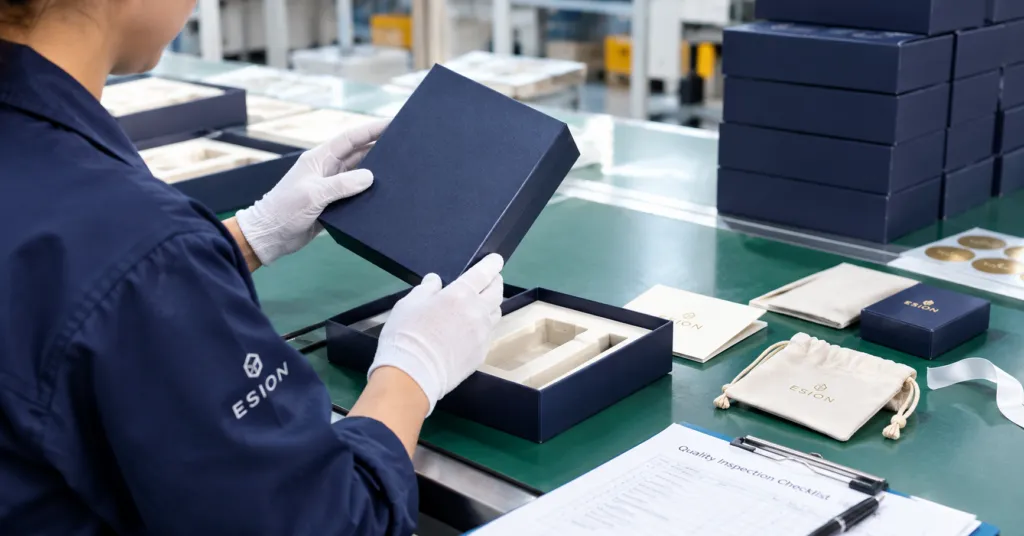
A packaging accessory can look correct on a drawing but perform differently in a physical package. Sampling should therefore be treated as an essential step before mass production.
Check the Product Fit
Place the actual product into the sample and check whether it sits correctly.
Look for:
- Excessive movement
- Excessive pressure
- Uneven positioning
- Interference with the box closure
- Difficult product removal
Check the Complete Package
The accessory should not be evaluated separately from the outer package.
Once the product and accessory are assembled, check the complete package from the customer’s perspective. The box should close correctly, the product should remain stable, and the opening experience should feel intentional.
Check the Physical Sample
Whenever possible, use the actual product rather than relying only on product drawings.
A simple sampling process can follow:
Product Information → Design → Physical Sample → Fit Check → Approval → Production
This stage can reveal problems that are difficult to identify from specifications alone, especially when several packaging components need to work together.
What Is Changing in Packaging Accessories in 2026?
In 2026, packaging design is increasingly influenced by both material efficiency and the changing requirements of e-commerce and sustainability.
One important regulatory development is the European Union’s Packaging and Packaging Waste Regulation (PPWR), which began applying on August 12, 2026. The regulation is intended to reduce packaging waste, improve recyclability, and address certain packaging materials and formats.
The PPWR applies from August 12, 2026, but many of its requirements are phased in over time, with additional obligations taking effect in 2028, 2030, and beyond.
For brands selling into Europe, packaging decisions should therefore consider both current requirements and upcoming compliance changes.
At the product level, this means packaging accessories should not simply provide maximum protection. They should also use materials efficiently and avoid unnecessary components where they do not add meaningful value.
For e-commerce brands, there is another consideration: packaging needs to survive handling while still creating a positive opening experience.
A useful way to think about the 2026 approach is:
Protection + Presentation + Material Efficiency
How Can You Avoid Common Packaging Accessory Problems?
Most problems can be reduced by evaluating the complete packaging system before production rather than focusing on one component at a time.
The Product Is Too Tight
If the product is difficult to remove, the supporting structure may be too restrictive.
Allow enough clearance for practical removal while maintaining sufficient stability.
The Product Is Too Loose
Excessive space can allow movement during handling and transportation.
In this situation, review the positioning areas and the relationship between the product and surrounding structure.
The Design Looks Good but Does Not Work in Production
A design may appear effective digitally but become difficult to assemble or inconsistent during production.
Production feasibility should therefore be considered during the design stage, especially when the package contains multiple components or requires manual assembly.
The objective is not simply to create an attractive design. It is to create a configuration that can be sampled, assembled, inspected, and reproduced consistently.
How Can Esion Package Support Your Project?
Packaging accessories work best when they are considered together with the product and outer package rather than developed as an isolated component.
Esion Package can coordinate the packaging structure, accessory configuration, sampling, production, and quality inspection according to the requirements of the project.
For more information about Esion Package and its manufacturing capabilities, visit the About Us page.
When the outer package is a premium rigid structure, the internal configuration should also be considered at the same design stage. You can explore Magnetic Rigid Boxes to see how premium outer structures can be developed around the product presentation.
What Information Should You Prepare Before Starting?
Having accurate product information at the beginning can make packaging development much more efficient.
Before discussing the project, prepare:
- Product dimensions
- Product weight
- Product photos or drawings
- Number of components
- Protection requirements
- Expected order quantity
- Preferred presentation or opening experience
You do not need to have every packaging detail finalized before starting.
A practical development process is:
Send Product Information → Discuss Structure → Develop Sample → Check Fit → Approve → Production
The more accurate the initial product information is, the easier it becomes to develop a packaging configuration that fits the actual product.
If you are developing packaging for a new product, start with the product itself rather than choosing accessories first. The right configuration should be a result of the product’s requirements, not the other way around.
Frequently Asked Questions
What are packaging accessories used for?
Packaging accessories are used to support product protection, positioning, organization, presentation, and usability. The specific components depend on the product and packaging structure.
Do all products need packaging accessories?
No. Some products can be packaged effectively without additional internal components. Accessories are useful when they solve a specific requirement such as product positioning, protection, organization, or presentation.
How do I choose packaging accessories for a new product?
Start with the product’s dimensions, weight, shape, fragility, and presentation requirements. Then consider how the product should be positioned, protected, and removed from the package.
Should I test packaging accessories before mass production?
Yes. A physical sample allows you to check product fit, stability, box closure, accessibility, appearance, and assembly before production begins.
Can packaging accessories be customized for different products?
Yes. Different products can require different shapes, materials, positioning methods, and configurations. Custom development allows the packaging to be matched more closely to the actual product and brand presentation.
Final Packaging Accessories Checklist
Before approving production, check:
Product Fit — Does the product sit securely?
Stability — Does it remain in position during handling?
Accessibility — Can customers remove it easily?
Box Closure — Does the complete package close correctly?
Presentation — Does the opening experience match the brand?
Material Efficiency — Are unnecessary components or excess material avoided?
Physical Sample — Has the complete package been tested with the actual product?
A well-designed packaging accessory should do more than fill empty space. It should help the product arrive safely, look organized when opened, and support the experience your brand wants to create.
If you have the product dimensions, photos, or drawings ready, the next step is to evaluate the product requirements and develop a physical sample before production.