
Table of Contents
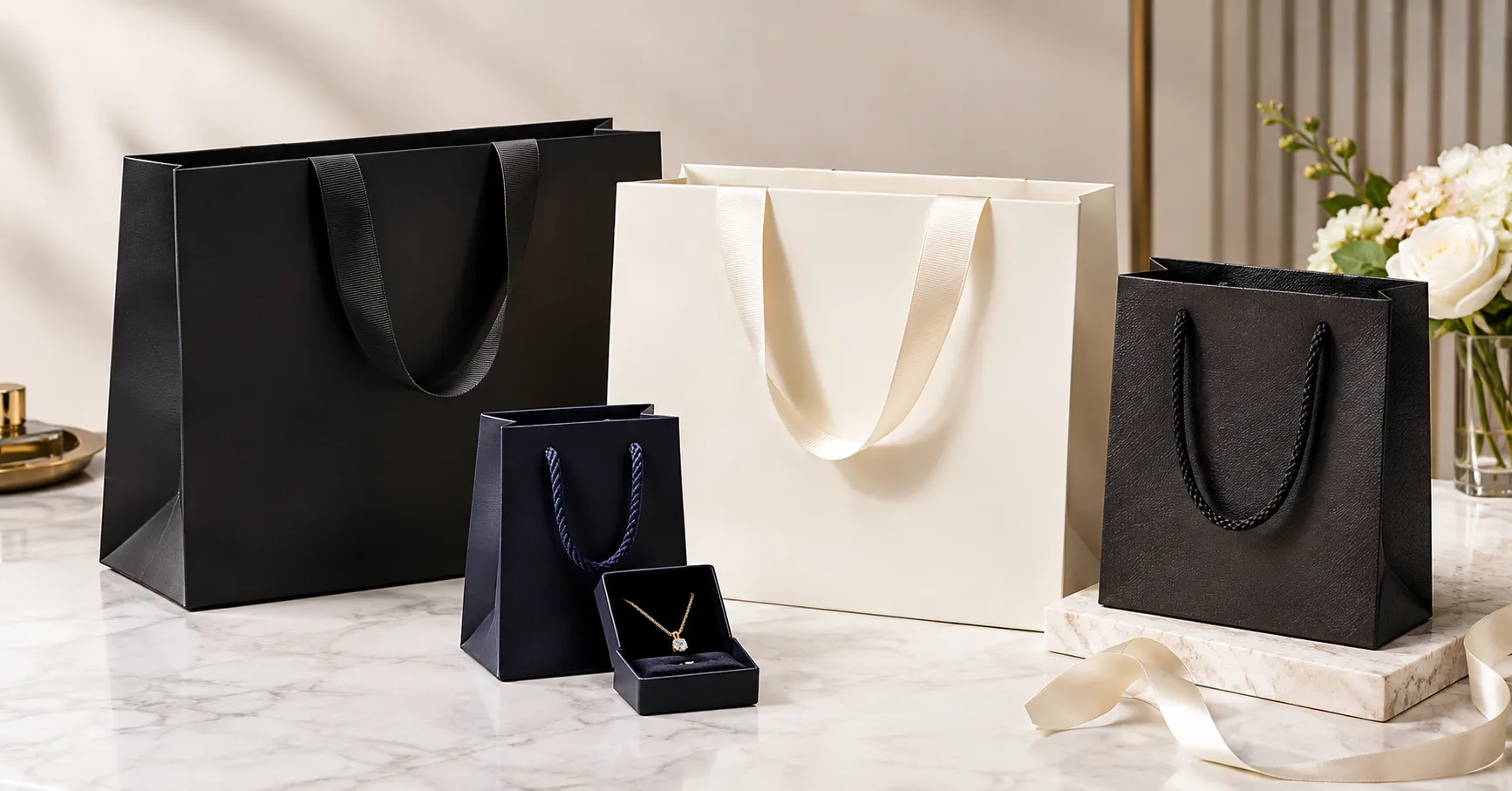
Paper Bag Packaging Design: A Practical Guide for Brands
2026-01-19Author: Esion Package Editorial Team
Packaging & Manufacturing Content Team
Last Updated: September 14, 2026
Designing a paper bag is not simply a matter of putting a logo on a template.
When working on custom paper packaging, we have found that many problems appear only after a design reaches the production stage. A color that looks right on screen may behave differently on paper. A logo may look balanced on a flat artwork file but become too close to a fold or handle area. A finishing effect may also change the visual hierarchy of the entire bag.
For brands, the better approach is to treat paper bag packaging design as both a branding decision and a production decision.
This guide explains the main decisions brands should make before approving a paper bag design, from product positioning and structure to paper selection, color approval, sampling and production.
What Should a Brand Decide Before Designing a Paper Bag?
The most effective paper bag designs start with the product and brand requirements—not the artwork.
Before opening a design file, define what the bag needs to communicate and what it needs to carry.
A jewelry brand may need a compact bag with a refined appearance. A cosmetics brand may prioritize clean graphics and strong shelf presentation. A premium gift brand may need a larger format with a more substantial feel.
Three questions should be answered first:
What is the product?
Consider its size, weight and how it will be placed inside the bag.
What should the customer notice first?
This may be the logo, brand name, product category or a specific visual element.
What should the packaging communicate?
Luxury, simplicity, natural materials, sustainability or another brand characteristic should influence the visual direction.
Once these decisions are clear, the artwork becomes much easier to control.
How Should Paper Bag Design Match the Product and Brand?
The paper bag should visually extend the product experience rather than compete with it.
A premium jewelry product, for example, may benefit from a restrained design with strong contrast and minimal graphics. A lifestyle or natural-product brand may prefer kraft paper and a simpler visual language.
Esion’s published paper bag products provide several real examples of how these decisions can be applied.
Real Esion Product Example: Matt Black Kraft Paper Jewelry Bag
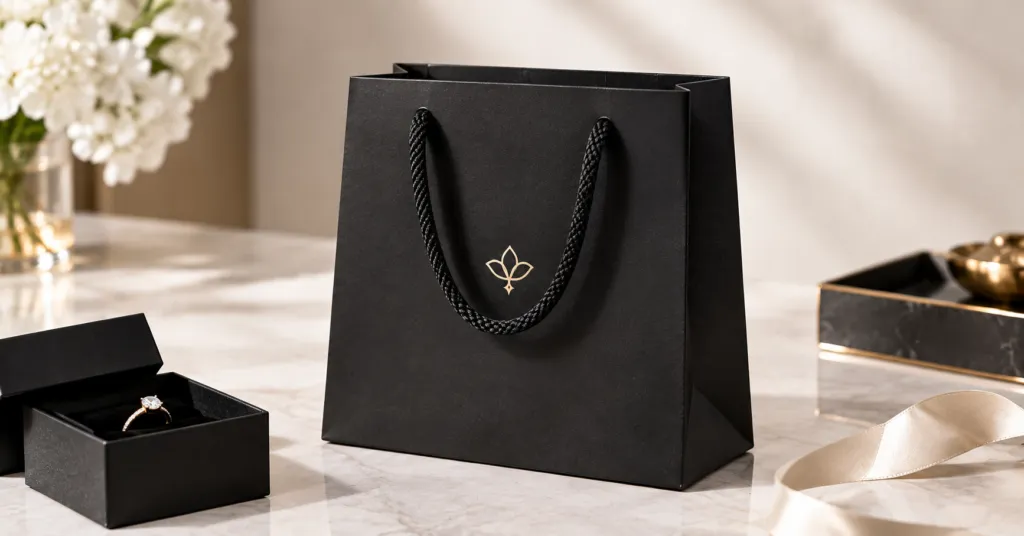
Esion’s Logo Matt Black Kraft Paper Jewelry Bags use a matte black kraft paper appearance with a custom logo, creating a relatively understated presentation suitable for jewelry packaging.
The product page lists custom sizing, custom logo options and artwork support in AI, CDR and PDF formats. It also lists an MOQ of 1,000 pieces per design.
This example shows an important design principle: a premium appearance does not necessarily require a complicated graphic layout.
Real Esion Product Example: Black, White and Gold Gift Bag
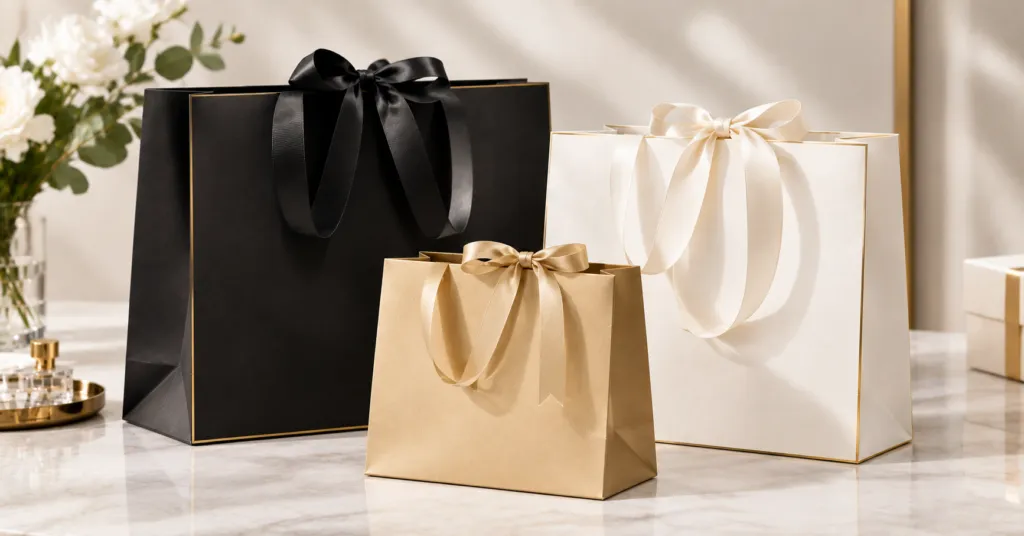
Another Esion example, the Elegant Black White Gold Gift Bag with Ribbon Handle, uses a black, white and gold visual combination with a ribbon handle.
The stronger contrast and metallic-looking visual direction make the bag more appropriate for gift-oriented presentation, where the packaging itself becomes part of the unboxing experience.
Real Esion Product Example: Recycled White Kraft Paper Bag
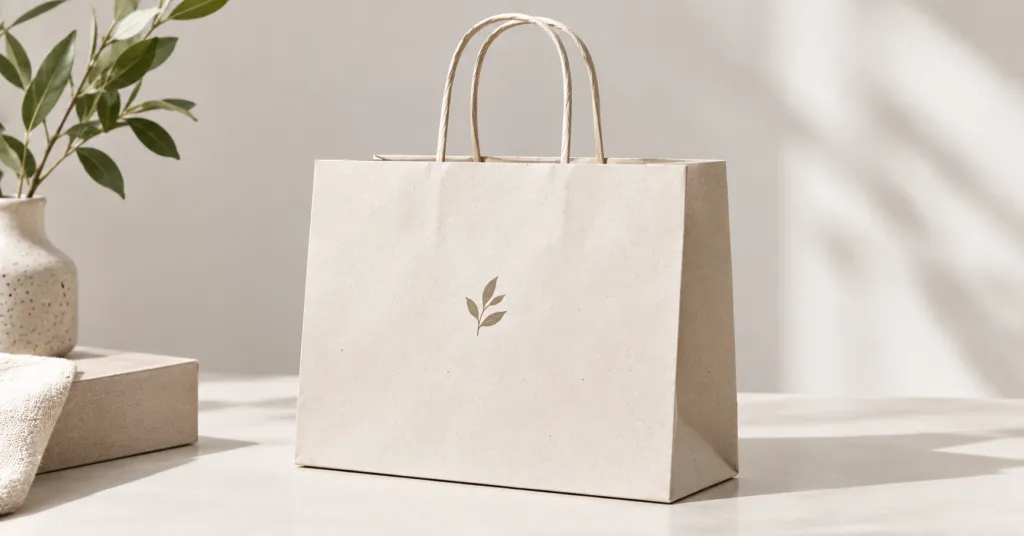
Esion also publishes a Recycled White Kraft Paper Bag with Twist Handle, combining recycled white kraft paper with a twisted paper handle.
Compared with a dark luxury presentation, this type of design supports a cleaner and more natural visual direction.
These examples demonstrate why the same paper bag structure should not automatically be given the same visual treatment. The design needs to reflect the product category, brand position and customer experience.
How Should Paper Choice Support Your Paper Bag Design?
The right paper should support the brand position, product weight and overall bag structure.
Kraft paper can create a natural and understated appearance, while coated paper provides a smoother surface for polished brand graphics. Specialty papers can be considered when texture itself is an important part of the packaging experience.
Paper weight should be selected according to the bag size, product weight and construction rather than simply choosing the heaviest available stock.
For example, a small lightweight retail bag does not necessarily need the same paper specification as a large gift bag carrying a heavier product.
The goal is simple:
Choose a paper that allows the design, structure and intended use to work together.
A more detailed breakdown of paper types, GSM and material performance will be covered in our upcoming Paper Bag Materials Guide, keeping this article focused on the design decisions that matter most to brands.
What Makes a Paper Bag Design Production-Ready?
A production-ready design accounts for the physical construction of the bag, not just the flat artwork.
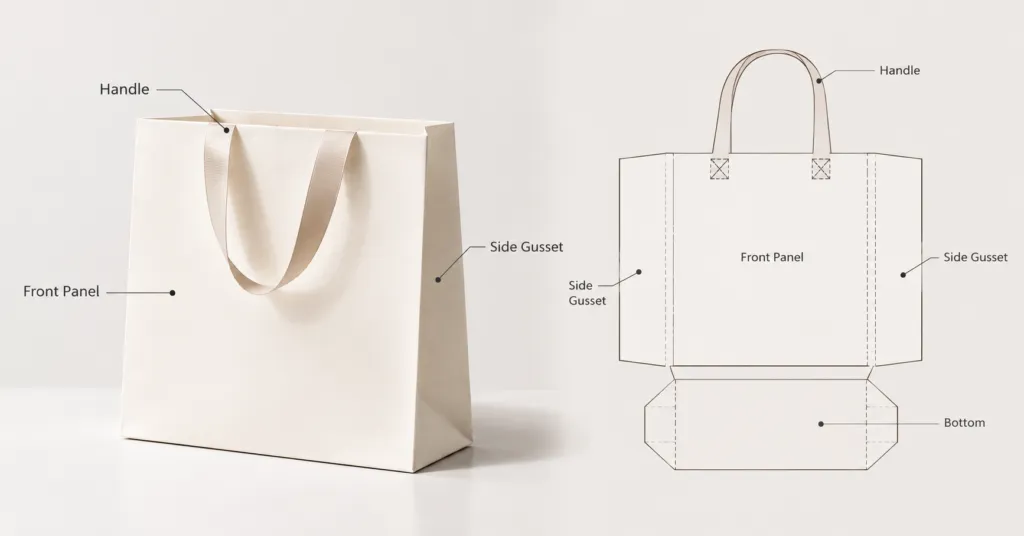
A paper bag may look perfect on a computer screen and still create problems during manufacturing if the artwork does not account for its physical structure.
Pay particular attention to:
Bag Dimensions
The finished width, height and gusset should match the actual product requirements.
A bag that is too small can damage the product or create an uncomfortable customer experience. A bag that is unnecessarily large may increase material usage and shipping volume.
Folding and Construction Areas
Important graphics should not be positioned too close to folds, seams or gussets.
The front panel should have enough clear space for the primary visual message to remain easy to recognize.
Handle Position
The handle is both a functional and visual element.
Its position, color and material should work with the overall design instead of appearing as an afterthought.
Front Panel Hierarchy
The most important brand element should normally have the strongest visual position.
If the logo, slogan, product information and decorative graphics all compete for attention, the bag can quickly become visually crowded.
A production-ready artwork file should therefore be evaluated together with the physical bag structure.
How Should Color Be Controlled Before Production?
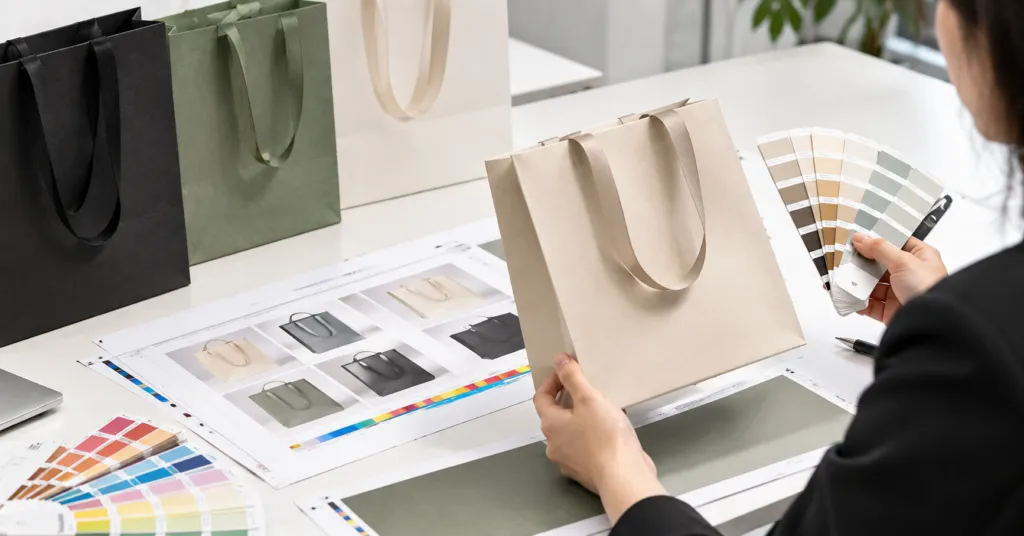
Color should be approved against a defined reference before mass production.
Brand colors can appear different depending on the paper surface, printing process and viewing conditions. For this reason, artwork should be prepared with an agreed color reference rather than relying only on a computer screen.
ΔE can be used to measure color difference, but the acceptable tolerance should be agreed according to the brand’s requirements, substrate, printing process and approved color reference.
Esion’s About Us page states that its production process includes precision color adjustment and uses Heidelberg printing equipment.
For this article, the key decision is simple:
Define the color reference and approve the physical sample before mass production.
Technical topics such as ΔE standards, Pantone matching, CMYK conversion and substrate-related color variation will be covered in our upcoming Paper Bag Color Management Guide.
How Much Finishing Does a Paper Bag Actually Need?
Finishing should strengthen the brand hierarchy rather than become decoration for its own sake.
Depending on the design, paper bags may use effects such as foil stamping, embossing, spot UV or lamination.
A luxury brand may use a subtle foil logo to create contrast on a dark surface. Another brand may achieve a stronger result by keeping the bag simple and allowing the paper texture to carry the visual identity.
The important question is not:
How many finishing techniques can we add?
It is:
Which finishing effect actually improves the packaging experience?
Finishing specifications should be confirmed during artwork and sampling rather than added simply because they are available.
A more detailed comparison of foil stamping, embossing, spot UV and other finishing methods will be covered in our upcoming Paper Bag Finishing Guide.
What Can Go Wrong When a Paper Bag Design Is Not Production-Ready?
Most design problems can be reduced when the artwork is reviewed as a physical packaging structure before production.
The Logo Is Too Small
A logo that looks acceptable on a large computer monitor may lose visibility once printed on the finished bag.
Important Graphics Are Too Close to Folds
A design may look balanced in a flat artwork file but become visually distorted once the paper is folded and assembled.
Colors Look Different From the Screen
Screen appearance is not a reliable substitute for physical color approval.
Too Many Visual Elements Compete
Adding more graphics, finishes and text does not automatically create a more premium appearance.
The Design Ignores the Product
A visually attractive bag can still fail if its dimensions, handle or construction are unsuitable for the product.
The best design review therefore considers appearance, function and manufacturability at the same time.
How Does a Paper Bag Move From Design to Production?
A reliable process turns the design from a graphic concept into a physical packaging product.
A typical workflow includes:
Product Requirements → Bag Specification → Artwork → Sample → Approval → Production → Inspection → Shipment
At the beginning, the manufacturer needs information such as the product dimensions, expected quantity, bag size, material preference, artwork and handle requirements.
The artwork is then prepared according to the actual bag structure.
After that, a physical sample can be reviewed before mass production.
Esion’s published production process covers raw materials, paper cutting, printing, gluing, laminating, die cutting, handmade assembly, QC inspection and packing.
This is why the sampling stage is important. It gives the brand an opportunity to evaluate the actual physical result instead of making the final decision from a digital file alone.
What Should You Confirm Before Approving a Paper Bag Design?
A short approval checklist can prevent many avoidable production problems.
Before approving the final design, confirm:
- Final bag width, height and gusset
- Product weight and intended use
- Paper type and specification
- Handle type and position
- Logo size and placement
- Artwork dimensions and construction areas
- Agreed color reference
- Finishing requirements
- Physical sample approval
- Final quantity
- Production schedule
The purpose of this checklist is not to make the design process complicated.
It is to make sure that the approved artwork matches the product that will actually be manufactured.
How Does Esion Package Support the Design-to-Production Process?
Esion Package combines custom packaging design support with production processes for brands that need a finished paper bag rather than a simple printed sheet.
Esion’s official website states that the company provides OEM, ODM and wholesale services and supports customized packaging products.
Its published manufacturing information includes:
- Heidelberg printing equipment
- Precision color adjustment
- Paper cutting
- Printing
- Gluing
- Laminating
- Die cutting
- Handmade assembly
- QC inspection
- Packing
Esion’s homepage currently states that the factory has more than 128 workers, while certain product pages also publish information about more than 100 advanced automated pieces of equipment and more than 10 engineers.
For paper bag projects, the published product information also provides useful reference points. Several paper bag product pages currently list an MOQ of 1,000 pieces per design, while sample and production lead times vary by product.
There is an important point to clarify regarding production time.
Esion’s general website FAQ currently states that mass production is usually 8–15 days, while specific paper bag product pages list 20–23 days depending on quantity.
Because production time can vary according to structure, quantity, material and project requirements, these figures should be treated as published references rather than a universal promise. The final production schedule should be confirmed for each project.
Esion production information reviewed: September 2026.
For company background and the published manufacturing process, visit the Esion Package bout Us page.
For project enquiries, visit Esion Package Contact Us.
Independent Marketplace Signal
Third-party marketplace information can provide an additional reference when evaluating a packaging supplier.
At the time of review in September 2026, several Esion paper bag listings on Alibaba.com storefront and product listings showed buyer ratings in the 4.8–5.0/5.0 range, including listings related to luxury jewelry and retail paper bags.
These figures were checked against publicly visible Alibaba.com marketplace listings in September 2026. Marketplace ratings can change over time, so they should be treated as a time-specific external reference rather than a permanent performance claim.
These ratings should also be viewed alongside physical samples, specifications, quality requirements and project communication when evaluating a supplier.
Final Takeaway: Design the Paper Bag as a Product, Not Just a Graphic
A successful paper bag design connects brand identity with physical production.
The logo and artwork are only part of the process.
A stronger result comes from considering the product, brand positioning, bag structure, paper choice, color approval, finishing and manufacturing requirements together.
You do not need to make every paper bag complicated.
In many cases, a clear brand hierarchy, suitable material, controlled color and well-proportioned structure can create a more professional result than a design overloaded with graphics and finishing effects.
The most important step is to evaluate the design as a real packaging product before mass production, not simply as an image on a screen.
Frequently Asked Questions
What paper weight is best for paper bags?
The appropriate paper weight depends on the bag dimensions, product weight, construction and desired appearance.
A small lightweight retail bag may require a different specification from a larger gift bag carrying a heavier product. The final choice should be made together with the bag structure and intended use.
How do I choose paper for a branded paper bag?
Start with the brand’s visual position and the product requirements. Kraft paper can support a natural look, while coated paper can provide a smoother surface for polished graphics. The final selection should also consider the bag’s structure and intended use.
How can I make a paper bag look more premium?
Premium appearance usually comes from visual consistency rather than adding as many effects as possible. Strong typography, balanced spacing, suitable paper, controlled color and selective finishing can create a more refined result.
Should I approve a physical sample before production?
Yes. A physical sample allows the brand to evaluate the actual size, structure, paper appearance, handle, color and overall presentation before mass production.
What information does a paper bag manufacturer need?
A manufacturer normally needs the product dimensions, bag size, quantity, material preference, artwork, handle requirements, finishing requirements and delivery requirements. Clear information at the beginning helps reduce unnecessary sampling and production changes.
Author: Esion Package Editorial Team
Packaging & Manufacturing Content Team
Last Updated: September 14, 2026