
Table of Contents
Custom Packaging Sample to Mass Production: A Step-by-Step Process Guide
2026-01-19I work with B2B custom packaging projects from initial requirements through sampling and production, and one problem comes up regularly: a packaging design can look right on screen but reveal issues once it becomes a physical sample.
The problem may be a tight product fit, an incorrect folding position, a color that looks different from the digital artwork, or a finishing detail that does not produce the expected result. If these issues are discovered after mass production starts, fixing them becomes much more difficult and expensive.
Last updated: September 15, 2026.
That is why a custom packaging sample is an important checkpoint before production. It gives the buyer and manufacturer a physical reference to review before committing to the full order.
This guide follows the process in chronological order:
Requirements → Sample → Approval → Production → QC → Shipment
You will see what happens at each stage, what can affect the timeline, and what should be confirmed before moving forward. After reading it, you should be able to evaluate whether a supplier has a clear sampling process and prepare the right information before requesting a sample.
If you are still deciding on the overall structure, materials, or specifications for your project, start with our broader custom packaging guide.
What Stages Does a Custom Packaging Sample Usually Include?
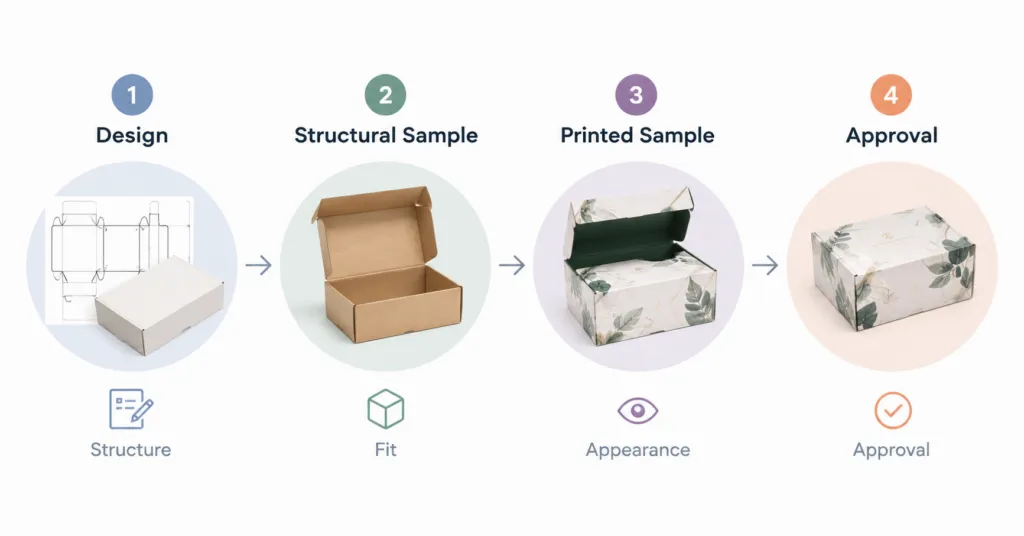
A typical sampling process has four main stages: design confirmation, structural sampling, printed sampling, and sample approval. Each stage has a specific purpose, and the goal is to solve potential problems before mass production begins.
1. Design and Structural Drawing Confirmation
Before a physical sample is made, the manufacturer needs to understand exactly what is being produced.
The basic information usually includes the product dimensions, packaging dimensions, structure, materials, artwork, printing, finishing, and any insert requirements.
The structural drawing or die-line is particularly important because it determines how the flat material will be cut, folded, and assembled.
A design can look correct on a computer but still create a practical problem when converted into a physical package. For example, the lid may not close correctly, the insert may leave insufficient clearance, or the finished dimensions may not suit the product.
The first question is therefore simple:
Can the design be turned into a practical package?
2. Structural Sample
The next step is a structural sample, which focuses on the physical construction before final visual details are evaluated.
This stage checks whether the product fits correctly, whether the dimensions work, and whether the opening, closing, folding, and assembly behave as intended.
This is also where a packaging prototype can be useful. It allows the buyer and manufacturer to identify structural problems before spending more time on final printing and finishing.
3. Printed Sample
Once the structure is workable, the printed sample focuses on the actual appearance.
The buyer can evaluate the combination of:
Material + Printing + Color + Finishing
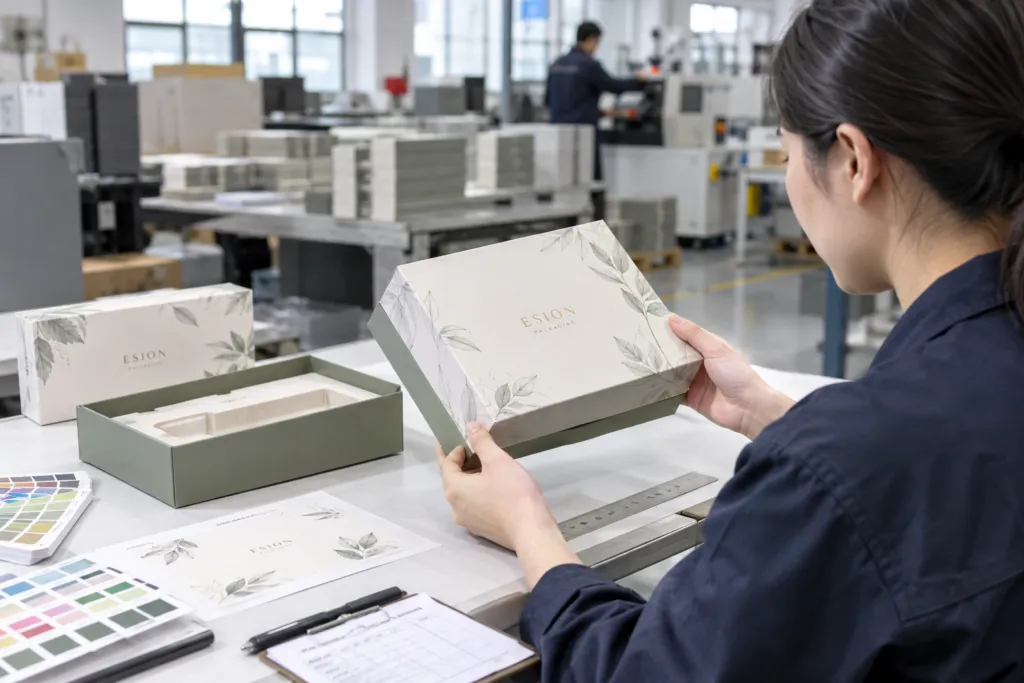
This matters particularly for premium packaging. A logo, color, foil, embossing, lamination, or spot UV effect may look different on the physical material than it does on a screen.
4. Sample Approval
The final stage is sample approval.
Once the buyer approves the sample, the agreed structure, dimensions, materials, artwork, printing, and finishing should become the production reference.
This is the point where the project moves from development to production.
How Long Does a Complete Custom Packaging Sampling Process Take?
The sampling timeline depends on the packaging structure, materials, printing, finishing, tooling, and the number of revisions required. Buyers should confirm the current sampling lead time with the supplier before starting the project.The actual timeline depends on the packaging structure, materials, printing, finishing, tooling, and the number of revisions required.
Sampling lead times can change according to project requirements and supplier scheduling, so buyers should confirm the current lead time with the supplier before placing an order.
Simple Packaging Usually Requires Less Development
A straightforward package with a relatively simple structure and limited finishing normally has fewer variables to coordinate.
Once the specifications are confirmed, the manufacturer can usually move more directly toward the physical sample.
Complex Structures Can Add Time
Sampling can take longer when the project involves:
- Complex structures
- Custom tooling
- Multiple materials
- Special finishing
- Detailed inserts
- Additional assembly
The physical sample itself is only one part of the schedule. Material preparation and revisions can also affect the total time.
Approval Time Is Part of the Timeline
For overseas buyers, the actual timeline should include more than the factory’s sample production time.
A realistic sequence is:
Specification → Sample Production → Shipping → Buyer Review → Revision if Needed → Approval
For example, imagine a brand developing a new retail package.
The factory completes the sample on schedule, but after receiving it, the buyer discovers that the product fits too tightly. The structure needs to be adjusted, another sample is produced, and the buyer needs additional time to review it.
The original sample production may have been on schedule, but the total sampling timeline has now increased.
That is why it is better to discuss the complete sampling timeline, rather than asking only how many days the factory needs to make one sample.
How Does the Sampling Fee Fit Into the Process?
The sampling fee is normally separate from the mass production price because sample development involves its own materials and production work. Whether the fee can later be credited toward a production order depends on the supplier’s commercial terms.
The exact sampling fee should be confirmed with the supplier before development begins, together with whether the fee can be credited toward a production order.
For this article, the important point is simply that the sampling stage should be completed before the project moves into mass production.
What Happens After the Sample Is Approved?
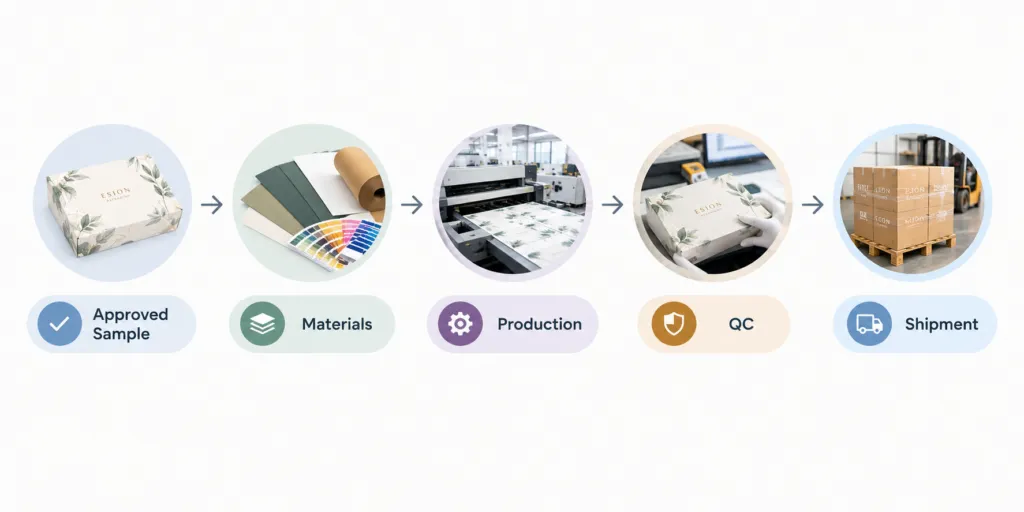
Once the sample is approved, the project moves from development into production. The key sequence is material preparation → first production check → mass production → final inspection → shipment.
1. Materials Are Prepared
After approval, the supplier prepares the materials and components required for production.
Depending on the package, this may include the main paper or board, wrapping material, printing materials, inserts, magnets, and other components.
Material availability can affect the production schedule, which is why the production timeline should be confirmed after the specifications are finalized.
2. First Production Check
Before the full order proceeds, the initial production output should be compared with the approved sample and production specifications.
The purpose is simple:
Identify important differences early rather than after the full quantity has been produced.
This is a production checkpoint, not a separate quality-control project.
For detailed inspection standards, the supplier should have a separate quality-control procedure covering the relevant production requirements.
3. Mass Production Begins
Once the production specifications and initial output are confirmed, the main production run can begin.
The exact sequence depends on the packaging structure, but a paper packaging production process may include:
Printing → Laminating → Die Cutting → Gluing → Assembly → QC → Packing
At this point, the approved sample serves as the physical reference for the production team.
4. Final Inspection and Shipment
Before shipment, the finished order is checked against the approved requirements and prepared for delivery.
For an overseas buyer, this is an important final checkpoint. Once the goods have left the factory, correcting a production issue becomes considerably more complicated.
The detailed inspection criteria should remain part of the supplier’s dedicated quality-control system rather than being expanded into this sampling guide.
5. How Can One Factory Simplify the Transition From Sample to Production?
When sampling and mass production are handled through the same manufacturing workflow, the approved specifications can move more directly from development into production.
For example, if a sample reveals that the product needs additional internal clearance, the change can be addressed before the production specification is finalized. Once the sample is approved, the same specifications can then move into material preparation, printing, die cutting, assembly, and inspection.
This is one practical advantage of working with a factory such as Esion Package. The company can support the project across sampling and production rather than treating those stages as completely separate processes.
Esion’s published manufacturing information describes a workflow covering paper cutting, printing, gluing, laminating, die cutting, handmade assembly, quality inspection, and packing.
For buyers evaluating the production background of a packaging manufacturer, see the Esion Package About Us page.
How Can You Reduce Sampling Rework and Production Delays?
Most avoidable delays begin with incomplete information or changes made after the project has already moved forward. Clear specifications and consolidated communication make the timeline easier to manage.
Confirm the Important Specifications Early
Before sampling begins, the supplier should have the key information required to develop the package.
This normally includes:
- Product dimensions
- Packaging dimensions
- Structure
- Material
- Color reference
- Artwork
- Finishing
- Quantity
The goal is not to make every technical detail perfect immediately. It is to provide enough information to prevent unnecessary redesign.
Use One Written Specification
A written confirmation sheet can reduce confusion when many packaging details are involved.
Instead of relying on separate messages about size, material, artwork, and finishing, both sides can work from one confirmed specification.
A simple sequence is:
Structure → Size → Material → Artwork → Finishing → Quantity
Once these points are confirmed, later communication becomes much easier.
Consolidate Feedback
When the sample arrives, review the entire package before sending feedback.
For example, the structure may be correct while the product fit is too tight and the logo color needs adjustment.
Sending all confirmed changes together can reduce unnecessary revision rounds and help keep the project moving.
Include International Shipping in the Timeline
For overseas projects, sampling does not end when the factory finishes the sample.
The timeline may also include:
Sample Production → Courier → Customs if applicable → Local Delivery → Internal Approval
The same principle applies to the final order. Factory production time and total delivery time are two different things.
What Should You Prepare Before Starting a Custom Packaging Sample?
The sampling process is easier when the supplier receives the basic product and packaging information before development begins. You do not need to have every technical detail finalized, but the main requirements should be clear.
Product Information
Prepare the basic product dimensions and, where relevant, product weight and photos.
It is also useful to explain how the product should sit inside the package, especially when a custom insert is required.
Packaging Requirements
Clarify the desired structure, approximate size, material preference, opening method, printing, finishing, and insert requirements.
If you have an existing package or reference product, photos can also help communicate the intended result.
Artwork and References
If available, provide:
- Artwork files
- Logo files
- Color references
- Product images
- Packaging references
The clearer the starting information, the easier it is to move through the sampling process without unnecessary revisions.
FAQ
How long does a custom packaging sample take?
The sampling timeline varies by project. Structure, materials, printing, finishing, tooling, revisions, and buyer approval can all affect the schedule. Confirm the expected lead time with the supplier before starting the sample.
Can the sampling fee be deducted from the production order?
It depends on the supplier’s terms. Some suppliers may credit the sampling fee toward a later production order, while others treat it as a separate development cost. Confirm this before starting the sample.
Does an approved sample guarantee identical mass production?
An approved sample provides the production reference, but the production order still requires proper material control and quality checks. Sample approval should therefore be viewed as the transition into controlled production, not the end of the quality process.
Do small packaging orders also need a sample?
A sample can still be useful when the structure, product fit, printing, or finishing is important. For a simple package with an established specification, the sampling process may be shorter.
How can I tell whether a packaging supplier has a professional sampling process?
Ask the supplier to explain the sequence from requirement confirmation to sample approval, production, QC, and shipment. A clear process with defined approval points is more useful than a supplier that only provides a price and an estimated delivery date.
Final Takeaway
A custom packaging sample is the bridge between a packaging concept and mass production.
The complete timeline is:
Requirements
↓
Structural Sample
↓
Printed Sample
↓
Sample Approval
↓
Material Preparation
↓
First Production Check
↓
Mass Production
↓
QC
↓
Shipment
The important question is not simply how quickly a supplier can make one sample. You also need to understand what happens after approval and how the approved specifications are carried into production.
For buyers, a clear process means fewer unnecessary revisions, better communication, and more predictable scheduling.
Before requesting a sample, prepare your product dimensions, packaging requirements, artwork, material preferences, and finishing requirements. Then ask the supplier to confirm the sampling timeline and explain what happens once the sample is approved.
That gives you a much clearer basis for comparing packaging suppliers and moving from the first sample to a production order with fewer surprises.