
Table of Contents
Magnetic Closure Gift Box: How to Choose and Test the Right Structure
2026-01-19I work with custom packaging projects where small structural details can make a noticeable difference in the finished box. With a magnetic closure gift box, the closure is only one part of the design. The lid, box construction, insert, and assembly accuracy all affect how the finished package looks and performs.
This is where buyers often run into problems. A sample can look correct on a drawing but behave differently when the actual product is placed inside. The lid may sit unevenly, the closure may feel uncomfortable, or the insert may interfere with the closing position.
This guide focuses on the decisions that matter before production: choosing the right structure, checking the closure, testing the finished sample, and confirming the details before mass production.
If you are comparing magnetic packaging options more broadly, see Esion Package’s Magnetic Gift Boxes.
What Makes a Magnetic Closure Gift Box Work Properly?
A reliable magnetic closure depends on the complete box structure, not simply the magnetic component. Closure placement, lid alignment, material layers, and assembly accuracy all affect the final result.
Magnet placement matters
The magnetic components need to meet at the intended position when the lid closes. If they are slightly misaligned, the box may still close, but the lid can shift or sit unevenly.
For this reason, closure placement should be considered during structural development rather than added as a final detail.
Lid alignment affects the finished appearance
Alignment is particularly important for premium packaging. A small offset along the front or side edge can be immediately noticeable.
The lid should therefore be evaluated together with the finished box dimensions, wrapping layers, folding areas, and insert height.
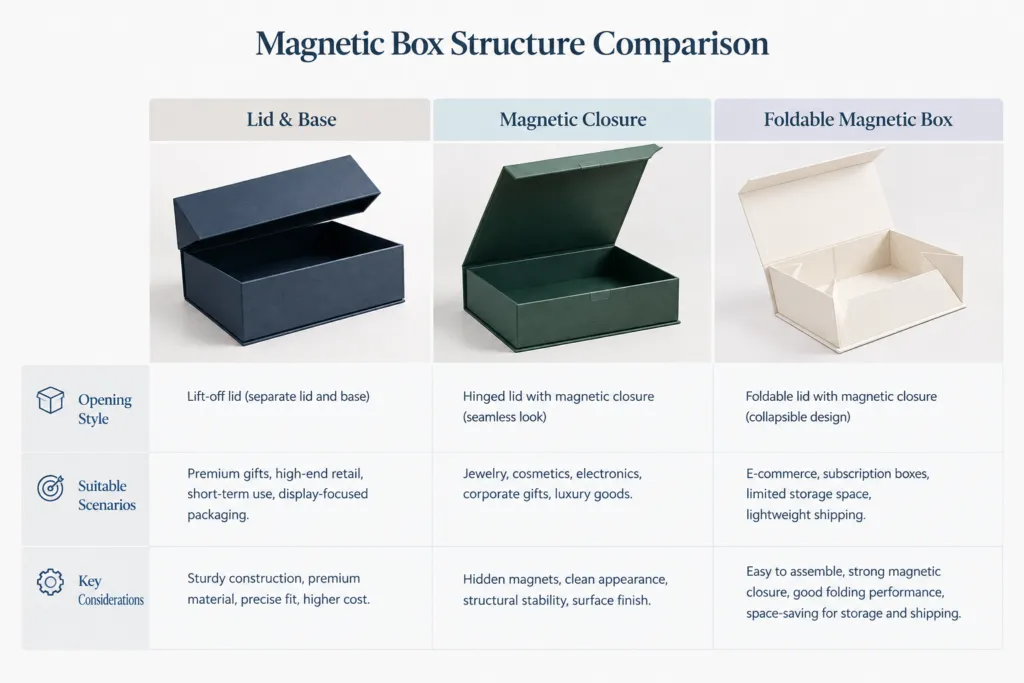
Which Magnetic Box Structure Should You Choose?
The structure should follow the product and desired opening experience. The magnetic closure is then positioned around that structure.
Lid-and-base structure
A lid-and-base structure provides a straightforward lift-open experience and a clean rigid presentation. It is suitable when the box itself is an important part of the product presentation.
Book-style structure
A book-style structure opens from one side and creates a distinctive opening movement. Consider it when the opening experience and exterior presentation are important. See the Book-Style Magnetic Perfume Gift Box for a specific product example.
Folding rigid structure
A folding rigid structure combines a rigid finished appearance with a foldable construction. It can be considered when storage or transportation efficiency is an important part of the packaging decision.
How Should You Choose the Magnetic Closure?
The closure should match the product, lid construction, and intended opening experience. The goal is not simply maximum magnetic force, but a closure that works correctly in the finished package.
Start with the product and insert
Confirm the product’s finished dimensions and weight first. Then check how the product and insert will sit inside the box.
For example, an insert that positions a cosmetic product slightly higher than expected can affect the lid position. An empty box may close correctly while the finished package does not.
Define the desired opening experience
Before sampling, describe the expected experience clearly:
Easy opening → controlled closing → secure closure
This gives the manufacturer a practical target instead of an unclear instruction such as “make the magnet stronger.”
Consider current packaging priorities
In 2025–2026, more buyers are considering recyclability, material efficiency, and reusability when evaluating premium packaging. For magnetic gift boxes, these considerations can be evaluated alongside appearance, durability, and closing performance.
The important point is to assess the complete material and structural combination rather than treating sustainability as a separate feature.
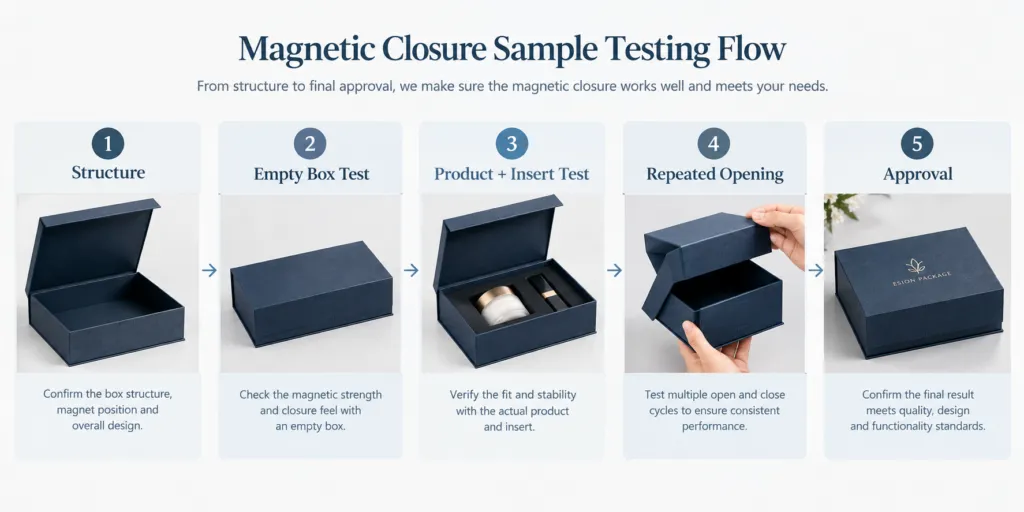
How Can You Test a Magnetic Closure Before Mass Production?
The physical sample is the most useful stage for evaluating the closure. Drawings can confirm dimensions, but they cannot fully show how the finished box behaves in actual use.
Test the empty box first
Close the sample several times and check whether:
- the lid aligns correctly;
- the edges sit evenly;
- the closure engages naturally;
- there is an unexpected gap.
This establishes whether the basic structure is working correctly.
Test with the actual product and insert
This step is critical.
Imagine a cosmetic product that fits correctly in an empty sample. After the final insert is installed, the product sits slightly higher and changes the lid position. The magnetic components have not changed, but the finished closing experience has.
The practical lesson is simple:
Test the complete packaging, not only the empty box.
Repeat the opening and closing process
Do not approve the sample after a single opening.
Repeated opening and closing helps reveal whether the lid consistently returns to the intended position and whether the closing experience remains stable.
What Problems Should Buyers Watch For?
When a magnetic closure does not perform correctly, identify the structural cause before changing the closure specification.
The lid does not close completely
Check the relationship between:
- magnetic alignment;
- lid dimensions;
- box deformation;
- material thickness;
- insert position.
A closure problem may come from the complete structure rather than the magnetic component itself.
The lid shifts after closing
If the box closes but the lid moves sideways, check the alignment between the lid and base.
This matters particularly for premium packaging because even a small visual offset can affect the perceived quality of the box.
The closure changes after the product is inserted
If an empty sample works correctly but the finished package does not, check the product height and insert position.
This is why testing with the actual product should happen before final approval.
What Should You Confirm Before Production?
Before mass production, confirm the finished structure and approved physical sample rather than relying only on a specification sheet.
Confirm the finished dimensions
Check the complete packaging:
- external box size;
- internal space;
- lid construction;
- insert dimensions;
- product fit.
Confirm the closure position
The approved sample should establish where the magnetic components are located and how the lid should close.
Any change to the closure position during production can affect both appearance and opening experience.
Use the approved sample as the production reference
For custom packaging, the approved physical sample gives both buyer and manufacturer a common reference for structure, appearance, assembly, and closure performance.
Esion Package’s production process covers printing, die cutting, assembly, QC inspection, and packing. Keeping the approved structure connected to these stages can help reduce communication problems and identify dimensional or assembly issues before shipment.
See Esion Package’s production process for an overview of the manufacturing workflow.

Pre-production checklist
Before approval, confirm:
- □ Finished dimensions
- □ Magnetic closure position
- □ Actual product fit
- □ Insert fit
- □ Opening and closing experience
- □ Approved physical sample
- □ Production reference
How Can You Choose the Right Magnetic Closure Gift Box?
The right magnetic closure gift box should balance structure, product fit, closing performance, and production consistency.
A practical decision sequence is:
Product → Structure → Closure Position → Physical Sample → Product Test → Approval → Production
This approach is more reliable than choosing a box from a photograph and deciding the closure details afterward.
If you are preparing a new project, start with the product dimensions, finished box size, insert requirements, and desired opening experience. These details give the manufacturer a clearer basis for developing and testing the packaging before production.
FAQ
What is a magnetic closure gift box?
A magnetic closure gift box uses magnetic components integrated into the box structure to keep the lid securely closed while maintaining a clean appearance.
How does a magnetic closure work?
Magnetic components are positioned in corresponding areas of the lid and box. When the lid approaches the closed position, magnetic attraction helps bring the two parts together.
How strong should a magnetic closure be?
There is no single specification suitable for every box. The required closure depends on the box structure, lid construction, product fit, material layers, and desired opening experience.
Why does my magnetic gift box not close properly?
Possible causes include magnetic misalignment, incorrect lid dimensions, box deformation, material thickness, or interference from the product or insert.
Should a magnetic closure gift box be tested before mass production?
Yes. Test the empty box first, then test it with the actual product and insert. Repeated opening and closing should be completed before final approval.