
Table of Contents

Retail Packaging: How to Choose the Right Format for Your Brand
2026-01-19At Esion Package, we work with brands on custom paper packaging and production. One problem appears again and again: a packaging concept can look right on screen but still be wrong for the actual product.
The problem is usually not the artwork. It starts earlier, when the packaging format is selected before the product, selling environment, protection requirements, and production process have been considered together.
A package that is too large can create unnecessary material and shipping volume. A package that is too tight may leave insufficient room for the product or its accessories. A highly finished package may look impressive but add complexity that the product does not actually need.
This guide focuses on the decision-making process behind retail packaging. Rather than reviewing every packaging type in detail, it explains what to evaluate first, what to confirm before sampling, and how to move from an initial idea to a production-ready package.
By the end, you should have a clearer way to define your requirements and discuss the project with a packaging supplier.
What Should You Define Before Choosing Retail Packaging?
The first step is to define what the package needs to accomplish. Do this before choosing a structure, material, or finishing.
Start with the complete product
Begin with the product that will actually go inside the package.
Record:
- Product length, width, and height
- Product weight
- Accessories
- Instruction cards or other components
- Fragile areas
- Number of items packed together
A useful example is a small cosmetic product sold with an accessory and instruction card. If the package is designed around the bottle alone, the final structure may leave the additional components without a proper position.
The package should therefore be developed around the complete packed configuration.
Define the customer experience
Next, decide what happens when the customer receives the product.
Will the package mainly:
- Present the product on a shelf?
- Protect it during direct shipping?
- Support a gift-opening experience?
- Combine several components?
- Carry the brand identity at the point of sale?
This gives the packaging project a clear purpose before structural decisions are made.
Set the practical boundaries
Before requesting a sample, also define:
Quantity + target market + sales channel + shipping requirements + expected delivery schedule
These factors can change the most suitable packaging direction.
How Do You Choose a Packaging Format Without Creating Unnecessary Complexity?
Choose the format that solves the actual packaging problem, rather than choosing the most elaborate option available.
This is the point where a retail packaging project should become narrower, not broader.
Use the product requirement as the first filter
Ask:
Does the product need internal support?
If yes, the structure should accommodate that support from the beginning.
Then ask:
Does the package need to be stored or transported before assembly?
If yes, a format that can be supplied efficiently before assembly may deserve consideration.
Finally:
Does the package also need to handle direct shipping?
If yes, the package should be evaluated for closure, handling, product movement, and shipping dimensions.
These questions help eliminate unsuitable directions before time is spent on artwork and finishing.
Let presentation determine the level of refinement
Once the functional requirements are clear, consider how much presentation the product needs.
A premium product may justify a more substantial structure or carefully controlled finishing. A straightforward retail product may achieve a stronger result through clean proportions and restrained printing.
The important distinction is:
Presentation should refine a suitable structure, not compensate for a poor one.
For brands specifically evaluating different structures, the relevant product pages should handle the detailed discussion:
- folding gift box formats — for folding structures
- mailer box packaging — for shipping-oriented formats
- magnetic rigid boxes — for premium rigid presentation
This page should not duplicate those detailed product discussions.
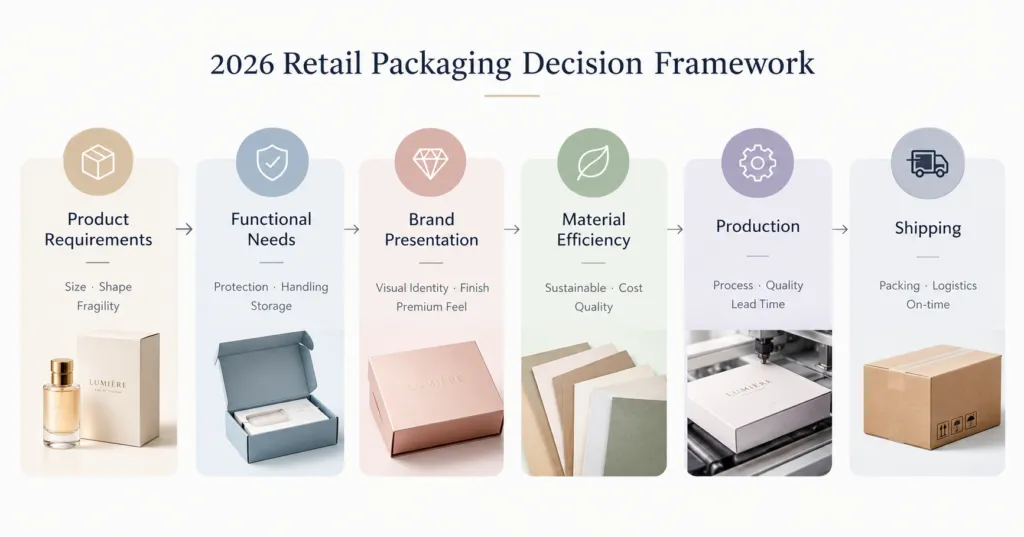
What Should Change in Your Retail Packaging Strategy in 2026?
Packaging decisions in 2026 need to account for regulatory and material considerations earlier than before. This is particularly important for brands selling into Europe.
Consider packaging efficiency before adding features
The European Commission’s PPWR entered into application on August 12, 2026. The regulation establishes a harmonized framework covering packaging and packaging waste across the EU, with objectives including waste reduction and a more circular packaging system.
For packaging buyers, the practical implication is not simply “use sustainable materials.”
A better starting point is:
Can the package perform its job without unnecessary material, space, or components?
That means reviewing the package size, empty space, unnecessary layers, and components during the structural stage rather than waiting until the end of the project.
The European Commission’s own PPWR materials emphasize smaller, lighter packaging and reducing unnecessary empty space.
Do not assume every paper-based option has the same compliance status
A paper-based package is not automatically compliant with every market requirement.
Material composition, intended use, destination market, printing and finishing specifications can all matter.
If a project has specific EU requirements, ask the supplier to confirm the applicable material and documentation for the actual order. Do not assume that a general sustainability claim applies to every board or material option.
Keep cost planning realistic
Packaging cost is also being influenced by a more complicated manufacturing environment.
Cepi’s 2025 statistics reported a 1.6% decline in European paper and board production, while packaging grades were comparatively stable. The organization also pointed to manufacturing costs, trade conditions, and regulatory pressures as continuing challenges for the sector.
That does not mean every packaging order will become more expensive by a specific percentage.
It means buyers should avoid building a project around an assumed fixed material price. A better approach is to finalize the structure, material, finishing, quantity, and shipping requirements before comparing supplier quotations.
How Can You Tell Whether a Packaging Concept Is Actually Working?
A good concept should pass functional checks before you spend more time refining its appearance.
Check the fit
Place the actual product inside the proposed package.
Look for:
- Excessive movement
- Unnecessary empty space
- Pressure points
- Difficult insertion or removal
- Interference from accessories
A package does not need to eliminate every millimeter of empty space. It needs enough clearance for the product to be packed safely and handled consistently.
Check the presentation
Once the fit works, evaluate the customer-facing appearance.
Look at:
- Overall proportions
- Logo placement
- Printing alignment
- Surface appearance
- Opening sequence
- Relationship between the package and product
This is the right time to assess whether the packaging communicates the intended brand position.
Check production practicality
A concept can work perfectly as a visual mockup but become difficult during production.
Ask:
- Is assembly straightforward?
- Are there too many separate components?
- Is the finishing process appropriate for the quantity?
- Can the approved appearance be reproduced consistently?
The purpose of sampling is to identify these issues before mass production.
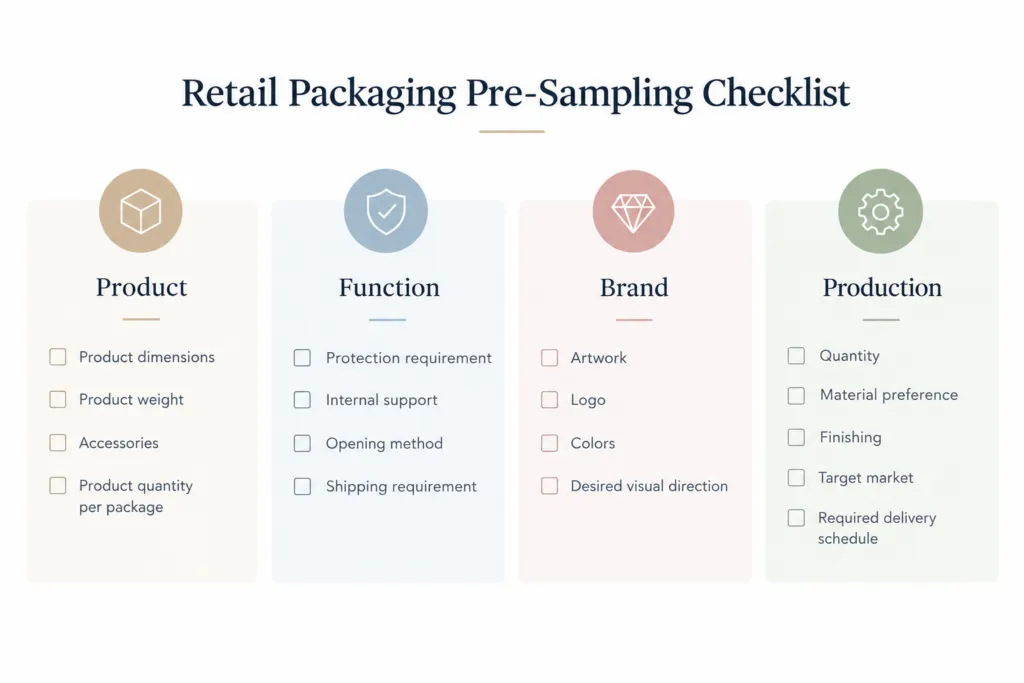
Retail Packaging Pre-Sampling Checklist
Before requesting a physical sample, confirm:
Product
- Product dimensions
- Product weight
- Accessories
- Product quantity per package
Function
- Protection requirement
- Internal support
- Opening method
- Shipping requirement
Brand
- Artwork
- Logo
- Colors
- Desired visual direction
Production
- Quantity
- Material preference
- Finishing
- Target market
- Required delivery schedule
When Should You Move From Concept to Sampling?
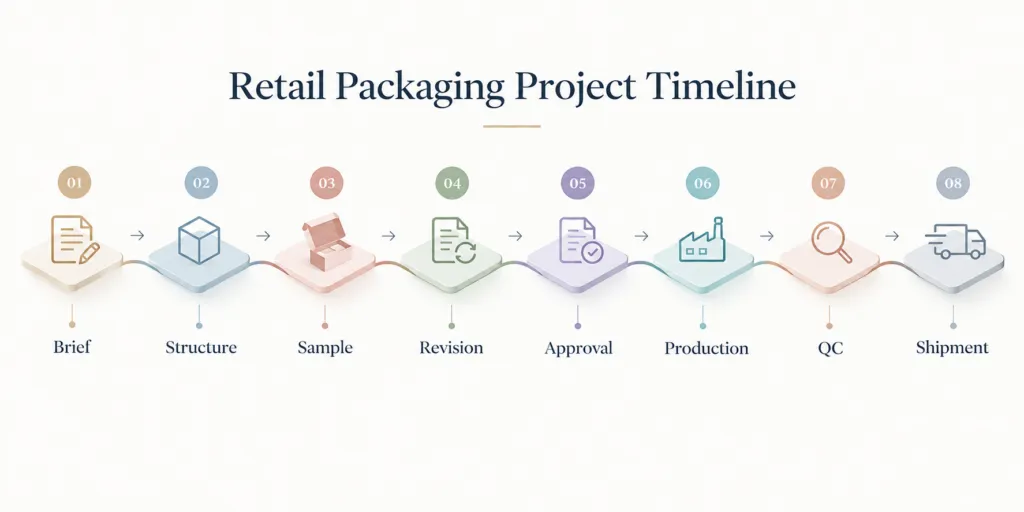
Do not wait until every detail is perfect before making a sample. Once the basic requirements are defined, a physical sample is the fastest way to test whether the concept works.
Stage 1: Define the brief
The supplier should receive the product information, quantity, artwork or visual direction, and basic packaging requirements.
If the final structure is unknown, that is acceptable. The supplier can evaluate the structure based on the product requirements.
Stage 2: Review the sample
The physical sample should answer practical questions:
Does the product fit?
Does it stay in position?
Does the package open and close correctly?
Does the artwork look right at actual size?
Is the assembly practical?
These questions are more useful than continuing to adjust a digital design without testing the physical package.
Stage 3: Approve the production reference
After sampling, establish one approved reference.
The structure, artwork, material, finishing, quantity, and packing requirements should all correspond to that approved version.
This reduces the risk of production starting from an outdated artwork file or an unclear sample.
Stage 4: Move into production and QC
Once production starts, the focus changes from concept development to consistency.
The approved package needs to be reproduced across the order, with inspection covering the relevant structure, appearance, printing, assembly, and packing requirements.
How Should You Compare Retail Packaging Suppliers?
A supplier should be evaluated on its ability to turn an approved concept into a consistent production result, not simply on the first quotation.
Compare how the supplier handles sampling
Ask whether the supplier can work from:
- Product samples
- Product dimensions
- Artwork
- Structural requirements
- Finishing references
A supplier that asks practical questions early can often identify problems before the sample stage.
Compare production communication
For B2B buyers, communication becomes especially important when a project involves several specifications.
The supplier should be able to clearly confirm:
- What has been approved
- Which artwork version is current
- Which material is being used
- What quantity is being produced
- What packing requirements apply
Clear documentation can prevent small misunderstandings from becoming production problems.
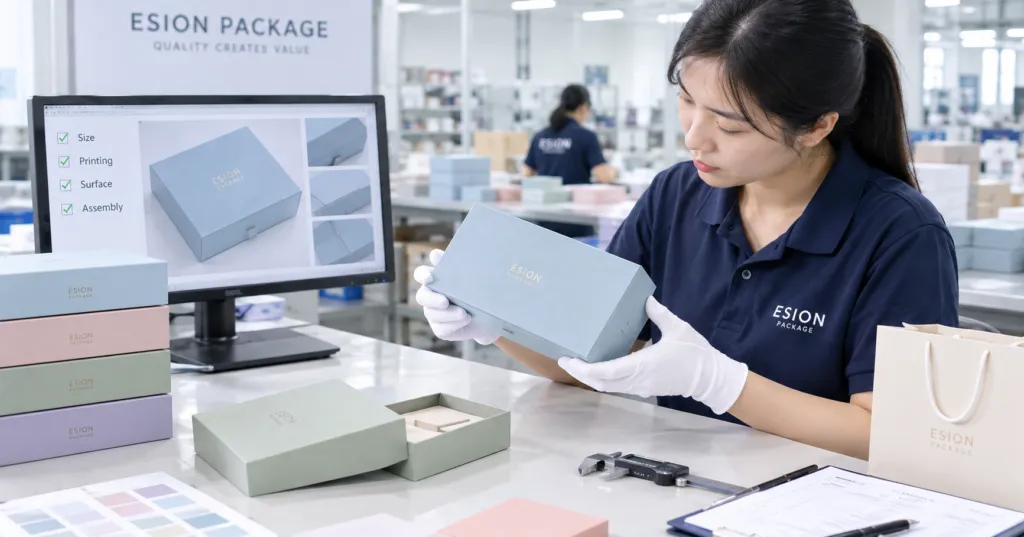
Compare quality control
Ask what will be checked before shipment.
For a custom paper package, relevant checks may include:
- Dimensions
- Printing
- Surface finish
- Structural assembly
- Component placement
- Packing condition
The exact inspection points should reflect the actual project rather than relying on a generic checklist.
How Can Esion Package Support the Retail Packaging Process?
The main value of a packaging supplier is coordination: turning a packaging requirement into a production-ready result without losing the approved details along the way.
Esion Package can support buyers through customization, sampling, production, assembly, and quality inspection. You can learn more about the company’s packaging production process before discussing your project.
This is particularly useful when the project requires coordination between structure, artwork, finishing, and final packing. Instead of treating each stage as a separate task, the requirements can be carried through the same production process.
For buyers, that can reduce repeated explanations and make it easier to keep the approved sample, production specifications, and final packaging aligned.
If you already have your product dimensions, quantity, artwork, or initial packaging idea, you can contact Esion Package to discuss the project.
FAQ
What is the first thing to determine when choosing retail packaging?
Determine the complete product configuration first: dimensions, weight, accessories, quantity, and protection requirements. The packaging format should follow these requirements rather than the other way around.
How do I know if my retail packaging is too large?
Check the actual product inside the physical sample. If there is significant unused space that does not serve a protection or presentation purpose, review the structure and internal support before production.
There is no universal “ideal empty-space percentage” for every package.
Should retail packaging be designed around sustainability or appearance first?
Start with function, then evaluate appearance and material efficiency together. For EU-bound products, packaging efficiency is increasingly important under the PPWR, which began applying on August 12, 2026.
When should I request a packaging sample?
Request a sample once you know the product dimensions, basic packaging requirements, quantity, and visual direction. You do not need to have every production detail finalized before sampling.
What should I compare when choosing a retail packaging supplier?
Compare more than the quotation. Review the supplier’s ability to understand your product, develop or reproduce the structure, manage artwork and specifications, produce consistently, and carry out appropriate QC before shipment.