
Table of Contents
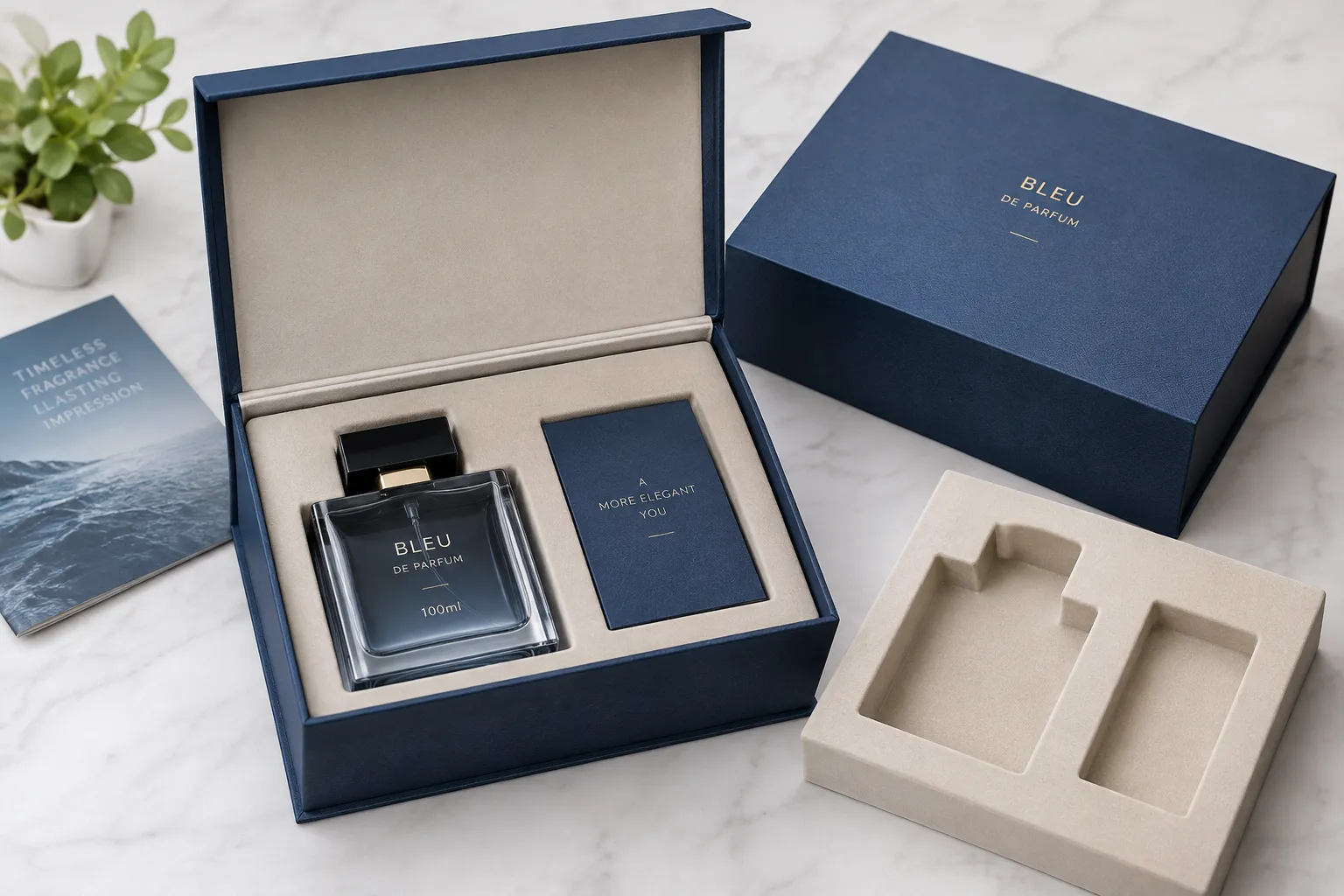
How to Test a Magnetic Gift Box Before Bulk Production
2026-01-19I work with custom packaging projects at Esion Package, supporting the transition from sample development to bulk production. In this stage, one of the most important questions is not simply whether a magnetic gift box closes, but whether the approved result can be reproduced in the final production configuration.
A single sample can look perfect while still leaving unanswered questions. The product may change the internal fit, the insert may affect the lid position, or different samples may behave differently when compared side by side.
This guide focuses on one specific decision point: how to test a magnetic gift box before bulk production. It explains what to test, what not to assume from a single measurement, and when a sample has enough evidence to become the production reference.
After reading, you can use the same approach when reviewing your own sample before giving the supplier bulk-production approval.
Start With the Final Packaging Configuration
The most reliable test starts with the finished packaging configuration, not an empty box.
The box should be evaluated together with the product and insert that will actually be used in production. Otherwise, a sample can pass an empty-box check but behave differently once everything is assembled.
Test the box with the actual product
Place the intended product and final insert inside the sample before evaluating the closure.
Pay attention to:
- Product position
- Insert height
- Available clearance
- Lid position
- Overall closure
This is particularly important when the insert sits close to the lid.
For example, during a jewelry packaging project, an insert that sits slightly higher than the approved configuration can change the way the lid closes. The issue is not necessarily insufficient magnetic force. The internal configuration itself may be affecting the result.
That is why the useful comparison is not simply empty box versus closed box. It is the finished configuration as a whole.
Confirm the configuration before making a judgment
Before testing, make sure the sample represents the intended production version as closely as possible.
If the box dimensions, insert, product, or internal components are still changing, the test result should not yet be treated as the final production reference.
Check Closure Performance Under the Same Conditions
A useful magnetic gift box test looks at actual closure behavior, rather than reducing performance to one magnetic-strength number.
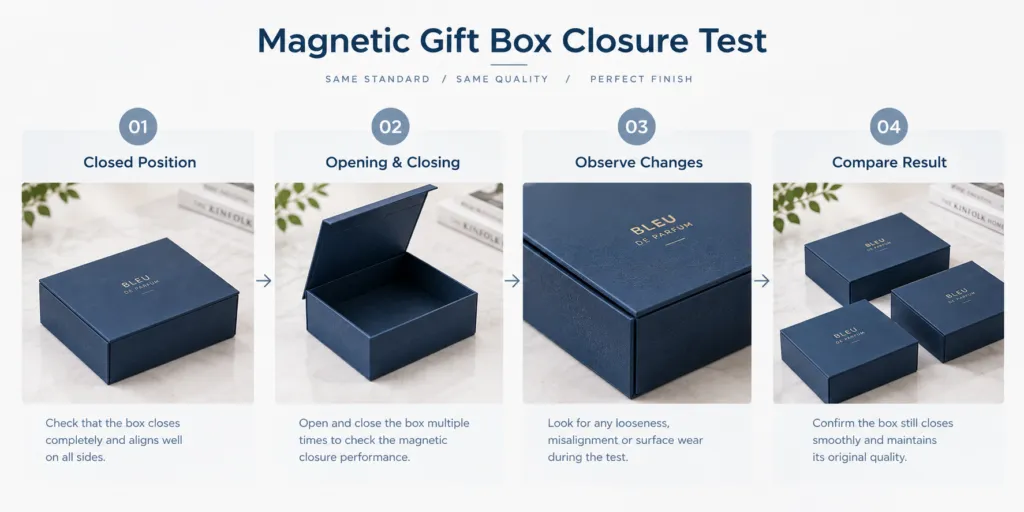
Check the closed position
Close the box normally and examine how the lid meets the base.
Look for:
- Correct lid position
- Even appearance
- Unwanted gaps
- Visible misalignment
- A lid that does not sit flat
For premium packaging, these details are part of the product presentation. A closure can function mechanically while still producing an unsatisfactory visual result.
Do not use Gauss alone as the acceptance criterion
Magnetic strength is sometimes expressed in gauss, but a gauss reading alone does not tell a buyer whether a finished magnetic gift box will close correctly.
The measured field depends on factors such as where and how the measurement is taken. Finished closure performance is also affected by magnet configuration, alignment, distance, and the surrounding packaging structure.
If a project requires a measured magnetic force, the requirement should therefore define both the measurement method and the acceptance value.
A magnetic number without a defined test method is not a complete packaging specification.
For many packaging projects, the more useful first check is whether the finished box produces the intended closure result under the actual product configuration.
Repeat the same opening and closing action
Open and close the sample repeatedly under consistent conditions.
The purpose is to see whether the behavior remains stable. It is not appropriate to state that every magnetic gift box must pass an arbitrary number such as 50 or 100 cycles.
Do not present a fixed number such as “50 cycles” as a universal industry requirement.
If repeated-use durability is important for a particular application, the buyer and supplier should agree beforehand on:
- the number of cycles,
- the test conditions,
- and what constitutes failure.
Compare Samples Before Giving Bulk Approval
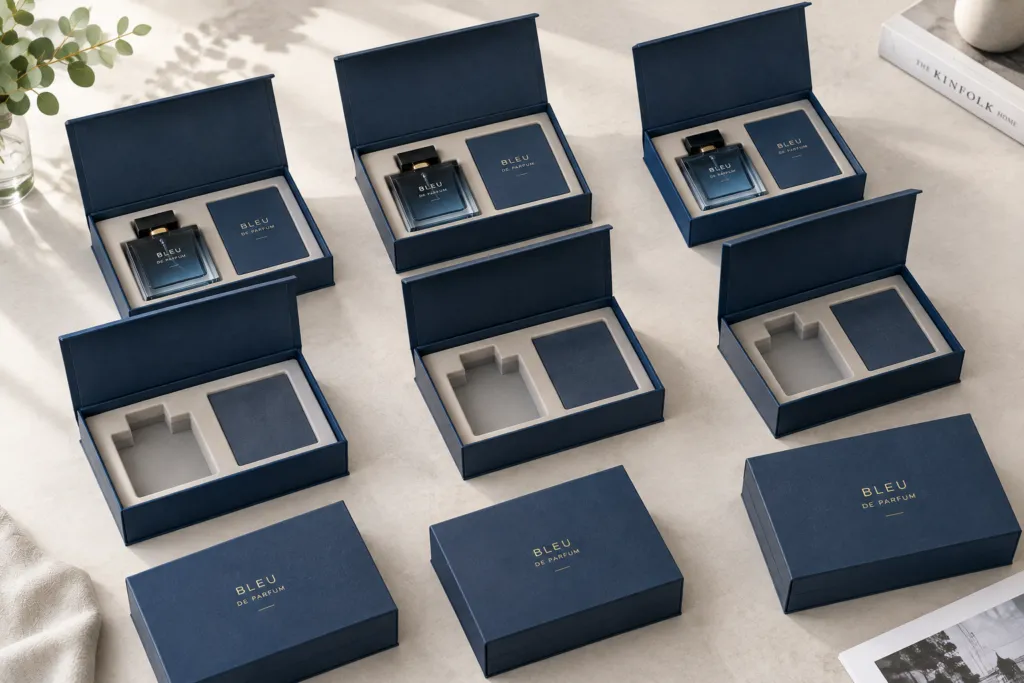
A single sample tells you whether a configuration can work. Several comparable samples give you evidence about consistency.
Keep the comparison conditions consistent
When checking multiple samples, keep the main variables unchanged:
- Same product
- Same insert
- Same box configuration
- Same opening method
- Same closing method
Otherwise, differences in the test setup can make the comparison misleading.
Look for unexplained variation
The purpose is not to create a complicated statistical report.
Instead, compare the details that directly affect the finished package:
Lid position, closure behavior, product fit, and overall appearance.
If one sample closes differently from the others, the next step is to identify why.
Do not simply label one sample “passed” and move on.
Use the comparison to establish the production reference
The important question before bulk production is whether the approved result is sufficiently clear and repeatable to be reproduced by the production team.
This is different from asking whether every sample is absolutely identical in every microscopic detail.
The practical objective is controlled consistency in the characteristics that matter to the finished product.
A Failed Sample Does Not Always Mean the Magnet Is the Problem
When a sample does not close as expected, changing the magnet immediately can lead to the wrong solution.
The closure is influenced by the entire packaging configuration.
Check the surrounding conditions first
Before changing the magnetic component, compare:
- Insert height
- Product position
- Lid alignment
- Box deformation
- Magnetic component position
- Internal clearance
For instance, if the insert is higher than intended, increasing magnetic strength may not solve the underlying problem. It may simply add more force to a configuration that is already incorrectly positioned.
Identify the cause before changing the specification
A useful troubleshooting sequence is:
Observe the result → Compare with the approved sample → Identify the difference → Determine the cause → Correct the configuration
This is intentionally different from a generic QC checklist. The objective at this stage is root-cause identification before bulk production, not simply recording that a sample failed.
Know What Pre-Production Testing Can Actually Prove
A pre-production test can confirm whether the proposed configuration works. It cannot by itself guarantee that every unit in a future production lot will be identical.
That distinction matters when buyers move from sampling to mass production.
Sample testing and lot inspection are different
Sample approval answers:
Does this configuration meet the agreed requirement?
Lot inspection answers a different question:
Does the finished production lot meet the agreed acceptance criteria?
For lot-by-lot acceptance sampling, ISO 2859-1:2026 provides sampling schemes indexed by Acceptance Quality Limit (AQL). The standard covers acceptance sampling for lot-by-lot inspection of products and other outputs. ISO 2859-1:2026 — Official ISO page
The important point is that an AQL value should not simply be copied into a magnetic gift box sample test and treated as a universal requirement. The sampling plan and acceptance criteria should be agreed according to the specific inspection situation.
Sample testing comes before bulk production; lot inspection evaluates the production result.
If Esion later publishes a dedicated guide to AQL inspection for custom packaging, this section should link to that page rather than expanding the subject here.
2026 Update: Consider the Complete Packaging Configuration
For 2026 projects, buyers may also need to consider regulatory requirements alongside functional packaging requirements.
The EU’s Packaging and Packaging Waste Regulation (PPWR) began applying on August 12, 2026. The regulation establishes requirements for packaging and packaging waste in the EU, including measures related to packaging design, prevention, reuse, and recyclability. European Commission — Packaging and Packaging Waste Regulation
For a magnetic gift box, this does not mean adding a generic “PPWR test” to the closure test.
Instead, if the project has specific material, component, or end-of-life requirements for the target market, those requirements should be considered before the final packaging configuration is approved.
The practical lesson for 2026 is simple:
Do not approve only how the box looks. Approve the complete configuration required for the intended market and use.
If Esion later publishes a dedicated article on PPWR requirements for paper packaging, that would be the appropriate place for a deeper regulatory discussion.
When Is the Magnetic Gift Box Ready for Bulk Production?
A magnetic gift box is ready for bulk production when the important conditions have been tested, the result is acceptable, and the approved configuration is clear enough to reproduce.
Before approval, confirm that:
- The actual product fits correctly.
- The insert does not interfere with the lid.
- The lid reaches the intended position.
- Opening and closing behavior is acceptable.
- Comparable samples show no unexplained differences.
- The tested configuration represents the intended production version.
The goal is not to create the longest possible testing procedure.
It is to remove the uncertainties that could otherwise appear after production has already started.
The two questions that matter most
A useful way to close the approval stage is to ask two different questions:
Does this configuration work?
And then:
Is this the configuration we want the factory to reproduce?
The first question validates the sample.
The second question determines whether it is ready to become the production reference.
How Esion Package Supports the Transition to Production
At Esion Package, the practical focus during this stage is connecting the approved sample with the actual production requirements.
For a custom magnetic gift box project, this can include sample development, product and insert matching, closure checks, production reference confirmation, and quality inspection during manufacturing.
The benefit for a buyer is straightforward: the production team has a clearer reference, potential configuration problems can be identified earlier, and unnecessary changes after bulk production can be reduced.
You can learn more about Esion Package’s manufacturing process on the Esion Package About Us page.
If your sample is ready for review, providing the box dimensions, product information, insert details, expected quantity, and specific closure requirements gives the production team a clearer basis for evaluation.
For project discussions, you can contact Esion Package.
Final Pre-Production Checklist
Before approving a magnetic gift box for bulk production, check these five points:
- Product fit: Does the actual product fit the final configuration?
- Insert clearance: Does the insert leave the intended space for closure?
- Closure position: Does the lid sit correctly?
- Consistency: Do comparable samples produce a consistent result?
- Production reference: Is the approved configuration clearly established?
These checks are intentionally short. A useful checklist should help a buyer make a decision, not create paperwork for its own sake.
FAQ
Can magnetic strength be measured with a gauss meter?
It can be measured, but a gauss reading alone does not define finished-box performance. The measurement location, method, magnetic configuration, and distance all matter. If a numerical requirement is necessary, the test method should be specified with the value.
What should I do if the box closes correctly but feels too difficult to open?
First compare the result with the intended user experience and approved sample. Then check the magnetic component position and the overall box configuration before deciding whether the magnetic specification itself needs to change.
What if production samples are slightly different from the approved sample?
First determine whether the difference affects an agreed functional or visual requirement. If it does, compare the production sample with the approved configuration and investigate the source before accepting or correcting the batch.
Should the product be shipped to the packaging factory for testing?
When product fit or insert interaction is important, providing the actual product or an accurate physical reference can significantly improve sample evaluation. Whether the physical product needs to be shipped depends on the project and the information already available.
What should happen if a production lot fails the agreed acceptance criteria?
The response depends on the type and extent of the nonconformity. The buyer and supplier should review the inspection result, determine the cause, and agree on corrective action before the affected goods are accepted. A failed lot does not automatically mean that the entire packaging design needs to be changed.