
Table of Contents
Jewelry Box Insert Guide: Types, Materials and How to Choose
28. 9 月, 2026By Esion Packaging Engineering Team
Technical review: Esion Packaging Engineering Team
Last updated: September 28, 2026
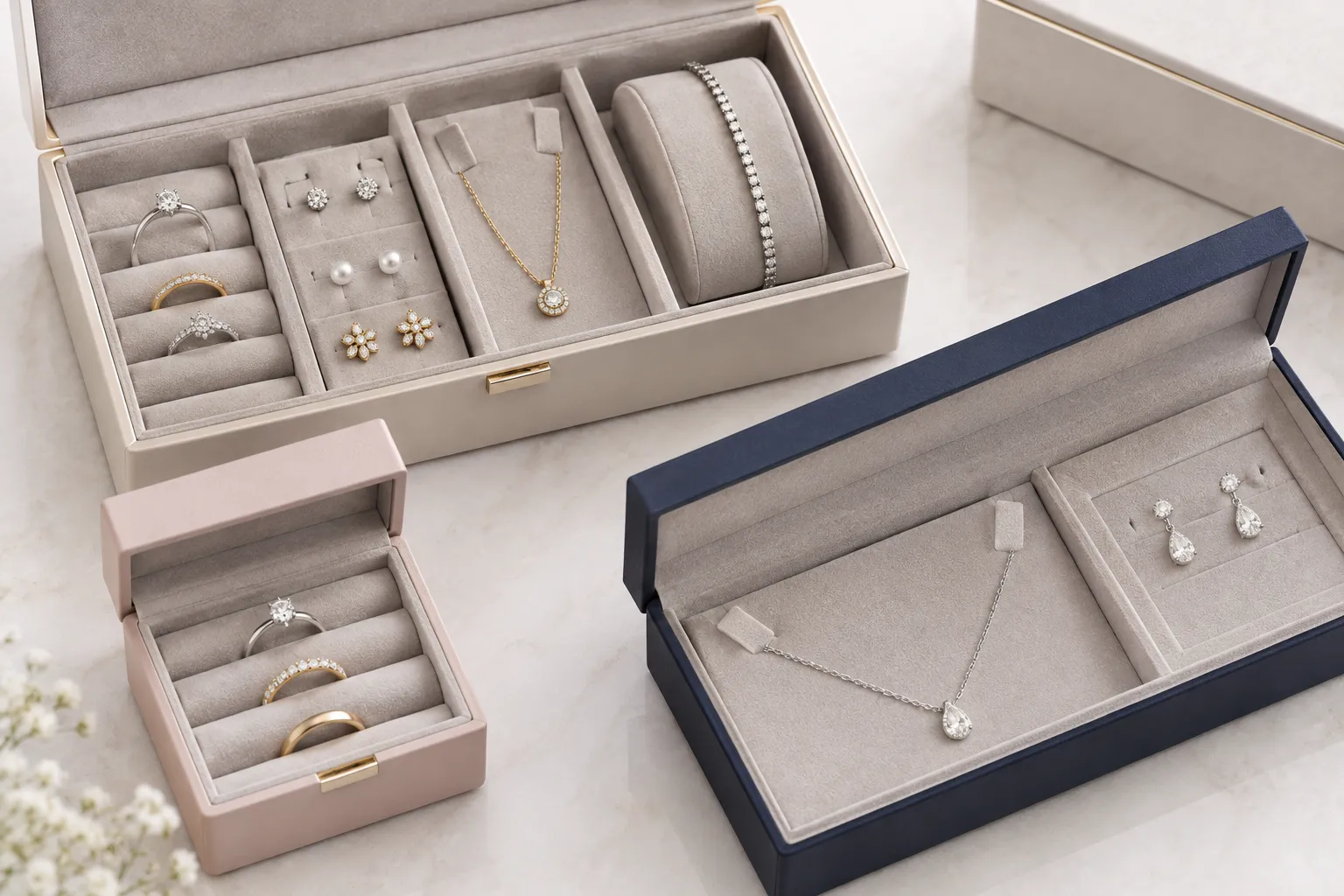
A jewelry box insert is the internal component that positions the jewelry, controls movement, and creates the contact surface between the product and the box. For custom jewelry packaging, the insert should be developed around the actual jewelry dimensions, shape, and presentation requirements rather than selected as a separate accessory.
If you are still deciding which jewelry box structure to use, start with our jewelry gift box guide. This guide focuses specifically on insert types, materials, contact surfaces, sampling, and common insert problems.
What Does a Jewelry Box Insert Do?
A jewelry box insert has four main jobs: positioning, protection, presentation, and compatibility with the outer box.
For a ring, the insert may need a defined slot that prevents the ring from moving. Earrings may require paired positioning. A necklace may need a combination of a holding point and a recessed area for the pendant. A multi-piece jewelry set may require several separate positioning zones within the same insert.
The insert also affects how the jewelry looks when the box is opened. A technically secure insert can still be unsuitable if the product sits too deeply, appears uneven, or cannot be removed easily.
For custom packaging, the insert therefore needs to be considered together with the jewelry, internal dimensions, and box structure.
Which Insert Type Suits Each Jewelry Piece?
Different jewelry pieces create different positioning requirements. The insert should be selected according to the shape and movement of the product rather than simply using the same internal construction for every item.
| Jewelry type | Typical positioning requirement | Insert approach | Main point to check |
|---|---|---|---|
| Ring | A defined position for the band | Ring slot or shaped positioning area | Ring remains seated without excessive pressure |
| Earrings | Two coordinated positions | Paired slots or two-position layout | Earrings remain aligned and easy to remove |
| Necklace | Chain and pendant need controlled positioning | Holding point plus recessed or shaped area | Chain movement and pendant position |
| Bracelet | Curved product needs stable support | Shaped channel or supported positioning area | Bracelet does not shift or deform during handling |
| Jewelry set | Several products require coordinated positioning | Multi-zone custom insert | All pieces remain separated and accessible |
Necklace Inserts Need More Control Than Simple Flat Support
Necklaces can create a particular challenge because the chain can move independently from the pendant.
For a custom necklace insert, the positioning system may need to control both components rather than simply providing a flat surface. The holding point, recessed area, and available clearance should be checked with the actual necklace during sampling.
For examples of jewelry packaging designed specifically around necklace presentation, see our Double Door Magnetic Necklace Gift Box.
Jewelry Set Inserts Need Coordinated Positioning
A jewelry set may combine rings, earrings, necklaces, bracelets, or additional accessories in one package.
The insert therefore needs to divide the internal space according to the actual product arrangement. The main consideration is not simply the number of compartments but whether each piece can be positioned, removed, and returned without interfering with the others.
Which Materials Are Available for Jewelry Box Inserts?
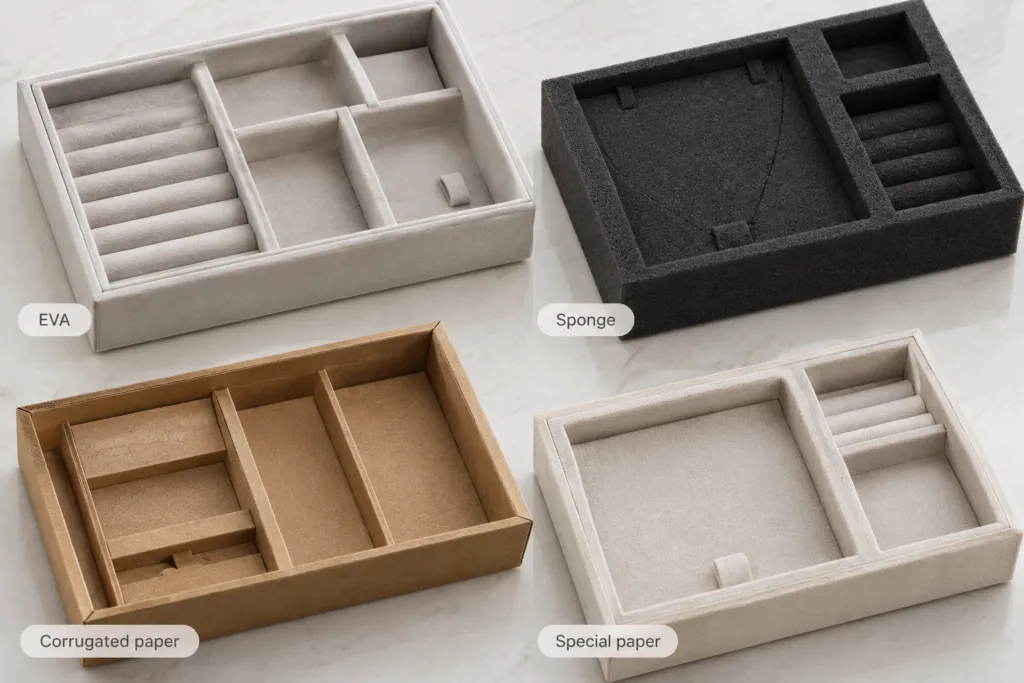
Esion Package works with EVA, sponge, corrugated paper, and special paper for jewelry and other custom packaging inserts. The appropriate material depends on the product, positioning requirements, internal construction, and desired presentation.
The term “foam insert” should not be treated as a sufficient technical specification. EVA and sponge are different material categories and should be identified specifically when the insert is quoted or sampled.
| Material | Typical use | Strengths | Points to check |
|---|---|---|---|
| EVA | Shaped positioning and cutout inserts | Can provide defined positioning and clean shaped cavities | Cutout dimensions and product fit need physical verification |
| Sponge | Cushioned internal support | Suitable where a softer internal support is required | Compression and product fit should be checked with the actual jewelry |
| Corrugated paper | Paper-based internal structures and partitions | Lightweight paper construction with structural support | Internal geometry must provide sufficient positioning for the jewelry |
| Special paper | Paper-based internal components and surface presentation | Supports a paper-based packaging direction and can coordinate with the box | Contact surface, folding structure, and finishing need to match the application |
Our current jewelry-related packaging range includes products using internal materials such as sponge, EVA, corrugated paper, and special paper. For example, our jewelry drawer box with foam insert is specified with sponge, EVA, corrugated paper, and special paper as available internal material options.
The exact insert specification should be confirmed during the quotation and sampling stage rather than inferred from the general term “foam.”
What About the Material That Touches the Jewelry?
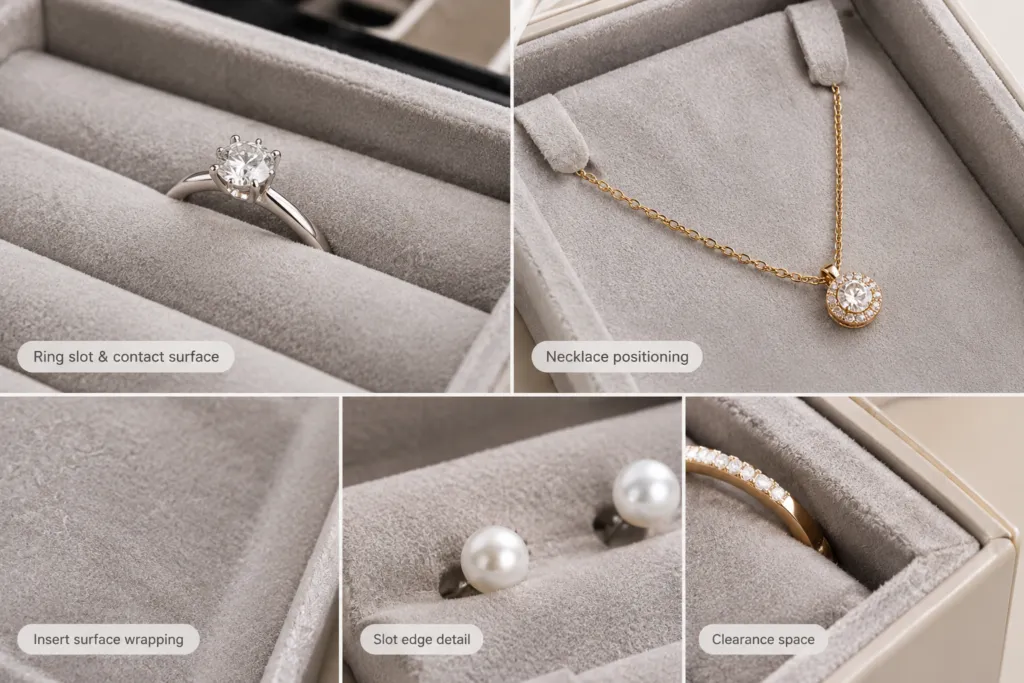
The material directly contacting the jewelry deserves separate attention from the structural insert itself.
The contact surface should be checked for:
- Excessive friction against the jewelry
- Loose fibers or surface shedding
- Exposed adhesive
- Rough cut edges
- Surface damage after repeated handling
- Compatibility with the jewelry and intended presentation
If the contact surface is part of a wrapped or covered insert, the covering material should be specified as part of the insert construction rather than treated as a purely decorative detail.
How Do You Protect Delicate and Silver Jewelry?
Protection starts with controlling the jewelry’s contact points and movement inside the insert.
For delicate jewelry, the insert should hold the product securely without creating unnecessary pressure or abrasion. Silver jewelry also requires attention to the materials that directly contact the product and the conditions in which the packaged item will be stored.
During development, we check the physical sample for:
- Movement — whether the jewelry shifts when the box is handled.
- Contact — whether edges or surfaces create unnecessary friction.
- Surface condition — whether the insert sheds fibers or leaves visible adhesive.
- Clearance — whether the lid or other box components can contact the jewelry.
- Presentation — whether the jewelry remains correctly positioned when the box is opened.
If a project has specific anti-tarnish or material requirements for silver jewelry, those requirements should be stated before sampling so the applicable material solution can be evaluated for the project.
How Does the Insert Work With the Box Size and Structure?
The insert and outer box should be developed together because changes to the insert can change the usable internal dimensions and the way the box closes or opens.
| Box structure | What the insert needs to accommodate | Related reference |
|---|---|---|
| Magnetic | Opening area and closure; jewelry must remain clear of the lid and closure components | Magnetic Gift Boxes guide |
| Hinged | Lid movement and closing clearance; jewelry should not be pressed when the lid closes | For hinge construction details, see the published Hinged Gift Box guide on the site |
| Drawer | Tray movement; the insert must remain secure while the drawer is opened and closed | Jewelry drawer box example |
| Collapsible rigid | Folding construction and the final assembled internal dimensions | Collapsible Rigid Box guide |
The outer structure should therefore be confirmed before the final insert dimensions are locked.
How Do We Develop and Test a Custom Jewelry Box Insert?
A custom insert should be developed through physical sampling rather than relying only on drawings or product dimensions.
Step 1: Confirm the Jewelry
We start with the actual jewelry dimensions and layout.
For a single product, this includes its length, width, height, shape, and any areas that require dedicated positioning. For a jewelry set, the complete arrangement should be provided because the relationship between individual pieces affects the insert layout.
Step 2: Define the Positioning Areas
The next step is to determine where each piece should sit inside the box.
This may include ring slots, paired earring positions, necklace holding points, recessed pendant areas, bracelet support, or separate zones for a multi-piece set.
The objective is to create controlled positioning without making the jewelry difficult to remove.
Step 3: Develop the Insert Material and Contact Surface
Once the positioning requirements are clear, the insert material and contact surface can be selected.
The choice should consider the required support, cut or fold structure, surface characteristics, and the appearance expected when the box is opened.
At this stage, the material should be specified precisely rather than using a broad term such as “foam.”
Step 4: Check the Physical Sample
The physical sample is checked with the actual jewelry whenever possible.
We examine:
- Jewelry positioning
- Insert fit inside the box
- Clearance around the product
- Lid or tray movement
- Contact areas
- Ease of product removal
- Overall presentation
If the jewelry moves, sits too deeply, contacts another component, or does not present correctly, the insert geometry can be adjusted before mass production.
Step 5: Confirm the Revised Sample Before Production
The revised sample should be checked against the approved requirements before the production specification is finalized.
This physical confirmation is particularly important when the insert contains several positioning areas or when the jewelry has delicate components that are difficult to represent accurately in a drawing.
What Are Common Jewelry Box Insert Problems?
The most useful way to solve insert problems is to identify the physical cause rather than simply changing the appearance of the insert.
| Problem | What to investigate | Typical development response |
|---|---|---|
| Jewelry moves inside the box | Check whether the positioning area is too large or the product is not adequately supported | Refine the positioning geometry or contact area based on the sample |
| Necklace chain tangles | Check where the chain can move and whether the pendant and chain have separate positioning needs | Adjust the holding point, recessed area, or internal layout |
| Lid contacts the jewelry | Check the vertical clearance between the jewelry, insert, and lid | Adjust insert height or product positioning before finalizing the structure |
| Adhesive or insert edges are visible | Inspect exposed adhesive, cut edges, and covering alignment | Refine the insert construction or surface treatment |
| Insert does not sit securely | Check the relationship between insert dimensions and the box cavity | Adjust the insert’s external dimensions or fixing method |
These adjustments should be based on the actual sample. The correct solution depends on the jewelry, insert material, and box structure rather than a universal dimensional rule.
What Information Do You Need to Develop a Custom Insert?
For an insert-specific quotation, provide the information that directly affects the internal construction.
A useful insert brief should include:
- Jewelry type — ring, earrings, necklace, bracelet, watch, or set.
- Actual product dimensions — including thickness or height where relevant.
- Product arrangement — especially for jewelry sets.
- Preferred positioning — such as ring slots, necklace holding points, or separate compartments.
- Insert material preference — if your brand already has a specified material.
- Contact-surface requirements — including any special handling or material requirements.
If you are preparing the complete packaging project rather than only the insert, see the jewelry gift box guide for the broader packaging brief.
The more accurately the product and internal layout are defined, the easier it is to develop an insert that fits the finished box.
FAQ
What is the best material for a jewelry box insert?
There is no single material that is best for every jewelry product. EVA, sponge, corrugated paper, and special paper can serve different insert requirements. The correct choice depends on the jewelry shape, required positioning, contact surface, presentation, and box structure.
What type of insert is best for a ring box?
A ring usually benefits from a defined positioning area that keeps the band stable while allowing the customer to remove the ring easily. The exact slot or positioning geometry should be developed around the actual ring dimensions and verified during sampling.
How can a jewelry box insert help prevent necklace tangling?
A necklace insert can reduce tangling by controlling the chain and pendant positions instead of allowing the necklace to move freely inside the box. The appropriate holding points and recessed areas depend on the necklace design and should be verified with the actual product.
Can jewelry box inserts be customized?
Yes. Custom inserts can be developed around the jewelry dimensions, product arrangement, box structure, material requirements, and desired presentation. Customization can include positioning areas, cutouts, compartments, and the overall internal layout.
Start Your Custom Jewelry Box Insert Project
A well-designed insert begins with the jewelry itself. Product dimensions, positioning requirements, material selection, contact surfaces, and the outer box structure all need to work together.
At Esion Package, we manufacture custom paper packaging and work with insert materials including EVA, sponge, corrugated paper, and special paper. Our production process covers paper cutting, printing, gluing, laminating, die cutting, handmade assembly, QC inspection, and packing.
For more information about our company and manufacturing capabilities, see About Esion Package. When your jewelry dimensions and insert requirements are ready, you can Contact Esion Package to discuss the project.