
Table of Contents
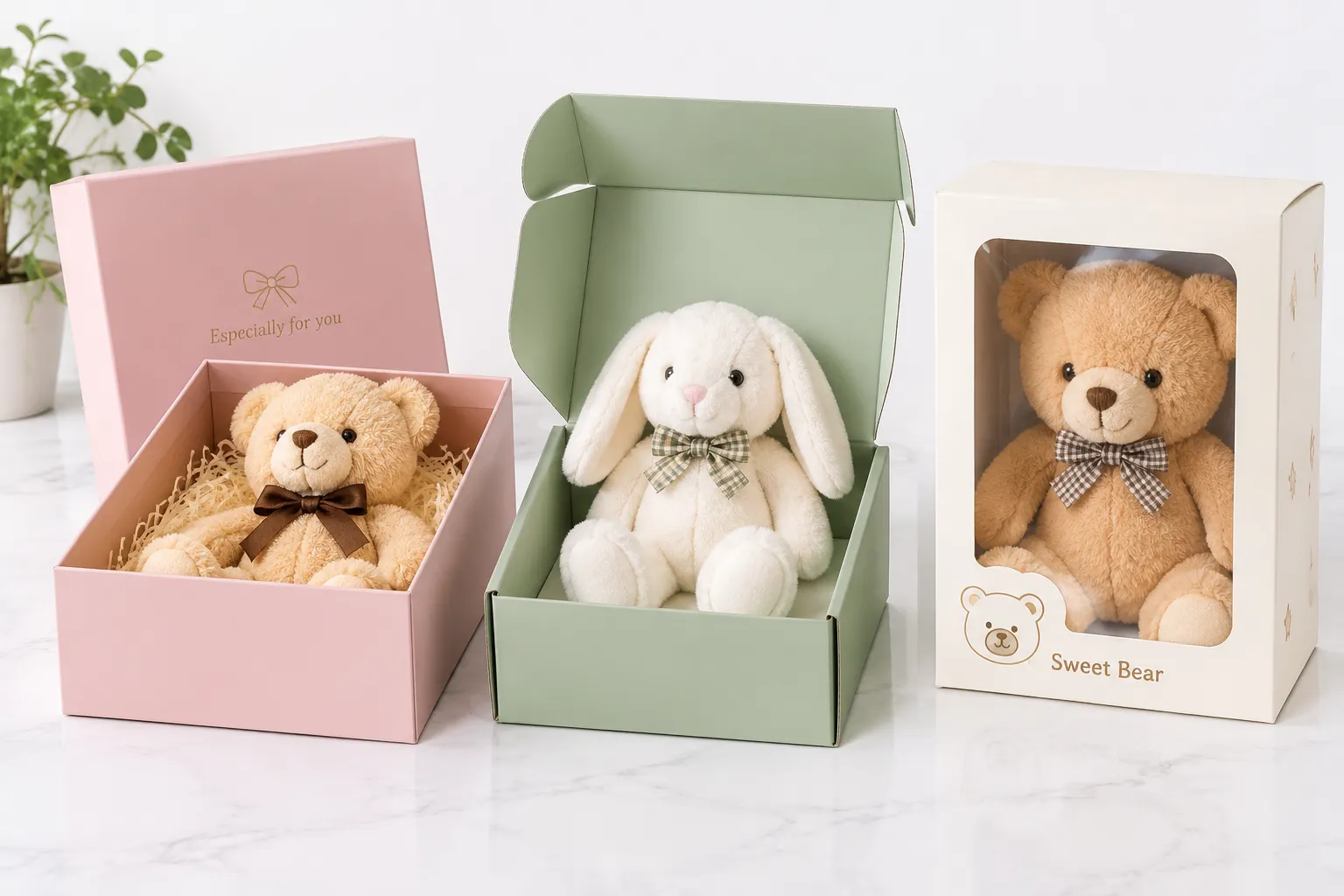
Custom Stuffed Animal Box: Fit, Window Design and Sample Checks
26. 11 月, 2026By Esion Package Editorial Team | Technical review: Esion Packaging Engineering Team | Last updated: November 26, 2026
A custom stuffed animal box should fit the toy in its natural display position, hold it without leaving marks and close properly after packing. Plush is soft, bulky and often irregular, so a box that looks right on screen can turn out too tight or too loose.
This guide is for brands and buyers planning plush toy gift or retail packaging. We cover box style, measurement, window design, internal fixing, safety questions, shipping volume and filled-sample approval. For other toy formats, see our custom toy packaging range.
Which Box Style Suits Your Plush Toy?
Start with how the toy will be sold, how heavy it is and whether buyers need to see it before opening.
| Box style | Consider it for | Check before choosing |
|---|---|---|
| Folding carton with window | Small, light toys on retail shelves | Board stiffness once the window is cut |
| Corrugated window box | Larger toys that need a stronger wall | Print surface, flute thickness and internal space |
| Rigid gift box | Collectibles and premium gifts | Storage space, packed volume and cost |
| Rigid box with window | Premium gifts that also need display | Lid strength around the opening |
A corrugated example is this toy paper packaging box with a PVC window. For gift formats without a window, browse our rigid gift boxes. If storage space is a concern, ask whether a collapsible structure is suitable for the toy’s weight.
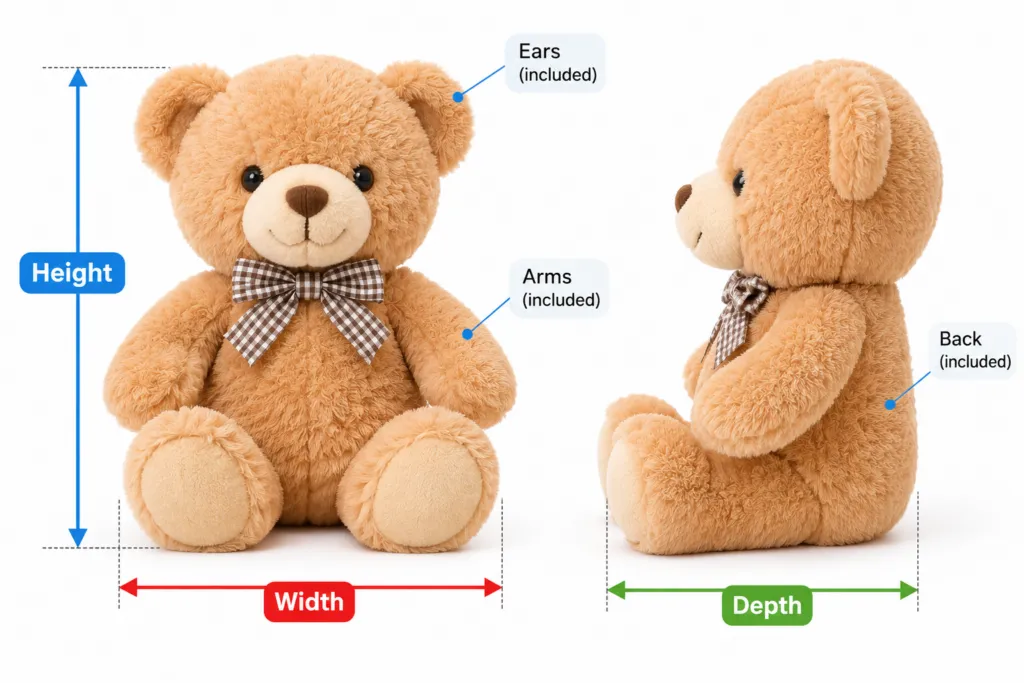
How to Measure a Stuffed Animal for a Box
Place the toy in the position it will hold inside the package. A seated teddy bear and a standing one need different boxes.
| Measurement | Where to measure | What is often missed |
|---|---|---|
| Height | Base to the highest point | Ears, hats and hair |
| Width | Widest point, left to right | Extended arms and bows |
| Depth | Front to back at the thickest point | Feet, tail and backpack |
| Weight | Toy with all accessories | Weighted filling or sound modules |
Measure the toy without pressing it. If production toys vary, measure several and note the largest and smallest.
Do not add the same allowance to every design. Filling density, pile length and sewing shape change how much a toy can be compressed. Record the unpressed toy size and the proposed internal box size separately, then confirm the gap with a physical sample.
How to Design a Window for a Plush Toy Box
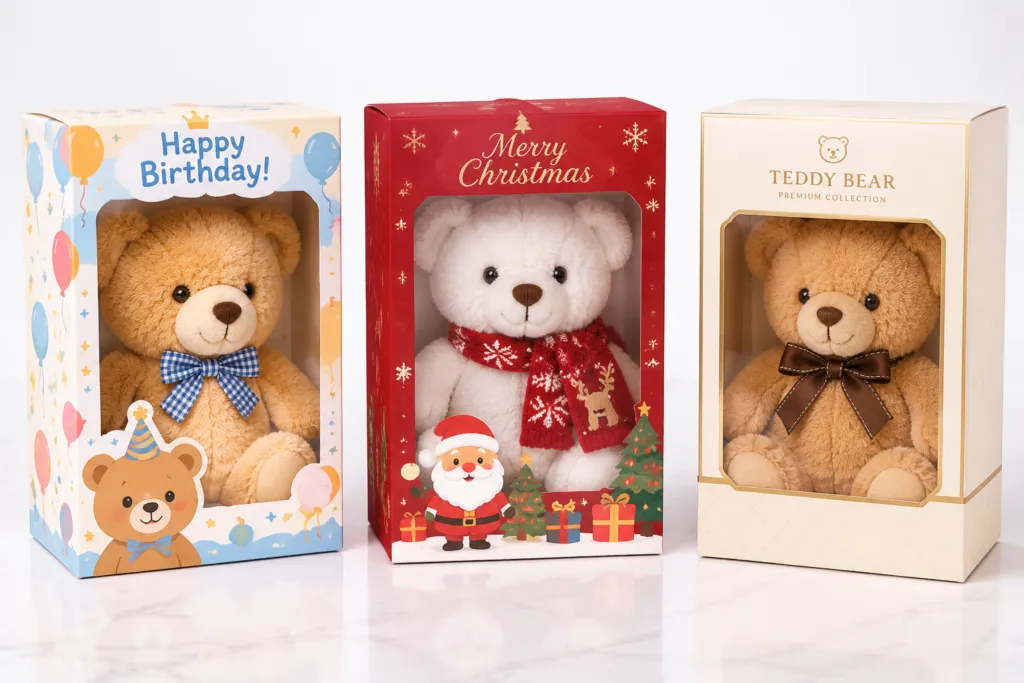
The window should show the features that sell the toy, usually the face, clothing and color, while leaving enough board to keep the box in shape.
Choose the Window Material
| Option | Main point | Confirm on the sample |
|---|---|---|
| PET film | Clear plastic window | Clarity, scratches, glue lines and recycling requirements |
| PVC film | Clear plastic window | Whether your retailer or market restricts PVC |
| Open cut-out | No film | Dust, handling and whether children can pull at the toy or fixings |
Ask the supplier to state the film type and thickness in the quote. A windowed structure does not have to use PVC, so name the material you want. You can compare this with our windowed toy packaging box.
Check Size, Position and Fit
- Align the window with the toy’s face in its fixed position, not only on the flat artwork.
- Test corners and narrow board strips for bending or tearing.
- Check whether long fibers press against the film or catch in the glue line.
- View the filled box under bright light for glare and fogging.
Keep Printing Clear of the Opening
Mark the window on the dieline before placing the logo, age information or barcode. Keep foil, embossing and important text away from cut edges and folds. A simple design that frames the toy usually reads better than several competing effects.
How to Secure the Toy Without Leaving Marks
The fixing method should limit movement while letting the customer remove the toy easily.
- Paperboard support: A shaped base or back card can stop a seated bear from leaning forward.
- Fitted platform or collar: This can hold the lower body of a heavier toy. Check that cut edges do not rub the fabric.
- Ribbon or tie: This can hold the toy upright. Check tension, fiber marks and how the tie is removed.
After packing, tilt and gently shake the sample. Then remove the toy and look for flattened pile, creased ears, color transfer or damaged accessories. Leave a sample packed for a period that reflects your storage and shipping time, and check how well the toy recovers.
What Safety and Market Requirements Should You Check?
Packaging approval does not show that a toy is compliant. The brand or importer should confirm toy and packaging requirements for each destination market, using a qualified testing laboratory where needed.
- United States: ASTM F963-23 applies to toys for children under 14 manufactured on or after April 20, 2024. Third-party testing and certification are required for toys designed primarily for children 12 and under. See the CPSC toy safety FAQ. Ask your laboratory which requirements, including those for plastic film, apply to your bags or wraps.
- EU toy rules: Regulation (EU) 2025/2509 applies fully from August 1, 2030, with certain provisions applying from January 1, 2026. Directive 2009/48/EC is repealed on the 2030 date.
- EU packaging rules: The Packaging and Packaging Waste Regulation applies from August 12, 2026. Its design minimisation requirement is dated January 1, 2030. See the European Commission guidance and review oversized boxes early.
Also assess ties, ribbons, staples, small decorative parts and sharp window edges for the intended age group.
How Do Box Size and Shipping Affect Your Order?
Plush toys are light for their size, so freight may be charged by volume instead of actual weight.
Illustrative calculation: An outer carton measuring 30 × 25 × 40 cm has a volume of 30,000 cm³. With a divisor of 5,000, its volumetric weight is 6 kg. Divisors and rounding rules vary, so confirm them with your carrier or forwarder.
A gift box presents the toy; it may not withstand direct shipping. For e-commerce or bulk shipments, test it inside the planned outer carton. Check crushed corners, window scratches, toy movement, moisture protection and odor after opening. Avoid heavy stacking that collapses the window or lid.
What Should You Check on a Filled Sample?
Approve the box with the production-representative toy inside, not as an empty box.
| Check | Pass condition to agree in writing |
|---|---|
| Fit | Box closes without bulging or pressing key features |
| Position | Toy stays in place after handling |
| Window | Face is visible; film is bonded and free of unacceptable marks |
| Fixing | No damage to pile, seams or accessories |
| Removal | Toy can be released without tearing it |
| Print and finish | Color, logo and finish match the approved reference |
| Packing | Gift box fits the outer carton as planned |
Photograph the approved filled sample from the front, side and inside. Keep one signed sample as the production reference. If the toy’s filling, clothing or accessories change, check the fit again.
What to Send for a Custom Box Quote
Include the toy’s unpressed dimensions and weight, photos from several angles, box style, window material, fixing preference, artwork, quantity, destination market, shipping method and required arrival date.
Order reference as of November 2026: Minimum order quantity depends on the product. Our PVC window box page lists 500 pieces, while our windowed toy packaging box page lists 1,000 pieces. Bulk production is generally about 15 days after sample approval. Sample timing, production schedule and final MOQ are confirmed for each project.
For Valentine’s Day 2027 orders, plan around the Lunar New Year on February 6, 2027. Confirm factory holiday dates, sample approval deadline and freight booking before ordering.
Dongguan Esion Packaging Co., Ltd. was established in 2011 and has passed FSC certification. Ask whether FSC-certified material is available for your project; FSC certification does not cover toy safety.
FAQ
What size box does a stuffed animal need?
It depends on the toy’s height, width and depth in its display position, plus how much it can be compressed without damage. Confirm the internal size with a filled sample.
Can a teddy bear gift box have a clear window?
Yes. Choose the window material and position it around the bear’s face and the strength of the box. An open cut-out is another option where exposure is acceptable.
Can plush toys be compressed to reduce shipping volume?
Some can, but results depend on filling and fabric. Test recovery after a realistic compression period, and avoid compression for toys with rigid parts unless testing supports it.
Can the gift box be shipped on its own?
Only if testing shows it can handle the delivery route. An outer carton is usually worth testing for window boxes and premium gift boxes.
Plan Your Stuffed Animal Packaging
Send us your toy photos, measurements, quantity and destination market. Contact Esion Package to discuss the box structure and sample.