
Table of Contents
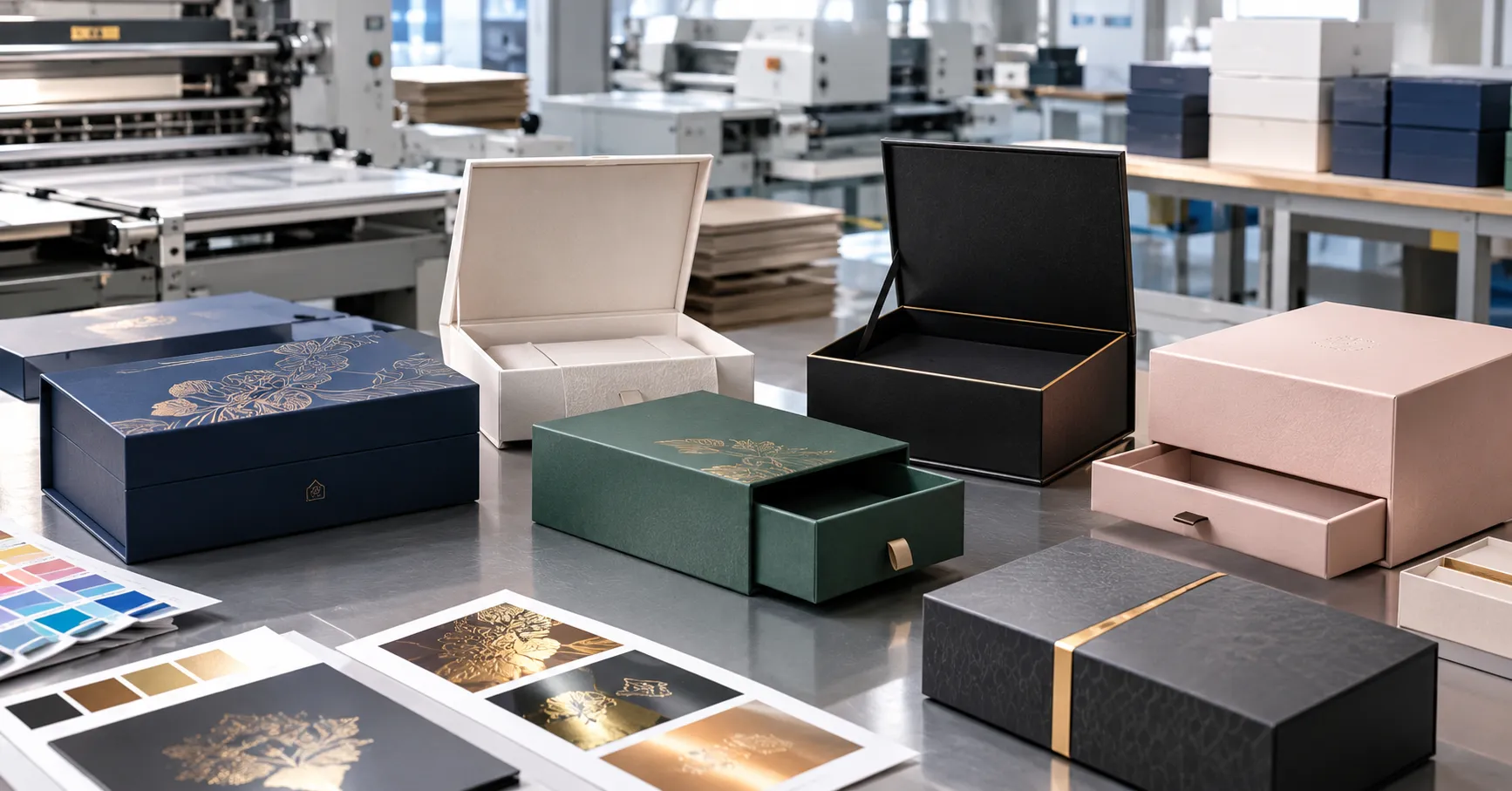
How to Choose the Right Gift Box Manufacturer for Your Brand
2026-01-19Author: Esion Package
Last updated: September 15, 2026
Choosing the right gift box manufacturer is not simply about finding the lowest unit price.
For brands selling premium products, the wrong production partner can lead to problems with dimensions, printing, finishing, inserts, quality consistency, packaging waste, and delivery schedules.
At Esion Package, we work with brands and importers on customized paper packaging projects. This guide explains how to evaluate production capability, review samples, compare suppliers, and prepare your packaging specifications before mass production.
If you are still deciding which box structure suits your product, start with our Luxury Rigid Boxes guide, then use the following criteria to evaluate the manufacturer.
What Should a Production Capability Checklist Include?
A capable manufacturer should be able to demonstrate more than attractive finished boxes. You should understand how your packaging will be produced, inspected, and packed from the initial specification through shipment.
Manufacturing Processes
Customized paper gift boxes can involve multiple production stages:
Raw Material → Paper Cutting → Printing → Gluing → Laminating → Die Cutting → Handmade Assembly → QC Inspection → Packing
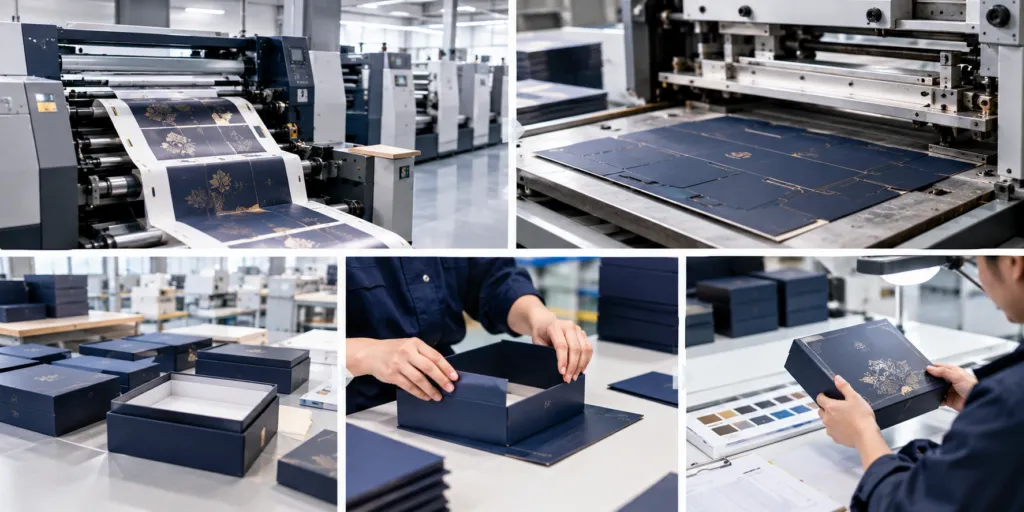
Esion Package’s current company information describes a production process covering these stages, from raw materials and paper cutting through printing, finishing, assembly, quality inspection, and packing. Learn more about Esion Package’s production process.
The important point is not simply how many processes a factory lists. Ask whether the manufacturer can control the processes that actually matter to your box.
For example, a premium rigid gift box may require accurate board cutting, wrapping paper alignment, foil stamping, embossing, magnetic closure assembly, and a precisely fitted insert.
Materials and Finishing
Material selection should match the product, structure, appearance, and intended use of the packaging.
Important specifications may include:
- Board thickness
- Wrapping paper
- Printing method
- Surface treatment
- Foil stamping
- Embossing or debossing
- Spot UV
- Magnetic components
- Custom inserts
For premium packaging, small differences in alignment, color, or surface finishing can become highly visible during mass production.
Quality Control
Quality control should not be treated as something that happens only after the boxes are finished.
A practical inspection system can be divided into several checkpoints:
Material
Board, paper, inserts, magnets, and other components.
Printing
Artwork, color, registration, and print quality.
Structure
Dimensions, assembly, folding, opening, and closure.
Finishing
Foil, embossing, lamination, UV, edges, and surface appearance.
Final Inspection
Overall appearance, functionality, quantity, and packing condition.
This makes it easier to identify problems before finished goods are packed for shipment.
How Should You Evaluate a Sample Before Mass Production?
A physical sample is one of the most useful ways to reduce production risk.
Do not evaluate it only by asking whether the box looks attractive. Compare it against the specifications that will matter during actual use.
Check Structure and Dimensions
Measure the finished sample instead of relying only on the design drawing.
Check:
- External dimensions
- Internal dimensions
- Lid or closure alignment
- Opening and closing performance
- Board rigidity
- Edge alignment
- Overall appearance
A difference of only a few millimeters can matter when a box is designed around a specific product.
Test the Insert and Product Fit
The insert should ideally be evaluated together with the actual product.
Check whether:
- The product sits securely
- The product can be removed easily
- The insert moves inside the box
- There is excessive empty space
- Fragile areas receive sufficient protection
- The product remains correctly positioned during handling
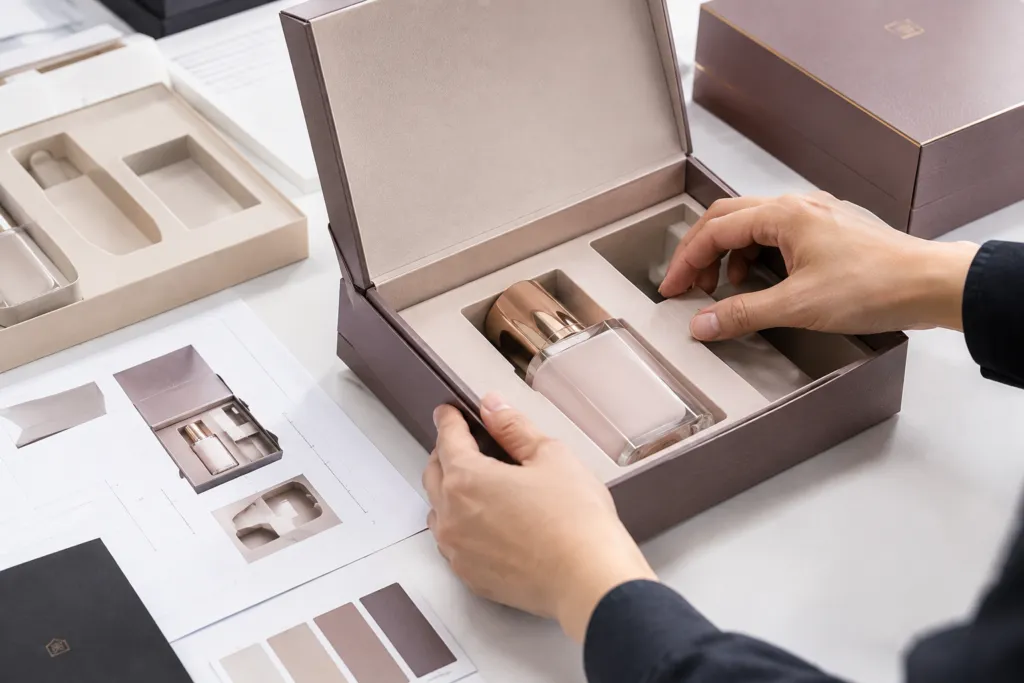
A box can look perfect when empty but perform poorly once the actual product is placed inside.
Use the Approved Sample as the Production Reference
After the sample is approved, the final specifications should be documented clearly.
The production reference should cover:
- Final dimensions
- Material
- Artwork
- Color requirements
- Finishing
- Insert structure
- Closure
- Packing requirements
This gives the manufacturer and buyer a common reference throughout mass production.
A Practical Production Example
Consider a rigid gift box with a custom insert.
The exterior dimensions and printing may be correct, while the product still moves slightly inside the insert.
In this situation, the entire box does not necessarily need to be redesigned. The insert can be adjusted, tested with the actual product, and approved before mass production.
The lesson is simple:
Sampling is not only an appearance check. It is a production-risk check.
Which Questions Reveal a Factory’s Real Production Capability?
Before placing an order, ask questions that require specific answers rather than general claims such as “high quality” or “fast delivery.”
MOQ and Lead Time
For Esion Package, the current minimum order quantity (MOQ) is 1,000 pcs. The company’s website also indicates that mass production generally takes around 8–15 days, although the final schedule should be confirmed according to the project specification and order quantity.
Ask the manufacturer:
- What is the MOQ for this project?
- What is the sample lead time?
- When does mass production begin?
- What information is required before production starts?
- What factors could affect the production schedule?
Clear answers to these questions make it easier to build a realistic purchasing timeline.
Sampling and Revisions
Ask how the manufacturer handles sample revisions.
Useful questions include:
- What happens if the first sample needs modification?
- Can structural problems be identified before production?
- How are specification changes recorded?
- Is the final approved sample used as the production reference?
A supplier’s answer to these questions can reveal much more about its actual workflow than a general statement about experience.
Quality and Export Packing
For international orders, discuss how the finished boxes will be packed for transportation.
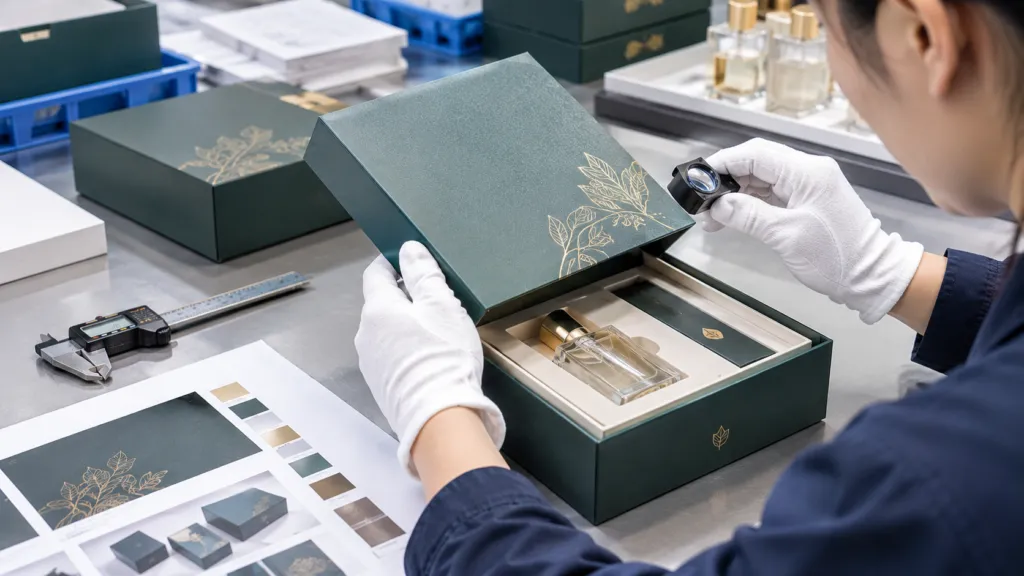
The packing method should help protect the boxes against:
- Compression
- Scratches
- Corner damage
- Moisture exposure
- Excessive movement inside cartons
If the packaging has delicate finishing or rigid structures, export packing should be discussed before production rather than after the boxes are completed.
How Should You Compare Suppliers Beyond Unit Price?
A lower unit price does not necessarily mean a lower total packaging cost.
The most useful comparison starts with the complete specification.
Compare the Complete Specification
Make sure suppliers are quoting the same:
- Box structure
- Finished dimensions
- Board thickness
- Paper
- Printing
- Finishing
- Insert
- Accessories
- Quantity
- Packing method
If one quotation includes a custom insert and premium finishing while another does not, the two prices are not directly comparable.
Consider Production Consistency
A good first sample is important.
However, repeatability is more important for brands placing recurring orders.
Evaluate how the manufacturer controls consistency in:
- Color
- Dimensions
- Finishing
- Assembly
- Insert positioning
- Closure performance
This is especially important when the same packaging will be reordered over time.
Consider Communication
Packaging projects contain many small specifications.
A capable manufacturer should identify unclear requirements rather than simply accepting incomplete instructions.
For example, “make the box premium” is not enough information for production.
The manufacturer should help clarify structure, dimensions, materials, finishing, insert requirements, and intended use.
Consider Delivery Risk
The complete packaging timeline may include:
Specification → Quotation → Sampling → Approval → Production → QC → Packing → Shipment
A supplier that communicates clearly at each stage gives the buyer more opportunities to identify potential delays before they affect the delivery date.
What Should Brands Know About Packaging Requirements in 2026?
Sustainability is becoming increasingly important in packaging procurement.
For international brands, packaging decisions should consider not only appearance and protection, but also material selection, packaging efficiency, recyclability, and market-specific requirements.
Material Selection and Documentation
If your project requires specific materials or certification, ask the manufacturer for the documentation that applies to the actual order.
Esion Package’s current product information lists credentials including FSC, GRS, ISO 9001, BSCI, and SEDEX on certain product pages. Buyers should request the current documentation applicable to their specific order before treating a certification as a purchasing requirement.
This is preferable to assuming that every material, product, or order automatically carries the same certification status.
Recyclability and Packaging Reduction
Sustainable packaging does not necessarily mean removing every premium feature.
Instead, buyers should consider whether each component has a clear purpose.
Questions include:
- Can unnecessary layers be removed?
- Can material use be reduced without compromising protection?
- Can the insert be simplified?
- Are the selected materials appropriate for the intended recycling system?
- Is excessive empty space being avoided?
For premium brands, the goal is to balance presentation, protection, material efficiency, and practical end-of-life considerations.
What Does the 2026 EU PPWR Mean for Buyers?
The EU Packaging and Packaging Waste Regulation (PPWR), Regulation (EU) 2025/40, began applying across the EU on August 12, 2026. It establishes a harmonized framework for packaging and packaging waste and introduces measures related to waste prevention, circularity, recyclability, and resource efficiency.
Some requirements are phased in over time. For example, the European Commission states that requirements related to recyclability and certain recycled-content measures apply from 2030.
For the latest official information, see the European Commission’s Packaging and Packaging Waste Regulation (PPWR).
If your brand sells into the EU, discuss applicable material, labeling, recyclability, and documentation requirements with your packaging supplier before finalizing production specifications.
What Should You Prepare Before Production Starts?
A complete packaging brief makes communication with the manufacturer much easier.
Product Information
Prepare:
- Product dimensions
- Product weight
- Product material
- Product quantity
- Fragile or sensitive areas
- Intended use and display requirements
If possible, provide an actual product sample or accurate product drawings.
Box Specifications
Your packaging brief should define:
- Box structure
- Finished dimensions
- Material
- Printing
- Finishing
- Insert
- Closure
- Logo requirements
- Packing requirements
If you are unsure which structure is appropriate, provide the product information and intended use first. A capable manufacturer should be able to discuss suitable options before production.
Quantity and Delivery
Also confirm:
- Expected order quantity
- Target delivery date
- Destination
- Shipping method
- Carton or pallet requirements
Providing this information early helps the manufacturer assess production and logistics requirements before the order moves forward.
Pre-Production Checklist
Before production starts, use this checklist:
- ☐ Product dimensions confirmed
- ☐ Box structure confirmed
- ☐ Material and board thickness confirmed
- ☐ Artwork approved
- ☐ Color and finishing confirmed
- ☐ Insert and product fit tested
- ☐ Physical sample approved
- ☐ Quantity confirmed
- ☐ Packing requirements confirmed
- ☐ Delivery schedule confirmed
Completing these items before production reduces the likelihood of avoidable changes during manufacturing.
How Can Esion Package Support the Production Process?
Esion Package is a paper packaging manufacturer based in Dongguan, China. Its current company information describes production covering raw materials, paper cutting, printing, gluing, laminating, die cutting, handmade assembly, QC inspection, and packing.
The company states that it has been operating in the paper packaging industry for more than 10 years and provides customized packaging for different product categories. Explore Esion Package.
For buyers, the practical value is the ability to move through a clearly defined process:
Specification → Sample → Approval → Production → Inspection → Packing → Shipment
The most important step is to make sure the specifications are understood and approved before mass production begins.
Final Takeaway
Choosing a gift box manufacturer should be based on more than unit price.
Before placing an order, evaluate:
- Production capability
- Material and finishing control
- Sample quality
- Product fit
- Quality-control procedures
- MOQ and lead time
- Communication
- Export packing
- Applicable documentation
- 2026 packaging requirements
A reliable production partner should be able to explain not only what the box will look like, but also how it will be produced, inspected, packed, and delivered.
For Esion Package, the current minimum order quantity is 1,000 pcs, providing a clear starting point for brands planning customized packaging projects.
Need help evaluating your box structure, dimensions, materials, or production requirements? Contact Esion Package to discuss your project before moving into mass production.
FAQ
How can I tell whether a gift box manufacturer is suitable for repeat orders?
Look beyond the first sample. Ask how the manufacturer controls dimensions, printing, finishing, assembly, and quality consistency during repeat production.
Should I approve a physical sample before placing a bulk order?
For customized packaging, a physical sample is strongly recommended. It allows you to check the structure, dimensions, product fit, appearance, and finishing before committing to mass production.
What factors can change the final gift box cost?
Important factors include structure, size, board thickness, paper, printing, finishing, inserts, accessories, order quantity, and packing requirements.
Can a manufacturer identify packaging problems before mass production?
Yes. Sampling and pre-production review can reveal problems with dimensions, product fit, structure, finishing, and usability before the full order is manufactured.
What should I confirm when sourcing packaging for the EU market in 2026?
Confirm the applicable material requirements, recyclability considerations, packaging design, documentation, labeling, and other market-specific obligations. The PPWR began applying in the EU on August 12, 2026, with some requirements introduced progressively.