
Table of Contents
Two-Piece Rigid Setup Box: Structure, Lid Fit & Customization Guide
2026-01-19Written by the Esion Package Packaging Development Team
Reviewed by: Structural Design Lead, Esion Package
Last updated: September 2026
At Esion Package, we work with brands on custom packaging development, including rigid box structures, sampling, materials, and production. One question that often comes up is surprisingly simple: how should the lid and base of a two-piece rigid setup box actually fit together?
For this type of box, choosing a size from the product dimensions is only the starting point. The relationship between the lid, base, board thickness, wrapping material, and internal clearance determines whether the finished box feels precise or awkward to use.
If you are new to this structure, start with our Custom Setup Boxes: A Practical Buyer’s Guide for the broader setup box framework. This article focuses specifically on the two-piece rigid setup box and the structural decisions that make this format work.
By the end, you should be able to define the basic dimensions, understand what needs to be checked during sampling, and prepare a more useful specification for a custom box project.
What Is a Two-Piece Rigid Setup Box?
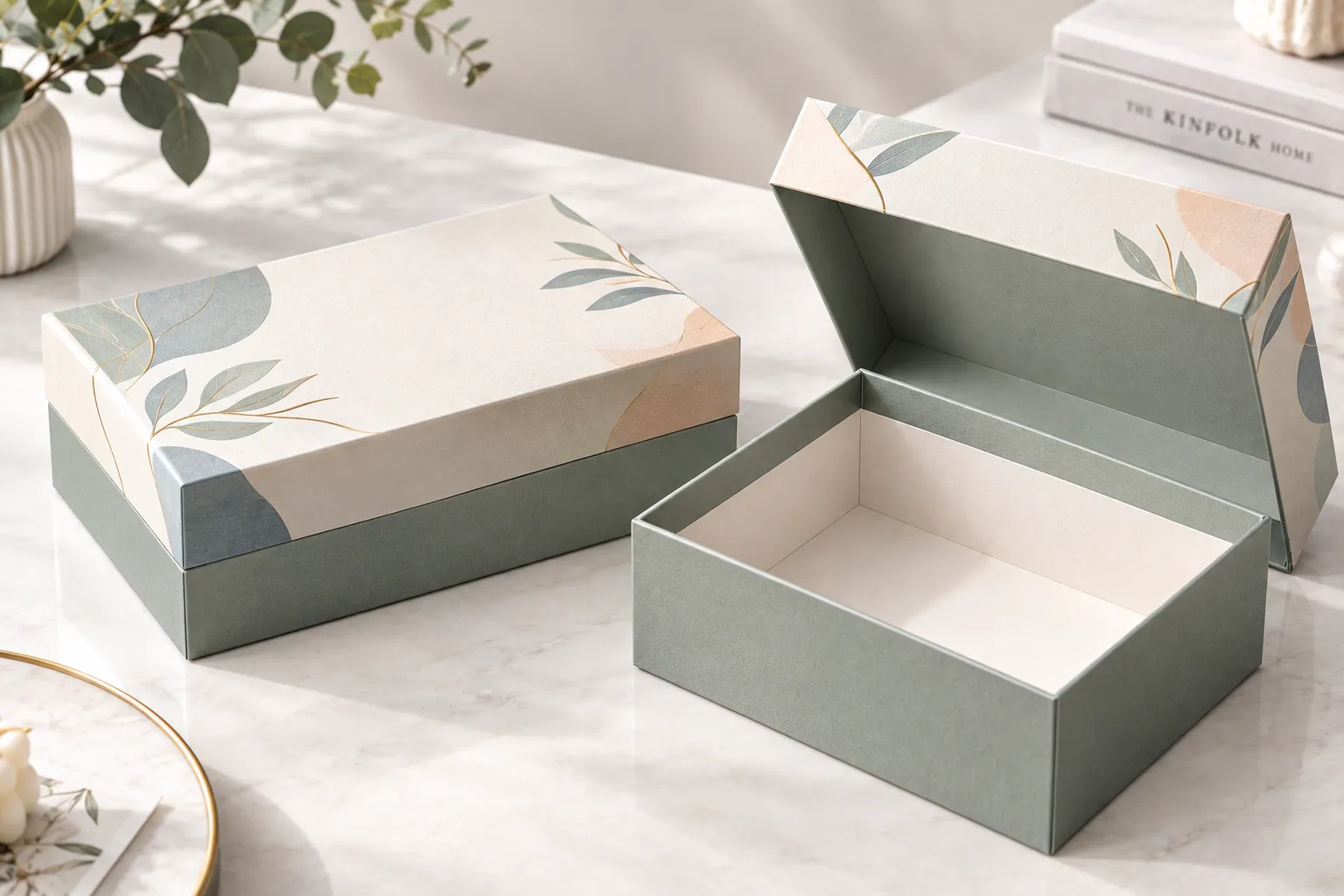
A two-piece rigid setup box is a rigid box made from two separate components: a base and a lid.
The base holds the product, while the lid fits over the upper section of the base. Unlike a folding structure, the box maintains its formed shape and is normally delivered as a finished rigid package.
The important point is that the two pieces cannot be designed independently. The lid and base have to work as one system.
How do the lid and base work together?
Think of the structure as three connected dimensions:
Product → Base → Lid
The base needs enough internal space for the product. The lid then needs to fit over the base with enough engagement to stay securely in place without making the box difficult to open.
That means the finished result depends on more than the outside length and width.
For example, two boxes may have the same external dimensions but feel completely different if their lid depth, board thickness, or internal clearance differs.
Why does this structure require careful fitting?
Because the lid is a separate component, even a small dimensional difference can become noticeable during opening and closing.
If the fit is too tight, the user may need excessive force to remove the lid.
If it is too loose, the lid may move during handling or fail to give the box the intended finished feel.
This is why lid-to-base fit is one of the most important structural considerations in a two-piece rigid setup box.
How Should the Lid and Base of a Two-Piece Setup Box Fit?
The lid should provide enough engagement with the base to keep the box stable while still allowing a controlled opening action.
There is no universal clearance value that works for every project. The correct fit depends on the finished dimensions, board construction, wrapping materials, box size, and intended opening feel.
What is lid overlap?
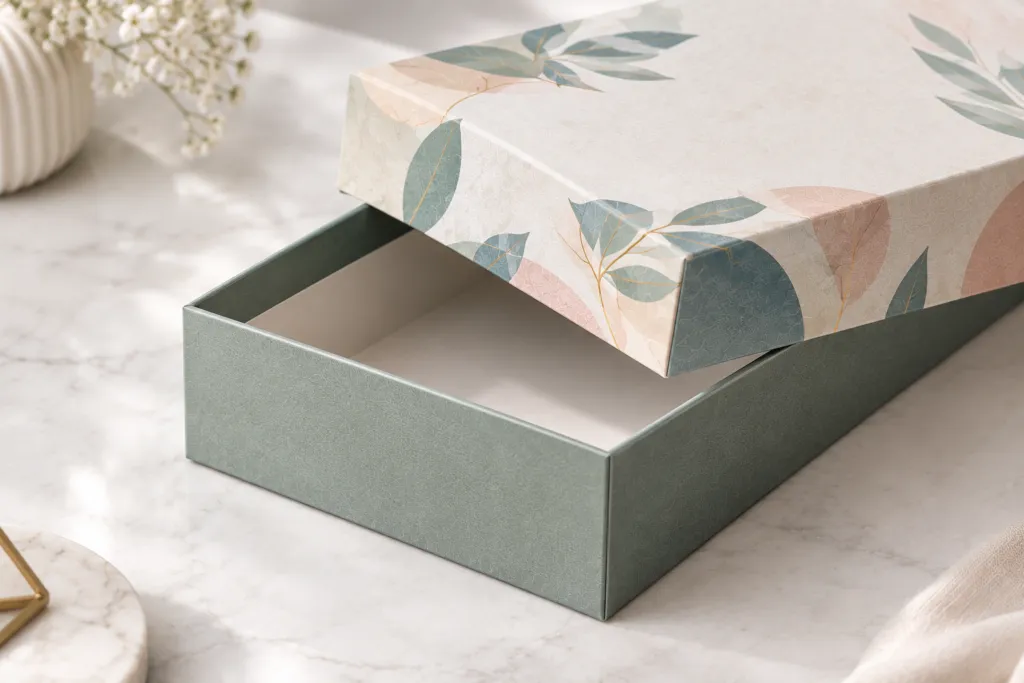
Lid overlap describes how far the lid extends over the upper portion of the base.
A deeper overlap can create a more substantial connection between the two parts, but increasing the overlap without considering the rest of the construction can also affect how easily the lid opens.
The important point is that overlap is a structural decision, not simply a visual measurement.
What is internal clearance?
Internal clearance is the space between the product and the inside of the box.
It needs to account for the actual product dimensions and any internal materials used in the package.
For example, imagine a product measuring:
120 × 80 × 30 mm
The finished internal space should not simply copy those three numbers. The supplier needs to consider the required clearance and how the product will be positioned inside the base.
Too little space can make packing difficult. Too much space can allow movement and make the presentation look unfinished.
How does board thickness affect the fit?
The board contributes to the physical dimensions of both the lid and base.
When the box is wrapped, the covering material also becomes part of the finished construction.
Therefore, a structural drawing that looks correct before material construction still needs to be verified as a physical sample.
This is one reason why a two-piece rigid setup box should not be finalized from external dimensions alone.
What Box Dimensions Should You Confirm Before Production?
For a two-piece setup box, the most useful dimensions are not just the final outside measurements. You need to understand the relationship between product size, internal space, base construction, and lid construction.
Should you start with the product or the box?
Start with the product.
A practical sequence is:
Product dimensions → internal space → base → lid → finished box
For a simple rectangular product, this is relatively straightforward.
For multiple products, irregular shapes, or products that need to sit in a particular orientation, the internal arrangement becomes more important.
What information should be measured?
Before structural development, confirm:
- Product length
- Product width
- Product height
- Number of products inside
- Product orientation
- Required internal clearance
- Any internal component that affects the available space
You do not necessarily need to know every final box dimension before contacting a supplier.
If the product dimensions are accurate, the packaging supplier can use them as the starting point for structural development.
Why shouldn’t the lid size be treated separately?
Because the lid must correspond to the finished base.
If the base changes because of product clearance or material thickness, the lid may also need to change.
This is particularly important when a project moves from a simple digital drawing to a physical sample.
How Can You Check a Two-Piece Rigid Setup Box Sample?
The sample should answer one central question: does the physical box perform the way the structure was intended to perform?
This section focuses only on the structural points that are unique to a two-piece box.
Does the lid open smoothly?
Open and close the box several times.
Pay attention to:
- Initial resistance
- Lid alignment
- Opening movement
- Whether the lid catches on one side
- Whether the closing action feels consistent
The goal is not necessarily a loose or effortless lid. A well-designed box should have a controlled opening action appropriate to its structure.
Does the product sit correctly inside the base?
Place the actual product inside the sample rather than checking the empty box only.
Look for excessive movement, pressure points, or unnecessary empty space.
A product that fits perfectly in a digital layout may behave differently once the actual materials are introduced.
Does the lid remain aligned with the base?
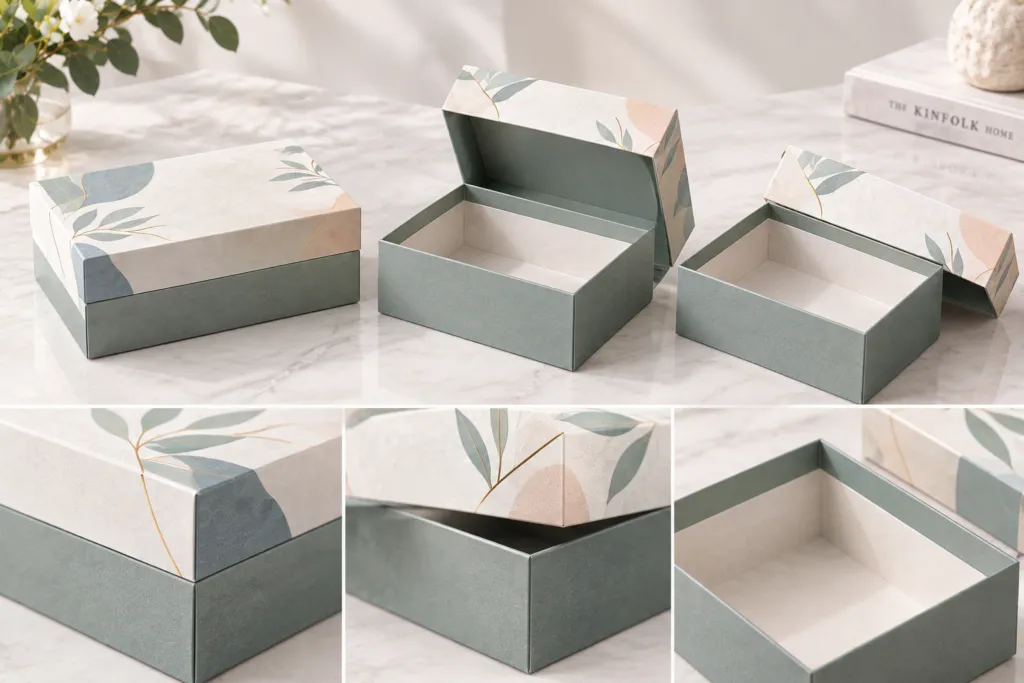
Check the corners and edges after closing.
The lid should sit consistently around the base rather than appearing shifted to one side.
For a premium package, small alignment problems are particularly visible because the lid and base create clear visual lines.
What Should Be Confirmed Before Approving the Box?
Once the structure works physically, the remaining specifications should be confirmed against the approved sample.
The objective is simple: the sample should represent the box you actually intend to produce.
Which structural details should be fixed?
Confirm:
- Finished box dimensions
- Lid and base fit
- Product position
- Internal clearance
- Overall appearance
- Opening and closing action
Avoid changing structural dimensions casually after sample approval, because even a small change can affect the relationship between the two components.
Which appearance details should be checked?
The physical sample should also be checked for:
- Printed artwork
- Wrapping paper
- Surface finish
- Logo placement
- Corner appearance
These are not separate from the structure. For example, a logo that appears correctly positioned on a digital file may look different once it is applied across a physical lid surface.
Why is the approved sample important?
Once approved, the sample provides a physical reference for production.
This is particularly useful for a two-piece box because both components need to remain consistent with each other throughout manufacturing.
What Materials and Finishes Should Be Considered?
Material and finishing choices should support the established structure rather than change the focus of the project.
How does wrapping material affect the finished box?
The outer wrapping material becomes part of the finished dimensions and appearance.
This is why material selection should be confirmed before final structural approval whenever possible.
Changing the wrapping material later can affect the finished fit between the lid and base.
Which finishes can be used?
Depending on the project, the exterior can be customized with options such as:
- Printed artwork
- Matte or gloss lamination
- Foil stamping
- Embossing
- Debossing
The right combination depends on the brand design and desired appearance.
For a two-piece box, however, finishing should remain secondary to accurate structure and fit. A visually attractive lid that does not align properly with the base is still a poorly executed package.
How Should You Prepare a Two-Piece Setup Box Specification?
You do not need a complicated technical document to start a project.
A concise specification should give the packaging supplier enough information to understand the product and intended structure.
What should the specification include?
At minimum, prepare:
Product
- Product dimensions
- Product quantity
- Product photos or sample
Box
- Two-piece rigid setup box structure
- Approximate dimensions, if known
- Material preference, if known
- Artwork or logo
Production
- Estimated quantity
- Sample requirement
- Target delivery schedule
If you do not know the exact lid or base dimensions, that is not necessarily a problem. Providing accurate product dimensions is more useful than guessing technical box measurements.
A practical quotation example
Instead of sending:
“We need a premium two-piece box with our logo.”
A stronger request would be:
“We need one rigid setup box for a product measuring 120 × 80 × 30 mm. The box should use a separate lid and base. We will provide the artwork and would like a physical sample before production. Estimated quantity: 1,000 pieces.”
The second request gives the supplier enough information to begin discussing the structure without pretending that every technical dimension has already been finalized.
How Does Esion Package Handle This Type of Project?
For a two-piece rigid setup box, the practical challenge is keeping structure, materials, sampling and production aligned. Esion Package handles these stages through an integrated production process covering paper cutting, printing, gluing, laminating, die cutting, handmade assembly, QC inspection, and packing. You can see more about our production process on the About Us page.
As of September 2026, Esion Package’s standard MOQ is 1,000 pieces, while production timing depends on the confirmed specifications and approved sample.
The useful part for a buyer is not simply having one supplier make the box. It is having the structural requirements, artwork, sample and production specifications communicated clearly enough that the finished boxes can follow the approved reference.
If you need to move from specification to quotation, the next practical step is to prepare your product dimensions, quantity and artwork, then send them through the Contact Us page.
How Does a Two-Piece Setup Box Differ From the Broader Setup Box Category?
A two-piece rigid setup box is a specific structural format, while setup boxes as a category cover a broader range of rigid packaging structures.
This distinction is important for both buyers and SEO.
A buyer researching custom setup boxes may still be comparing different structures, materials and applications.
A buyer searching specifically for two-piece rigid setup box is already closer to a structural decision: they want to understand how a separate lid and base should be designed and fitted.
That is why this article focuses on the lid, base, clearance, dimensions and sample verification rather than repeating a general overview of setup box packaging.
What Are the Most Common Two-Piece Setup Box Problems?
Most problems with this structure can be traced back to the relationship between the lid, base and product.
The lid is too tight
This can make opening difficult and may become more noticeable after the finished wrapping materials are applied.
The lid is too loose
Excessive movement can make the box feel less precise and may affect how the package behaves during handling.
The product has too much empty space
A large internal gap can allow the product to move and reduce the clean presentation expected from a rigid box.
The product fits, but the lid does not
This can happen when the base is designed around the product but the lid is treated as a separate afterthought.
The solution is to develop both components together and verify them through physical sampling.
The approved sample and production specification do not match
This is why the approved sample should be treated as a reference rather than simply a visual preview.
Conclusion: When Is a Two-Piece Rigid Setup Box the Right Choice?
A two-piece rigid setup box is a straightforward structure, but its quality depends heavily on the relationship between two separate components.
The key decisions are:
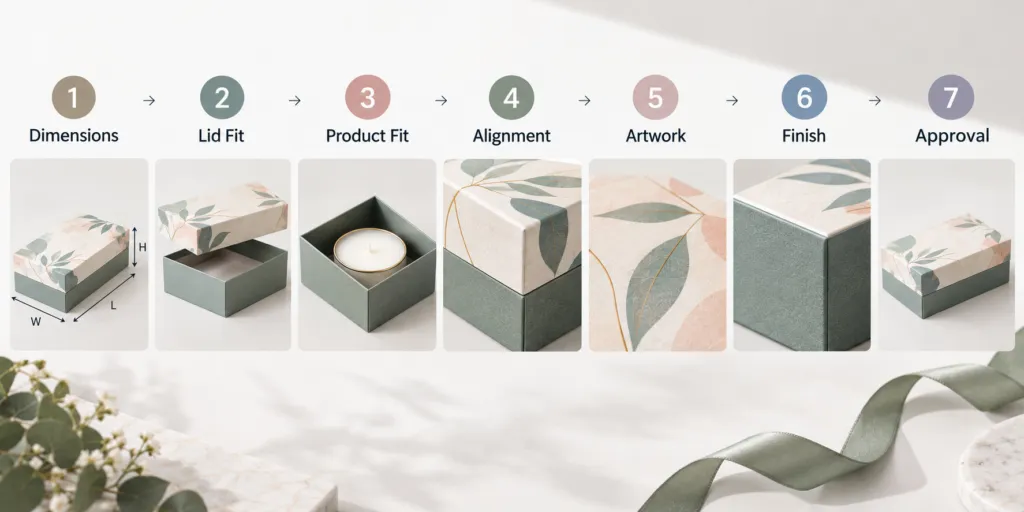
Product size → base dimensions → internal clearance → lid dimensions → lid/base fit → physical sample → approval
If those relationships are correct, the box can provide a stable structure and a controlled opening experience without unnecessary structural complexity.
If you already know that you need a separate lid and base, the next step is much more specific: provide the product dimensions, quantity and artwork, then confirm the structure through sampling before production.
FAQ
What is a two-piece rigid setup box?
A two-piece rigid setup box consists of two separate rigid components: a base and a lid. The lid fits over the base to create the finished package.
How should the lid fit on a two-piece setup box?
The lid should fit securely over the base while still allowing controlled opening and closing. The exact fit depends on the box dimensions, board construction, wrapping materials and intended opening feel.
How much clearance does a two-piece rigid setup box need?
There is no universal clearance value. It depends on the product dimensions, internal materials, box construction and required product fit. A physical sample is the best way to confirm the final clearance.
Can I customize a two-piece setup box with my own artwork?
Yes. The exterior can be customized with printed artwork, logo treatments and finishing options such as foil stamping, embossing or debossing, depending on the selected materials and construction.
Do I need a sample before ordering two-piece rigid setup boxes?
For a custom project, a physical sample is strongly recommended. It allows you to check the lid fit, product clearance, alignment, appearance and opening action before mass production.