
Table of Contents
Custom Setup Boxes: A Practical Buyer’s Guide for 2026
2026-01-19Written by the Esion Package Packaging Development Team
Reviewed by: Structural Design Lead, Esion Package
At Esion Package, our packaging development team works with B2B buyers on custom box projects from structural development and material selection through printing, assembly, quality inspection, and packing. In setup box projects, one of the most common sources of rework is making decisions about artwork and finishing before the product fit and internal structure have been properly confirmed.
A setup box may look correct in a digital file but still require changes once the actual product is placed inside. The lid may need additional clearance, an insert may need to be repositioned, or the finished proportions may need adjustment.
This guide focuses on the practical decisions involved in custom setup boxes: how to prepare a project brief, determine the structure, select materials, review a sample, and confirm the final specification before production.
The process is straightforward:
Product → Structure → Materials → Artwork → Sample → Approval → Production → QC → Packing
By following this sequence, buyers can reduce unnecessary revisions and give a setup box manufacturer the information needed to develop a more accurate quotation and sample.
What Makes Setup Boxes Different?
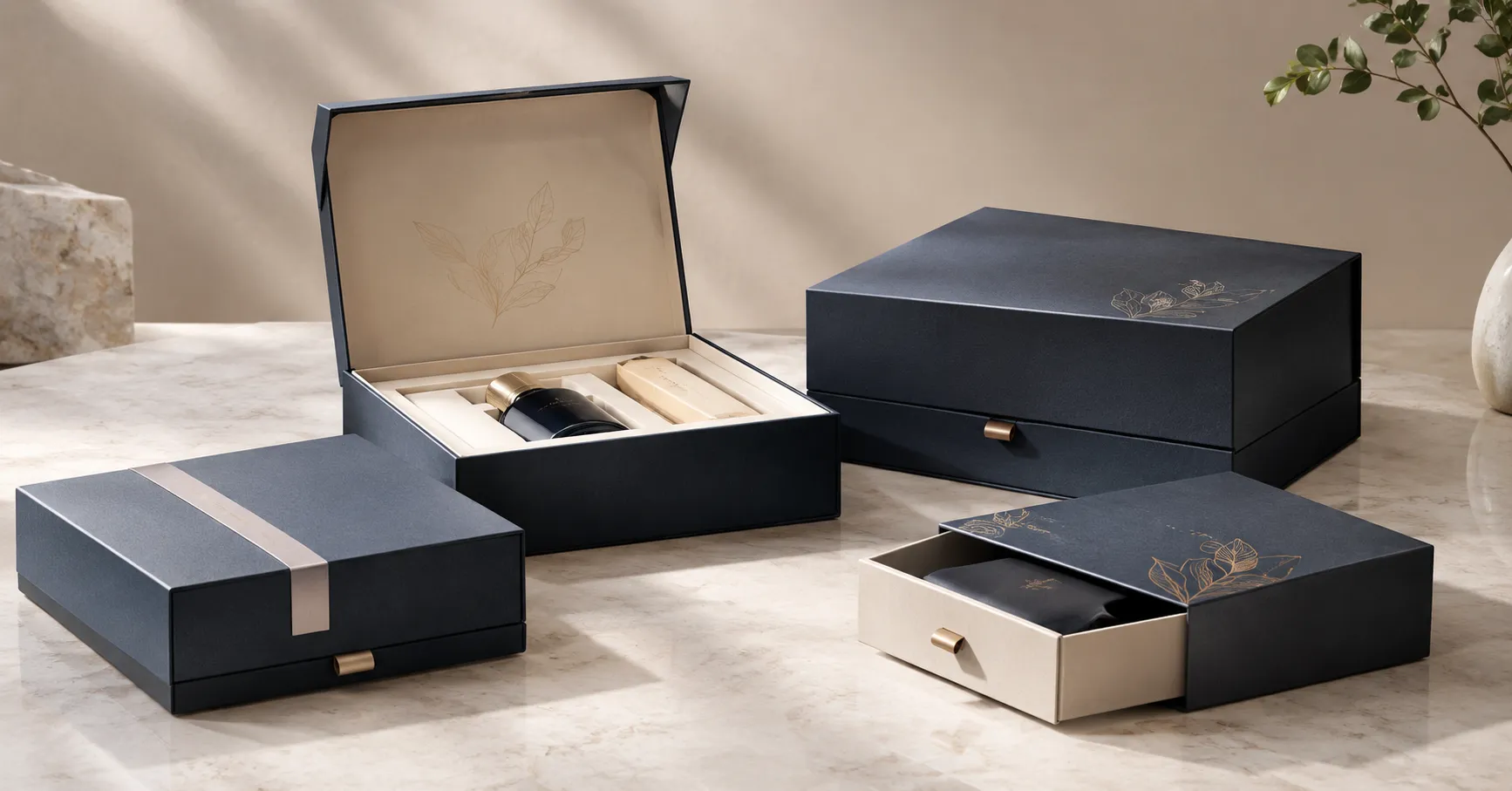
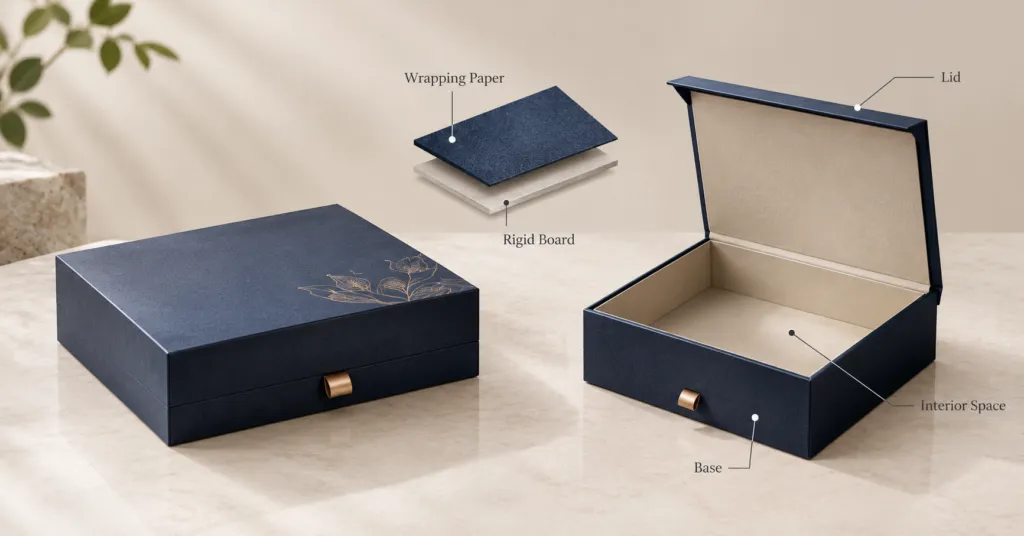
Setup boxes are rigid boxes that are formed and assembled into their finished shape during manufacturing. Their structure is based on rigid board covered with paper or another specified wrapping material, with optional internal components added according to the product.
For a B2B buyer, the important distinction is that a setup box is not simply a printed package. The finished result depends on the relationship between the product, rigid structure, wrapping material, artwork, and assembly.
The structure should start with the product
The most reliable approach is to develop the box around the actual product rather than selecting an approximate box size first.
Product length, width, height, weight, and internal components can all affect the final dimensions.
For example, during setup box development, a product that includes a main item plus a secondary accessory may require a different internal arrangement from a package containing only one item. If the second component is added after the structure has already been finalized, the insert and internal clearance may have to be redesigned.
This is why product information should be available before the final box dimensions are confirmed.
Rigid board and wrapping material have different functions
The rigid board provides the basic shape and structural body of the box. The wrapping material determines much of the visible surface and contributes to the finished appearance.
There is no universal board thickness or wrapping paper specification that works for every setup box. The appropriate combination depends on the dimensions, structure, internal arrangement, and intended appearance.
Material selection should therefore be made together with the structural requirements rather than independently.
How Should You Plan Custom Setup Boxes Before Requesting a Quote?
A clear quotation begins with a clear packaging brief. The manufacturer needs enough information to understand what the box has to do before recommending a final structure or price.
A practical starting sequence is:
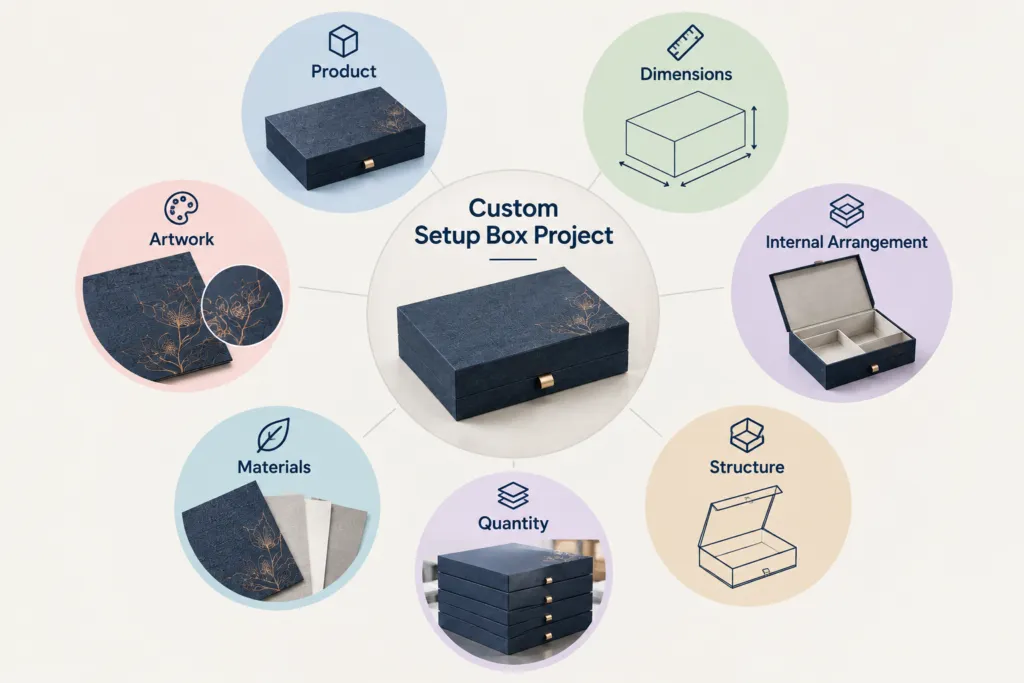
Product → Dimensions → Internal Arrangement → Structure → Materials → Artwork → Quantity
Start with accurate product information
Provide the product’s length, width, height, approximate weight, and the number of components that will be packed together.
If the product is already available, an actual sample or accurate dimensional drawing is more useful than estimating measurements from photographs.
This becomes especially important when the packaging has a close-fitting insert or limited internal clearance.
Define how the product should sit inside
The internal arrangement should be considered before the outside dimensions are finalized.
For example, determine whether the product should:
- Remain in one fixed position
- Sit inside an insert
- Share the box with additional components
- Be presented in a specific orientation
- Be easy to remove after opening
These requirements influence the internal space and, consequently, the finished box dimensions.
Keep the initial brief practical
A buyer does not need a complicated technical document to begin a project. A concise brief covering the product, dimensions, structure, material direction, artwork, and quantity is usually a much better starting point.
If you are unsure about the structure or material, say so. It is more useful to give the manufacturer accurate product information and explain the packaging objective than to specify a structure that has not yet been tested against the product.
Which Setup Box Specifications Should Be Confirmed?
The final specification should separate structural requirements from visual requirements so that both the buyer and manufacturer are working from the same information.
The main areas to confirm are size, structure, materials, artwork, finishing, internal components, quantity, and the approved sample.
Structural requirements
Confirm the finished dimensions, lid and base configuration, internal space, and insert requirements. If you are considering a separate lid-and-base structure, see our guide to two-piece rigid setup boxes for a closer look at fit, clearance, and sample approval.
A small change to the internal arrangement can affect the external proportions of the box, so these decisions should be settled before production.
Material requirements
The main material decisions normally concern the rigid board and wrapping paper.
If a buyer has a specified material requirement, it should be communicated at the quotation stage. Otherwise, the manufacturer can recommend a suitable specification based on the box dimensions and structural requirements.
Sustainability requirements should also be stated early when they form part of the purchasing criteria. For example, FSC explains that its chain-of-custody certification is designed to verify the sourcing, processing, and sale of FSC-certified forest-based products.
This does not mean every setup box needs FSC-certified materials. It means that if FSC certification is a purchasing requirement, the material and supply chain should be discussed before production rather than added at the end.
Printing and finishing requirements
Artwork should be finalized around the confirmed structure.
Depending on the design, a project may include printing, foil stamping, embossing, debossing, lamination, or other surface treatments.
These details should be recorded in the final specification so that the physical sample can be reviewed against the intended result.
For buyers comparing different rigid packaging approaches, the Luxury Rigid Boxes guide provides additional background without changing the focus of this setup box guide.
How Does a Custom Setup Box Project Move From Design to Production?
A setup box project is easier to manage when every stage has a clear decision point. Structural problems should be solved during development rather than after mass production begins.
1. Prepare the packaging brief
Begin with the product dimensions, estimated quantity, desired packaging structure, artwork, and internal requirements.
The purpose is to give the manufacturer enough information to assess the project without relying on assumptions.
2. Confirm the structure
The proposed structure should be considered against the actual product.
At this stage, the priorities are fit, dimensions, construction, internal arrangement, and material direction.
3. Develop the sample
The physical sample is where the digital concept becomes a real packaging system.
Whenever possible, the actual product should be placed inside the sample. This makes it possible to evaluate the fit, clearance, insert position, opening experience, and overall proportions.
4. Review and revise
If the product does not sit correctly, the insert needs adjustment, or the appearance does not match the intended design, the changes should be made before approval.
This is where practical packaging experience becomes important. A digital drawing can show dimensions, but a physical sample reveals how those dimensions behave when the product, board, paper, adhesive, and assembly are combined.
5. Approve the final specification
Once the sample and specifications are accepted, the approved version becomes the production reference.
Any change made after approval should be clearly confirmed before production continues.
6. Production, QC, and packing
After approval, the project moves into production, followed by quality inspection and packing before shipment.
For buyers who use formal acceptance-sampling procedures, the relevant inspection method should be agreed in advance. ISO 2859-1:2026 is the current edition of the international standard covering sampling schemes indexed by acceptance quality limit for lot-by-lot inspection.
The standard should not simply be assumed to apply to every project. If a buyer requires a particular inspection or AQL system, that requirement should be discussed and confirmed before production.
How Should You Evaluate a Setup Box Sample?
A sample should be evaluated as a complete packaging solution rather than judged only by its appearance. The most useful review combines the actual product, physical structure, and approved artwork.
Check the product fit first
Place the actual product inside the sample and confirm that it sits in the intended position.
If an insert is used, check whether it holds the product securely without making removal unnecessarily difficult.
Also check the relationship between the product, insert, lid, and base. A visually attractive exterior does not compensate for an unsuitable internal arrangement.
Check the physical construction
Review the finished sample for:
- Overall dimensions
- Lid and base alignment
- Corners and edges
- Wrapping consistency
- Assembly
- Internal arrangement
The purpose is not to create a complicated inspection system. It is to identify issues while the project can still be changed easily.
Check the printed and finished appearance
Compare the physical sample with the approved artwork.
Look at the logo position, print alignment, surface appearance, and finishing placement.
A useful sample review should answer three questions:
Does the product fit?
Does the structure work?
Does the finished appearance match the approved design?
For projects requiring a more detailed inspection procedure, a dedicated Setup Box Sample & QC Checklist is better handled as a separate resource rather than expanding this buyer’s guide into a full quality-control manual.
What Should You Confirm Before Production?
Before production begins, the buyer and manufacturer should have the same understanding of the final specification. A short pre-production review can prevent small misunderstandings from becoming production problems.
Pre-production confirmation
| Area | What to confirm |
|---|---|
| Size | Finished dimensions and measurement method |
| Structure | Lid, base, internal arrangement, and insert |
| Material | Rigid board and wrapping material |
| Artwork | Final artwork and logo position |
| Finishing | Confirmed surface and decorative treatments |
| Quantity | Final order quantity |
| Sample | Approved physical reference |
| Production | Confirmed production schedule |
The approved sample is particularly important because it gives the production team a physical reference alongside the written specification.
The objective is simple: everyone involved should be working from the same final version.
How Can Esion Package Support a Custom Setup Box Project?
For B2B buyers, the difficult part is often not finding a company that can manufacture a box. It is keeping product requirements, structural decisions, artwork, sampling, production, and quality expectations aligned throughout the project.
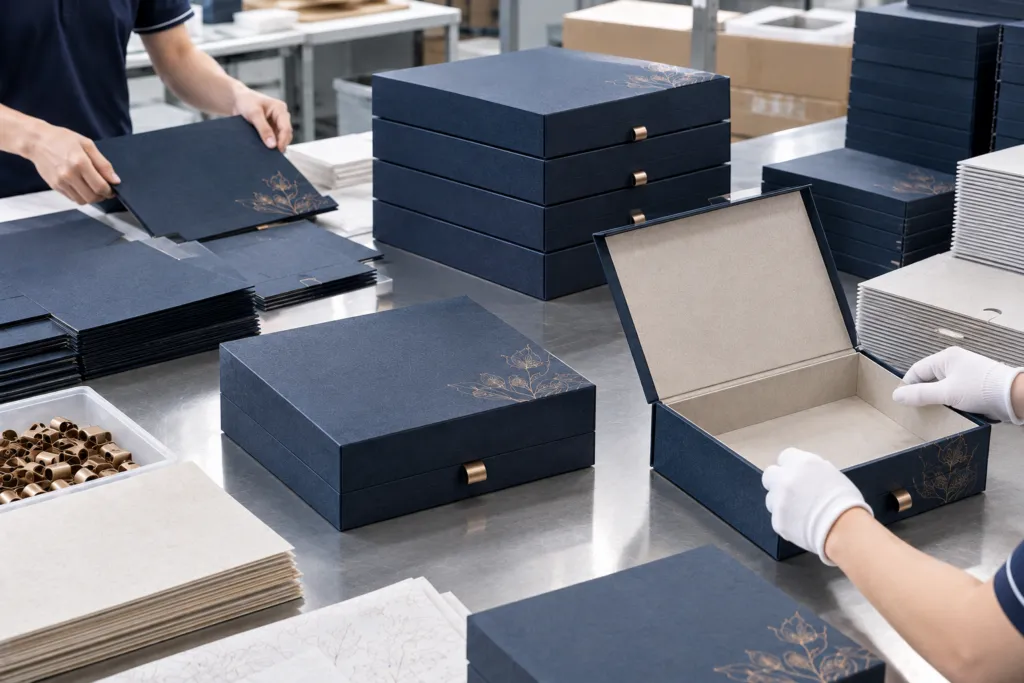
Esion Package can support setup box projects from material selection and structural development through printing, assembly, quality inspection, and packing.
A common practical situation is a buyer who already has the product dimensions and brand artwork but is uncertain about the internal arrangement. In that case, resolving the structure during development and sampling is more efficient than trying to correct the packaging after production has started.
As of September 2026, Esion Package’s standard MOQ is 1,000 pieces, with production approximately 15 days depending on the project specifications and approval status. These details should be reconfirmed when the quotation is prepared.
How Can You Start a Setup Box Project?
The most efficient starting point is to define the product first and let the packaging decisions follow from the actual requirements.
Begin with the product dimensions and quantity. Then determine how the product should be positioned, what structure is required, and whether an insert is necessary.
After that, provide the artwork and material preferences, develop the sample, review the actual product inside the box, and approve the final specification.
The complete sequence is:
Product → Structure → Materials → Artwork → Sample → Approval → Production → QC → Packing
Conclusion
A successful custom setup box project is not simply a matter of selecting a rigid box and adding a logo.
The better approach is to work from the product outward: establish the dimensions, determine the internal arrangement, select the appropriate structure and materials, prepare the artwork, and verify the result through a physical sample before production.
For B2B buyers, this process makes quotations clearer, reduces unnecessary revisions, and gives both sides a defined reference for production.
If you already have the product dimensions, artwork, estimated quantity, and packaging requirements, you can Request a Setup Box Quote and provide those details as the starting point for the project.
FAQ
What are setup boxes?
Setup boxes are rigid boxes that are formed and assembled into their finished shape during manufacturing. They are commonly made from rigid board covered with paper.
Can setup boxes be customized to specific dimensions?
Yes. Custom setup boxes can be developed around the product dimensions, internal arrangement, materials, artwork, and finishing requirements.
What information is needed for a setup box quotation?
The most useful starting information includes product dimensions, quantity, desired packaging structure, artwork, material preferences, and any insert requirements.
Should I test the actual product inside a setup box sample?
Yes. Using the actual product during sample review makes it easier to confirm internal fit, positioning, clearance, and overall presentation.
What should I check before approving a setup box sample?
Check the product fit, finished dimensions, lid and base alignment, corners, wrapping, printing, finishing, insert position, and overall appearance against the approved requirements.