
Table of Contents

Collapsible Rigid Box Structure: How to Choose, Test and Use It
21. 9 月, 2026Author: Esion Package Editorial Team
Technical Review: Esion Package Production & Quality Team
Last updated: September 21, 2026
A rigid gift box needs to feel solid and premium, but shipping fully assembled boxes can take up considerable space. A collapsible rigid box is designed to solve that particular problem: it keeps a rigid presentation while allowing the structure to fold down for transportation and storage.
At Esion Package, we approach this type of packaging from the structure first. The important questions are not simply whether a box can fold, but whether it can form accurately, hold its shape, fit the product and return to the folded state without damaging the folding areas.
Quick answer: A collapsible rigid box is worth considering when flat shipping and storage efficiency matter, while a rigid presentation is still required. If the box must arrive fully formed and ready to pack, a setup rigid box may be the better choice.
What Is a Collapsible Rigid Box?
A collapsible rigid box is a rigid box designed to fold down along defined folding or hinge areas and return to its intended three-dimensional shape when formed.
The terms collapsible rigid box, foldable rigid box and fold-flat rigid box can describe closely related structures. The exact construction can vary, so the structure itself matters more than the terminology.
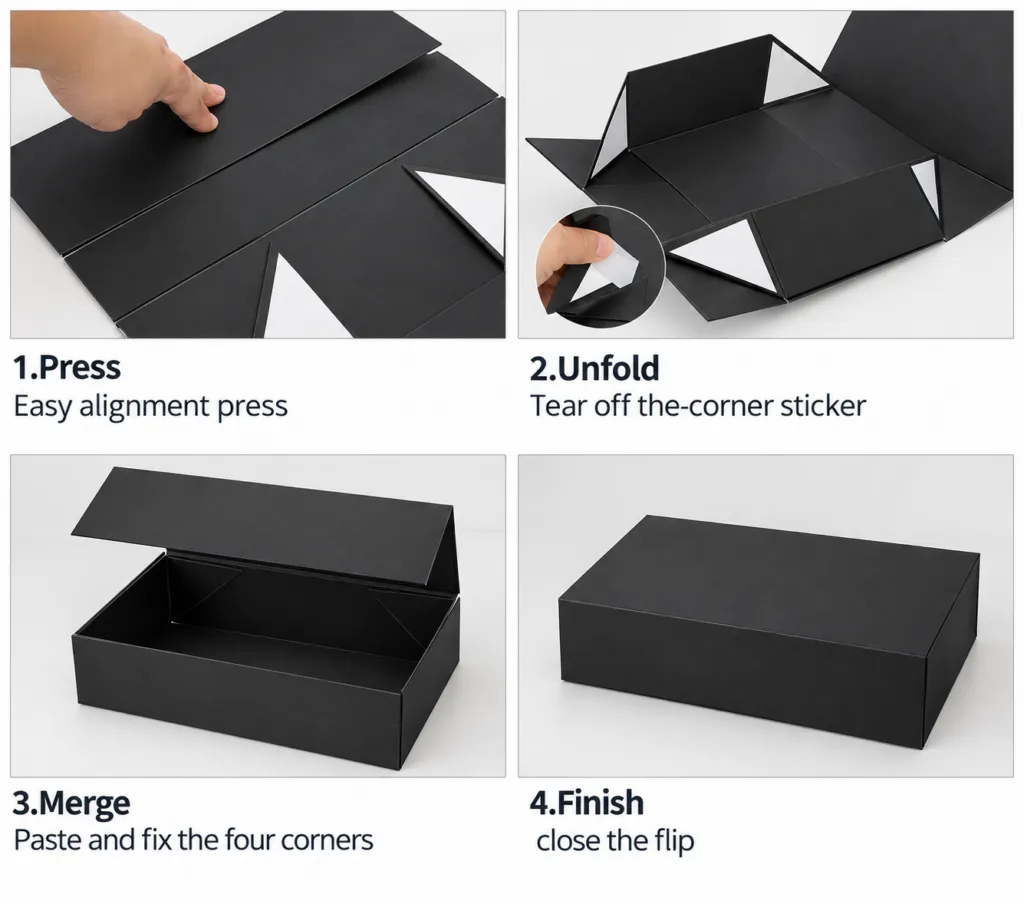 Unlike a conventional setup rigid box, which normally arrives already formed, a collapsible rigid box is designed around two practical states:
Flat → Formed
The box must therefore be designed for both transportation and final presentation rather than optimized for only one of them.
Collapsible Rigid Box vs Setup Rigid Box vs Folding Carton
These three packaging formats solve different problems. The most useful comparison is rigidity, shipping condition, forming requirements and final presentation.
| Factor | Collapsible Rigid Box | Setup Rigid Box | Folding Carton |
|---|---|---|---|
| Construction | Rigid panels with folding/hinge areas | Pre-formed rigid structure | Folding paperboard structure |
| Shipping state | Flat | Formed | Flat |
| Forming before packing | Required | Usually not required | Required (erected before packing) |
| Finished rigidity | High, with folding areas as potential weak points | Generally highest | Lower |
| Storage efficiency | High | Lower | High |
| Premium presentation | High | High | Depends on board and design |
| Typical use | Premium packaging where flat shipping matters | Ready-to-use rigid presentation | Lightweight retail packaging |
A collapsible rigid box is not simply a thinner rigid box. Its advantage comes from combining rigid panels with controlled folding areas so that the package can move between flat and formed states.
For brands that need a fully formed rigid presentation rather than a collapsible construction, see our Custom Rigid Gift Boxes options.
When is a collapsible rigid box the better choice?
A collapsible structure makes more sense when:
- shipping and storage volume are important;
- the box will be formed before packing;
- the brand still wants a rigid, premium presentation;
- the product does not create unusually concentrated loads;
- the forming process can be controlled consistently.
A setup rigid box is generally more suitable when the package needs to arrive fully formed and ready for immediate packing or display.
How Does a Collapsible Rigid Box Actually Fold?
The folding mechanism is built around rigid panels connected by defined flexible or hinged areas. The rigid panels provide the final box geometry, while the folding areas allow the structure to collapse.
The exact construction depends on the approved design, but the forming sequence normally follows:
Flat → Raise Panels → Square the Box → Secure the Form → Fit Product → Close
What happens to the panels?
The base panel establishes the footprint of the box. Side panels are raised along their intended folding areas until the corners reach their designed positions.
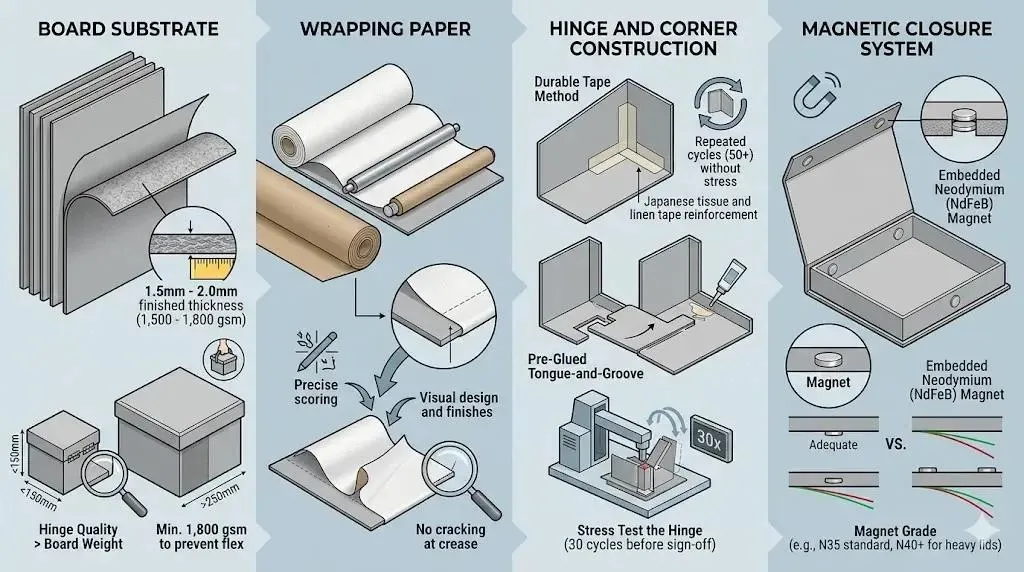
The folding areas need to allow controlled movement without creating unwanted gaps, wrinkles, surface cracking or distortion in the wrapped paper.
Once the panels reach the correct position, the designed connection areas hold the formed geometry.
How is the formed structure held?
This depends on the specific construction.
Some collapsible rigid boxes use fixed connection areas created during manufacturing, while the intended folding or hinge areas remain flexible enough for the structure to collapse and reform.
The closure performs a different job. A magnetic closure, ribbon or other closing element can keep the finished package closed, but it should not be treated as the component that creates the basic box geometry.
For closure-specific information, see our Magnetic Gift Box Guide.
What Should You Check During Sampling?
A collapsible rigid box sample should prove more than appearance. The key question is whether the structure can form accurately, hold its shape and collapse and reform without developing visible problems.
Check the folding areas
Look for:
- cracking or whitening on the wrapped paper;
- visible wrinkles;
- uneven folding;
- excessive resistance during forming;
- movement outside the intended folding area.
Check the corners and formed shape
After forming the box, check whether the corners remain square and whether opposite sides sit consistently.
A box that looks acceptable during the first forming can still reveal alignment problems when it is collapsed and formed again.
Check product fit and closure
The product should sit correctly without forcing the side panels outward.
The lid or closure should operate naturally. If the lid only closes after one side is pushed into position, the problem may be structural alignment rather than the closure itself.

Why Does Repeated Forming Matter?
A first successful forming check does not prove that a collapsible package will behave consistently after repeated handling.
The package is designed to move between flat and formed states, so sampling should also examine what happens when the structure is collapsed and formed again.
A practical check is:
- Form the box.
- Check the folding areas and corners.
- Check the surface condition.
- Fit the intended product or representative load.
- Close the package.
- Collapse the structure along its intended folding areas.
- Form it again.
- Recheck alignment, surface condition and closure.
The number of cycles should be agreed according to the intended use rather than presented as one universal industry requirement. Packaging that is formed once before final packing has different requirements from packaging that will be repeatedly opened, stored and re-formed.
What warning signs should you look for?
| Symptom | Possible cause | What to inspect |
|---|---|---|
| Corner position changes after reforming | Folding alignment issue | Folding line and connection area |
| Surface cracks at the fold | Material or wrapping stress | Paper direction and folding area |
| Lid sits unevenly | Box geometry is inconsistent | Opposite corners and side panels |
| Box is difficult to collapse | Folding area is too restrictive | Hinge or folding construction |
| Product pushes the walls outward | Internal fit is too tight | Product dimensions and insert arrangement |
This combined check is more useful than approving the box only from a single fully formed sample.
Surface cracks at the fold — see our guide to collapsible rigid box cracking and wrinkling for causes and prevention.
Who Should Form the Box Before Packing?
The answer depends on the customer’s packing operation.
If the buyer has a packing team and the box is designed to be formed during packing, shipping the boxes flat can provide a meaningful logistics advantage.
If the supplier forms every box before shipment, the boxes occupy considerably more space during transportation and the main flat-shipping advantage is reduced.
This should be decided before production because it affects packing labor, warehouse space, outer-carton planning and shipping efficiency.
The production sample should also represent the same forming method that will be used during actual packing.
How Do Cost and MOQ Affect the Decision?
A collapsible rigid box is not automatically cheaper than a setup rigid box. The quotation depends on the construction, materials, finishing, assembly requirements and order quantity.
The main cost factors include:
- folding-area complexity;
- board construction;
- wrapping and finishing;
- connection method;
- sample development;
- forming requirements;
- packing configuration.
As of September 2026, Esion Package’s general MOQ is 1,000 pieces. The final quotation and production timing should be confirmed for the specific structure, dimensions and order.
For a project requiring a different construction or forming method, it is better to confirm the quotation from the actual sample or structural drawing than to apply a generic price.
Why Can Flat Shipping Matter?
The strongest commercial reason to consider a collapsible rigid box is often space efficiency before packing.
When boxes are shipped flat, they can occupy significantly less volume than fully formed rigid boxes. The actual improvement depends on the box dimensions, folding depth, outer carton and packing method, so a supplier should calculate it from the approved structure rather than promise a universal percentage.
For a brand ordering thousands of rigid gift boxes, reducing the volume before the packing stage can affect:
- warehouse space;
- outer-carton requirements;
- freight planning;
- receiving and handling.
If the supplier ships the boxes fully formed, this particular advantage is largely lost.
When Should You Not Choose a Collapsible Rigid Box?
A collapsible rigid box is not the right solution for every packaging project.
A setup rigid box may be better when the packaging must arrive fully formed and ready for immediate use. A folding carton may be more suitable when the project prioritizes lightweight construction and high-volume folding-carton production rather than rigid presentation.
A collapsible structure may also be unsuitable when the product creates unusually concentrated or heavy loads at specific points of the box. In that situation, the structure needs to be evaluated against the actual product weight and load distribution.
The decision should therefore balance four factors:
Presentation → Forming → Logistics → Product Load
What Should EU Buyers Consider in 2026?
For EU-bound packaging, material and construction choices should also be reviewed in the context of the Packaging and Packaging Waste Regulation (PPWR).
Regulation (EU) 2025/40 entered into force on February 11, 2025 and generally applies from August 12, 2026, with some requirements phasing in later.
Source: Regulation (EU) 2025/40 on EUR-Lex
For collapsible rigid boxes, this can become relevant when the structure combines paper-based materials with other components such as magnets, adhesives or mixed-material elements.
The regulation should not be interpreted as a blanket approval or rejection of collapsible rigid boxes. Specific requirements depend on the final packaging construction, market and applicable compliance provisions.
How Can a Supplier Make the Project Easier?
A useful supplier should help identify structural problems before mass production rather than only produce the final boxes.
At Esion Package, we can review the proposed dimensions, structure, artwork and finishing requirements together so that the folding areas are considered alongside the finished appearance.
Our production process includes paper cutting, printing, laminating, die cutting, gluing, handmade assembly and quality inspection. Coordinating these stages can help reduce unnecessary communication between separate packaging suppliers.
For a new collapsible rigid box, it is useful to provide:
- product dimensions;
- approximate product weight;
- target box dimensions;
- reference packaging;
- artwork or logo;
- preferred opening style;
- expected packing method;
- target market.
You do not necessarily need a finished structural drawing to start the discussion. Photos, dimensions and an existing reference package can also provide a useful starting point.
For more information about Esion Package, see About Esion Package.
What Is the Best Way to Approve a Collapsible Rigid Box?
Do not approve the sample only because it looks good when fully formed.
Before production, confirm that the box can:
Fold → Form → Align → Fit → Close → Collapse → Reform
The key checks are the folding areas, corner alignment, surface condition, product fit and closure operation.
If the structure performs consistently and the flat-shipping advantage is meaningful for your packing operation, a collapsible rigid box can provide a useful balance between premium rigid presentation and transportation efficiency.
If you are developing one, send the product dimensions, weight, target box size and reference packaging to Contact Esion Package. These details provide a practical starting point for evaluating the structure before sampling.
FAQ
Are collapsible rigid boxes shipped flat?
Yes. Their main advantage is that they can be collapsed for transportation and storage, then formed before packing. If the supplier ships them fully formed, much of that logistics advantage is reduced.
Are collapsible rigid boxes as rigid as setup boxes?
Generally, setup boxes provide the strongest fully formed rigid structure. A collapsible rigid box can still provide a premium rigid presentation, but its folding areas are naturally more structurally sensitive.
Does a collapsible rigid box need to be formed before packing?
Yes, when it is shipped flat. The box needs to be formed and squared before the product is packed.
How many times can a collapsible rigid box be folded?
There is no single cycle number for every design. The required repeated-forming performance should be agreed according to how the packaging will be handled and checked during sampling.
Can collapsible rigid boxes use magnetic closures?
Yes. A magnetic closure can be incorporated into a collapsible rigid box, but the folding structure and closure have different functions. The structure establishes the box geometry, while the closure keeps the finished package closed.
Is a collapsible rigid box cheaper than a setup rigid box?
Not necessarily. The quotation depends on the folding construction, materials, finishing, assembly and order quantity. The main potential commercial benefit often comes from reduced transportation and storage volume rather than lower manufacturing cost.