
Table of Contents

Collapsible Rigid Box Cracking and Wrinkling: Causes and Prevention
21. 9 月, 2026Last updated: September 21, 2026
Written by: Esion Package Editorial Team
A collapsible rigid box can look premium when it is formed correctly, but the folding areas can become the most sensitive parts of the finished package. Cracks, white marks, wrinkles, lifted edges, or damaged printed surfaces may appear when the fold design, paper, coating, artwork, or finishing process is not properly matched.
Quick answer: Most fold-line defects come from the interaction between folding geometry and the material or surface treatment. The best opportunity to prevent them is during structural development and sampling, before final artwork and finishing are approved.
A collapsible rigid box may also be described as a foldable rigid box or fold-flat rigid box. These terms generally refer to related packaging constructions, while this article focuses specifically on surface problems around folding areas.
What Fold-Line Problems Can Appear?
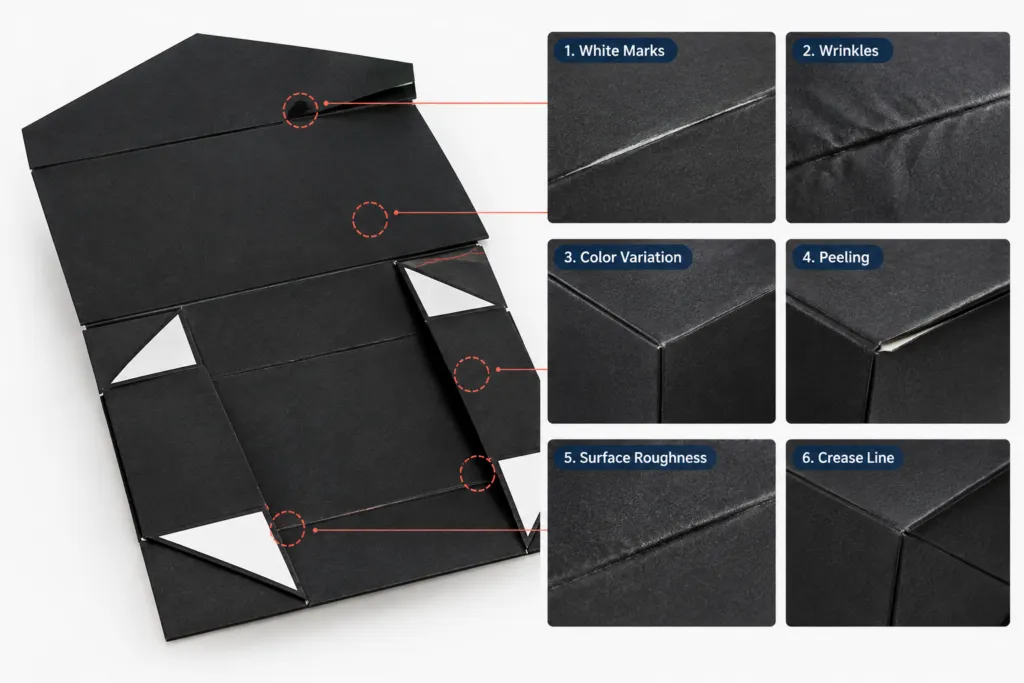
The most common visible problems include:
| Defect | What it may look like | What to check |
|---|---|---|
| Cracking | Paper or printed surface splits along the fold | Paper, fold geometry and surface treatment |
| White marks | A light line appears on a dark or solid-color surface | Paper surface, coating and folding stress |
| Wrinkling | Small waves or creases develop beside the fold | Material movement, fold transition and bonding |
| Lifted edges | Wrapped paper separates or lifts near an edge | Adhesive coverage and edge construction |
| Finishing damage | Foil, embossing or graphics become distorted | Finishing position and distance from the fold |
Why Do Collapsible Rigid Boxes Crack or Wrinkle?
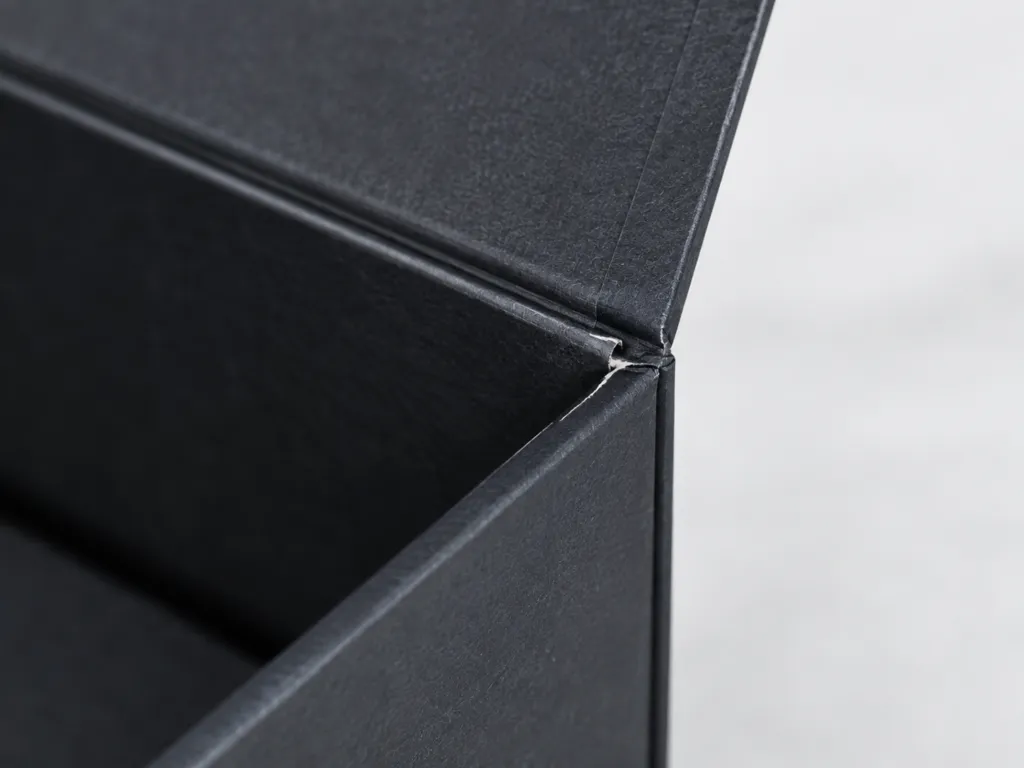
1. Fold geometry concentrates stress
A folding area behaves differently from a flat panel. When the box is formed, several layers of paper and board have to accommodate movement around a relatively narrow transition.
If the geometry creates too much localized stress, the surface may show cracking, wrinkles or other visible deformation.
This is why the folding area should be considered together with the surrounding panel construction rather than treated as an isolated line.
2. Paper grain direction can affect the fold
Paper does not behave identically in every direction. The relationship between paper grain and the folding direction can influence how the surface responds to forming.
For a custom project, grain direction should therefore be considered during structural development and verified on the intended material rather than assumed from a generic rule.
3. Paper and coating affect surface performance
The outer paper and surface treatment influence how a fold looks after forming.
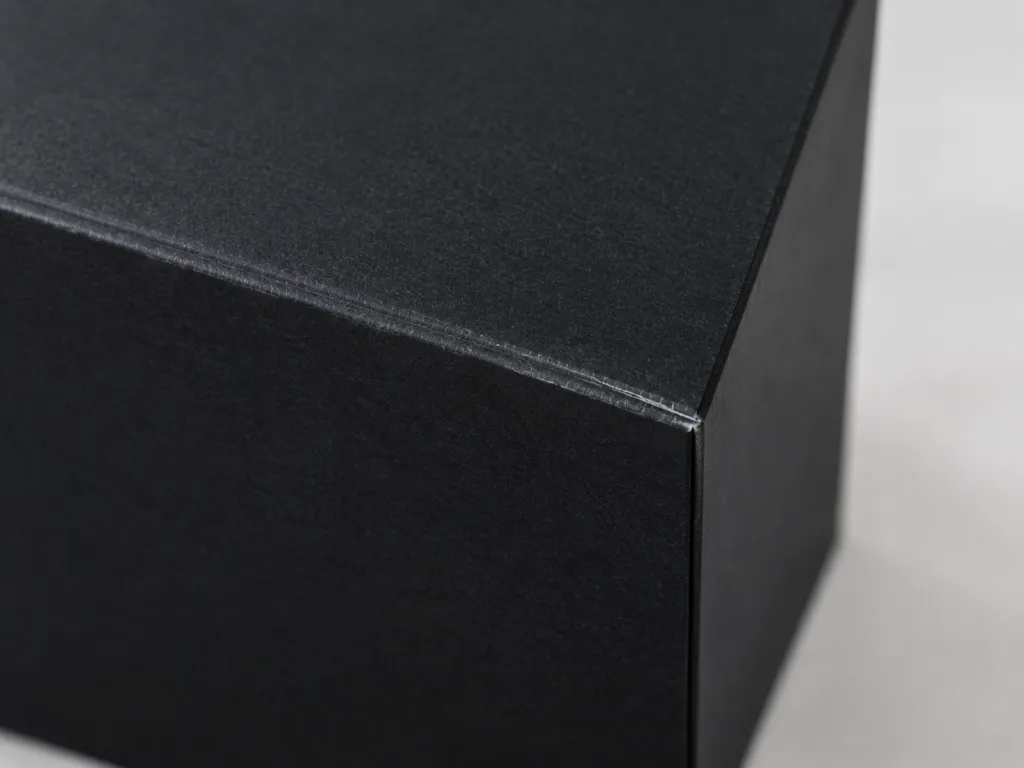
A surface can appear smooth on a flat sheet but show a visible mark once the package is folded. Dark colors and large solid printed areas can make these changes particularly noticeable.
4. Artwork can make small defects more visible
A small change at a fold may be difficult to notice on an unprinted surface but much more obvious when the fold passes through:
- a dark solid color;
- a large printed area;
- a fine graphic;
- a logo; or
- a high-contrast background.
The issue is therefore not always a structural failure. Sometimes the same physical fold simply becomes more visually obvious because of the artwork.
How Can Fold-Line Problems Be Prevented?
Keep important artwork on stable panels
When possible, important logos, product names and key graphics should be positioned on stable panels rather than directly across major folding areas.
This is particularly useful for dark printed surfaces, where white marks or slight surface changes can be more visible.
Match the material and surface treatment to the fold
Paper and coating should be considered together with the actual folding construction.
If a premium surface treatment is required, the folding area should be reviewed during sampling so that the final surface appearance can be evaluated under the intended construction.
Position foiling and embossing carefully
Foiling and embossing can create a strong premium appearance, but their location matters when they are close to a folding area.
Where possible, keep important decorative elements away from the main fold. If a design requires foil, embossing or another finishing treatment near the fold, the position should be confirmed during sampling.
Review adhesive and edge construction
Wrinkles or lifted edges can also be related to bonding and wrapping.
The adhesive coverage, bonding area and edge construction should be checked as part of the sample review, particularly where several material layers meet around a folding transition.
How Should the Surface Be Checked During Sampling?
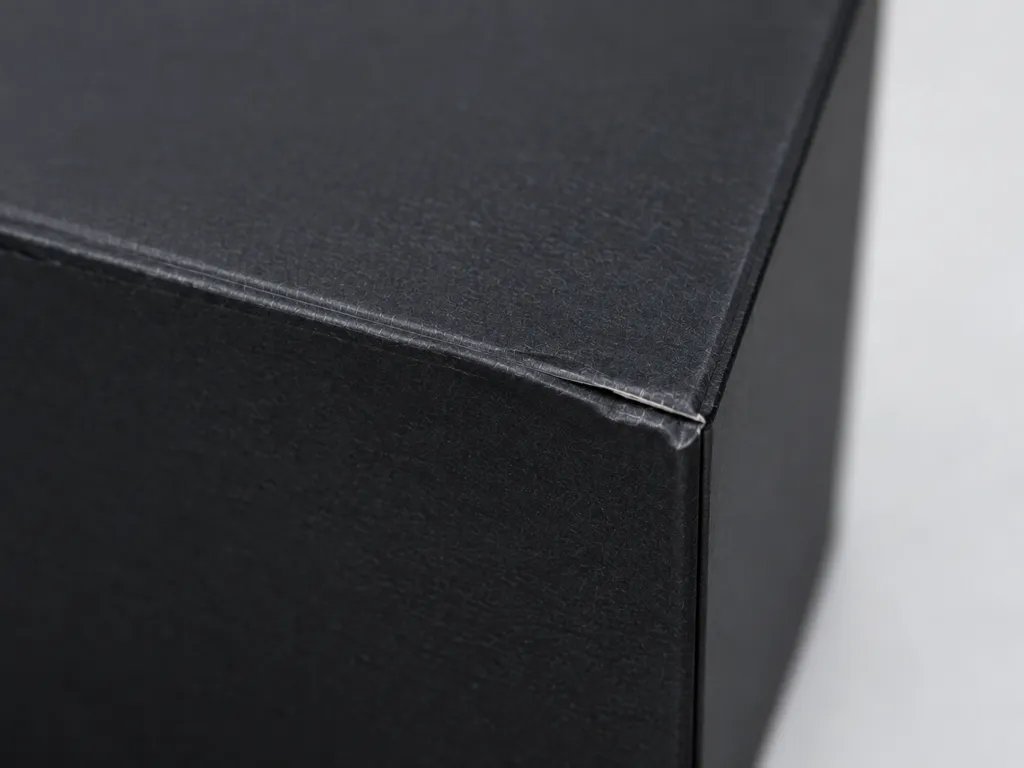
A useful surface review should focus on the areas most likely to show defects:
| Check area | What to look for |
|---|---|
| Fold line | Cracks, white marks or coating damage |
| Adjacent surface | Wrinkles, waves or distortion |
| Wrapped edge | Lifting or incomplete bonding |
| Artwork | Distortion or visible damage |
| Finishing | Foil or embossing affected by the fold |
The surface should be checked on the formed package rather than judged only from a flat material sample.
For projects where repeated collapse and forming, structural design, shipping condition or overall box testing are the main concerns, see our guide to collapsible rigid box structure and testing.
When Should You Change the Structure Instead of the Material?
Changing the material is not always the best solution.
If the same location repeatedly develops a visible surface defect, first review how the fold interacts with the surrounding panel and artwork.
A structural adjustment may be worth considering when:
- an important graphic must cross a major folding area;
- foil or embossing is required close to the fold;
- the fold creates excessive visual stress on the wrapped surface;
- there is too little stable panel area for important artwork.
The objective is to create a better relationship between structure, artwork, material and finishing, rather than simply choosing a heavier or different paper.
A Practical Development Sequence
For a custom collapsible rigid box, the development sequence can be kept simple:
Structure → Artwork → Material → Finish → Sample → Form → Inspect → Adjust
This order helps identify potential conflicts between the folding areas and the visual elements before production approval.
What Information Helps Us Review a Fold-Line Problem?
If you want Esion to review a folding-area issue, provide:
- finished box dimensions;
- product weight and approximate contents;
- artwork showing important graphics or logos;
- required surface finishes and their positions;
- whether the package needs to be collapsed again after forming;
- reference packaging or photographs of the current problem.
If your project requires a different rigid-box construction, you can also review Custom Rigid Gift Boxes.
For project enquiries, contact Esion Package with your dimensions, artwork, material requirements and finishing details. You can also learn more about our packaging production process.
FAQ
Can a dark printed collapsible rigid box show white marks at the fold?
Yes. Dark or solid-color surfaces can make small changes around a fold much easier to see. Check the fold geometry, paper and surface treatment together.
Can I put a logo or foil across a folding area?
Yes, but it is better to place important logos or foil on a stable panel and avoid major fold lines where possible. If the design must cross a fold, confirm the result during sampling.
Is cracking always caused by the paper?
No. Cracking can result from the interaction between paper, coating, fold geometry, grain direction, artwork coverage and the forming process.
What should I check first if a fold shows white marks?
Check the fold geometry, paper surface and coating first, then review the artwork and finishing position. Dark printed areas can make relatively small fold marks much more visible.
Can Esion review my folding-area design?
Yes. Our team can review the supplied dimensions, artwork, materials and finishing requirements and identify areas that should receive particular attention during sampling.