
Table of Contents
Custom Hinged Gift Box Guide: Structure, Opening and Production
23. 9 月, 2026We work with brands on custom paper and rigid packaging, from structural development and sampling to production and quality inspection. When developing a custom hinged gift box, the most important decisions often happen before printing or finishing: the box needs to fit the product, open correctly and maintain its appearance through production.
This guide explains how a hinged gift box fits within the rigid box family, how its opening structure works, what information to prepare for customization, and what to check before approving production.
By the end, you should have a clearer specification for your project and know what to discuss with a packaging manufacturer before requesting a quotation.
Where Does a Hinged Gift Box Fit in the Rigid Box Family?
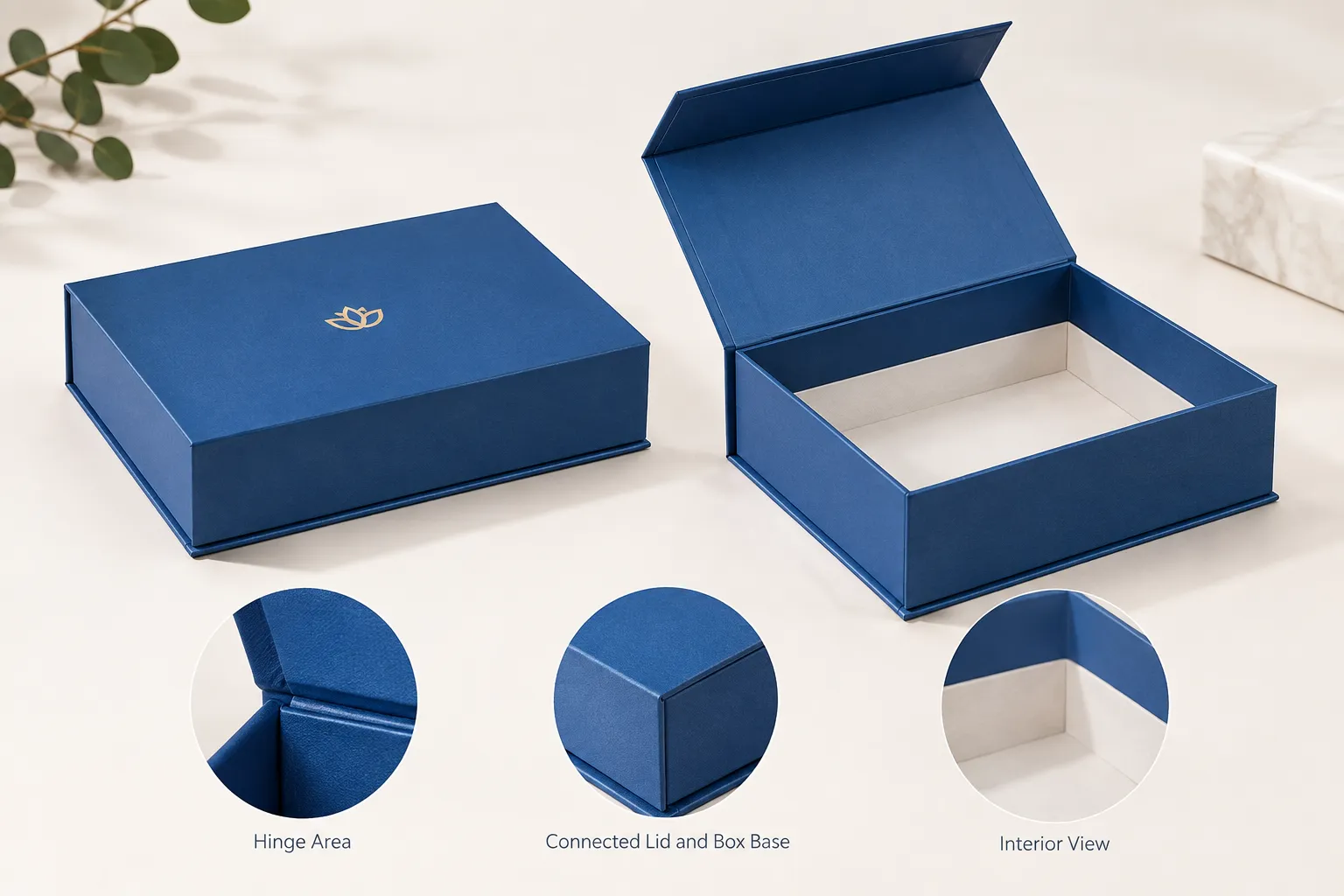
A hinged gift box is a rigid packaging structure with a connected lid and base. The hinge controls how the lid opens and closes while keeping it attached to the box.
For buyers, the important point is that the hinge is part of the box’s functional structure. It affects product access, presentation and repeated use.
The hinge defines the opening structure
A typical hinged gift box includes:
- a rigid box base;
- a connected lid;
- a hinge area between the lid and base;
- an exterior paper wrap;
- an internal space for the product.
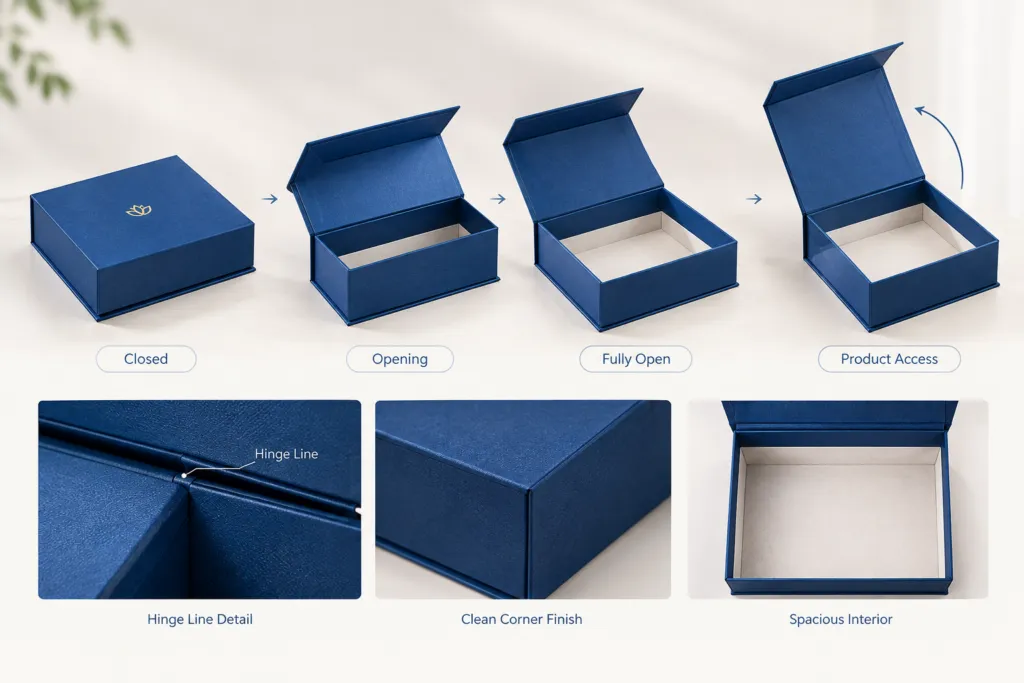
When opened, the lid follows a defined movement rather than being completely removed from the box.
This can create a more controlled opening experience, particularly when the product needs to remain visible while the package is being opened.
How are hinged, magnetic and collapsible structures different?
These terms describe different parts of a packaging design.
A hinged structure describes how the lid connects to and moves around the box.
A magnetic structure describes a closure method that helps keep the box closed. A magnetic closure can be combined with a hinged structure rather than replacing it. For more information, see the Magnetic Gift Boxes guide.
A collapsible rigid box focuses on reducing the assembled volume of the box by allowing parts of the structure to fold. For a closer look at this structure, see the Collapsible Rigid Box guide.
They therefore address different packaging needs: a hinged box controls how the lid opens, while a collapsible box focuses on reducing the box’s assembled volume for storage or shipping.
The Opening Movement Is the Core Design Consideration
For a hinged gift box, the opening movement should be considered before decorative details. The lid needs to move smoothly, provide enough access to the product and return to the correct position when closed.
How does the lid move?
The basic sequence is:
Closed → Opening → Product access → Closing
Each stage affects how the finished package feels in use.
A lid that is difficult to open, provides limited product access or does not align correctly when closed can make an otherwise attractive box feel poorly developed.
This is why structural development should begin with the intended use of the box rather than the artwork alone.
Why does the opening angle matter?
The required opening movement depends on the product and how it needs to be presented.
A small jewelry product may need enough opening movement for the item to be clearly visible. A larger gift set may require wider access so that several products can be viewed and removed comfortably.
The correct opening movement should therefore be determined by the actual product and internal arrangement rather than by appearance alone.
During production, the hinge area, lid proportion and board construction can all affect how the finished box opens. These details should be checked on the physical sample before mass production.
How Is a Hinged Gift Box Different From a Removable-Lid Rigid Box?
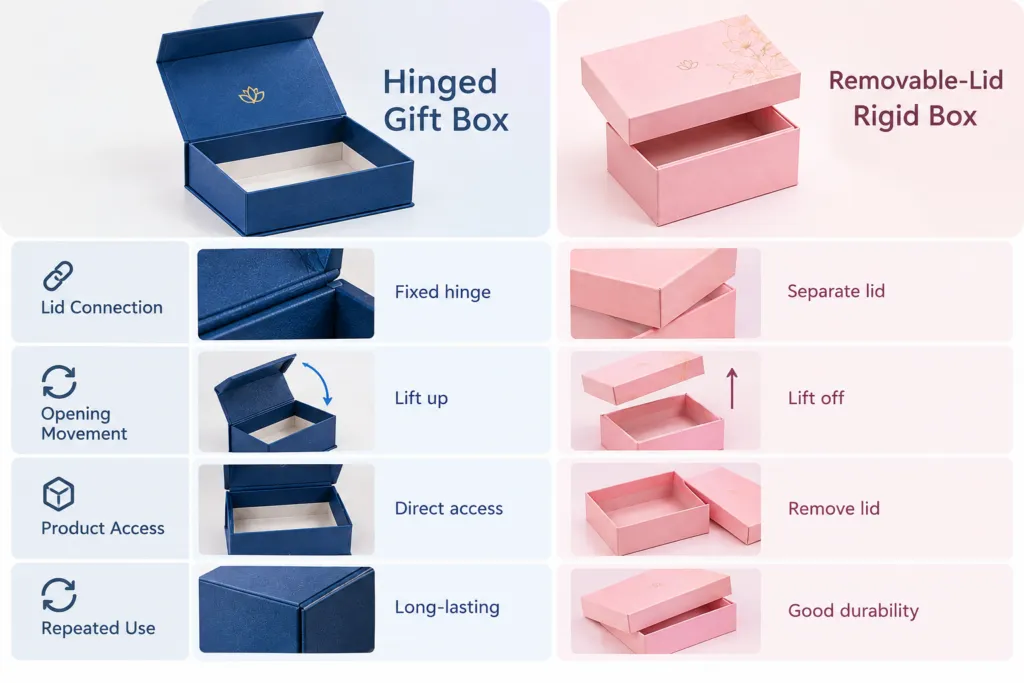
The main difference is simple: a hinged lid remains connected to the base, while a removable lid comes completely away from it.
| Consideration | Hinged Gift Box | Removable-Lid Rigid Box |
|---|---|---|
| Lid connection | Remains attached | Separates from base |
| Opening movement | Controlled by hinge | Lid is lifted away |
| Product access | Follows a defined opening path | Lid is removed completely |
| Repeated use | Lid remains with the box | Separate lid needs to be handled |
A hinged structure is useful when keeping the lid attached improves the opening and presentation experience.
A removable-lid structure may be more suitable when the buyer needs complete access to the product without the lid remaining connected to the base.
When Does a Custom Hinged Gift Box Make Sense?
A custom hinged gift box is particularly useful when controlled opening, product presentation and repeated access are important.
Jewelry and small premium products
For jewelry and other small premium products, the opening sequence can become part of the presentation.
The internal space needs to hold the product securely while giving the lid enough movement to provide clear visibility.
Cosmetics and gift sets
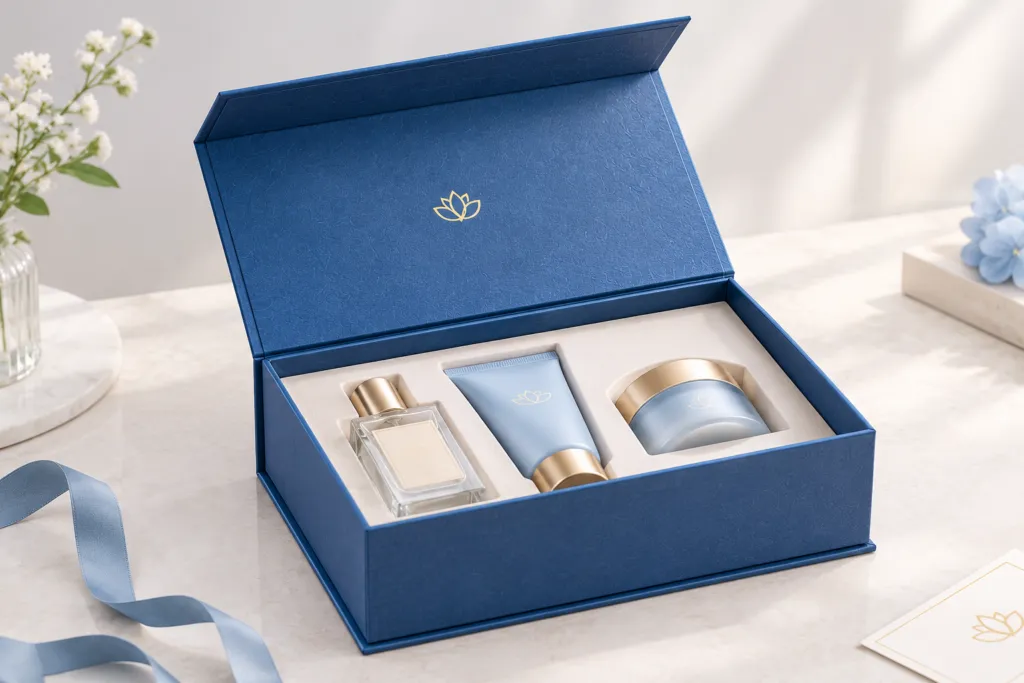
A cosmetics gift set may contain several products that need to be visible immediately after opening.
In this case, the internal arrangement and lid movement should be considered together. A box can have enough overall space but still provide poor presentation if the product positioning does not work with the opening structure.
Reusable premium packaging
A connected lid can also be useful when the packaging is expected to be opened and closed repeatedly.
This can be relevant for premium gifts, branded presentation packaging and products where customers may keep the box after purchase.
The right structure depends less on the product category itself and more on how the packaging needs to function during use.
Custom Hinged Gift Box Specifications Start With the Product
The most useful packaging brief begins with the product rather than the finished appearance of the box.
What product information should you provide?
At the beginning of a project, provide:
- product length;
- product width;
- product height;
- product weight when relevant;
- number of products;
- product arrangement;
- any accessories that need to be packed inside.
These details provide the basis for determining the internal dimensions.
For example, a gift set with three products arranged side by side requires a different internal layout from a single product positioned in the center.
What should you specify about the opening?
Explain how you want the customer to interact with the packaging.
A useful specification could be:
“The lid should remain connected to the base and provide enough opening movement for the complete product set to be visible.”
This gives the manufacturer a clear functional requirement without requiring the buyer to develop the hinge independently.
When should materials and finishes be discussed?
Once the basic structure is understood, define the visual requirements:
- board construction;
- wrapping paper;
- printing;
- surface finishing;
- interior treatment;
- branding requirements.
Separating the structural requirements from the decorative requirements makes it easier to review the project and identify changes.
Sampling Comes Before Production Approval
For a custom hinged gift box, the physical sample is where structural decisions can be tested with the actual product.
A sample should not be judged only by how the box looks when closed.
What should be checked on the sample?
Use the actual product whenever possible and check:
- product fit;
- lid movement;
- opening access;
- hinge alignment;
- closing position;
- visible finishing around the hinge area.
A box can look correct when closed but behave differently when opened repeatedly.
Checking the actual product inside the sample also helps identify problems with internal space that may not be obvious from drawings or artwork.
These same structural and finishing requirements should be reconfirmed during QC to ensure that mass-produced boxes remain consistent with the approved sample.
What happens after the sample is approved?
Once the structure and finish are approved, the production reference is established.
The typical sequence is:
Brief → Structural Development → Sample → Approval → Mass Production → QC → Packing
Major structural changes should be resolved before mass production begins.
What Should Buyers Know About MOQ and Production Time?
For planning purposes, Esion’s general packaging reference as of September 2026 is a MOQ of 1,000 pieces, with mass production typically taking around 15 days after the required specifications and sample have been confirmed.
These figures are a general planning reference rather than a fixed promise for every project. Material availability, finishing requirements, quantity and structural complexity can affect the final schedule.
Why should MOQ be discussed early?
Quantity affects material purchasing, production planning and unit cost.
If the expected order is close to the minimum production quantity, it is better to confirm this before structural development and sampling are completed.
What can affect the production schedule?
The main factors include:
- final structure approval;
- material availability;
- artwork approval;
- finishing requirements;
- production quantity;
- changes made after approval.
For an overseas packaging project, confirming these points early can make delivery planning more predictable.
How Does Esion Package Support Custom Hinged Gift Box Production?
A custom rigid box project requires the structural, printing and production details to remain consistent from development through shipment.
Esion Package, Dongguan Esion Packaging Co., Ltd., handles processes including raw-material preparation, paper cutting, printing, gluing, laminating, die cutting, handmade assembly, QC inspection and packing. Esion has also passed FSC certification.
Having these processes within one production workflow can help reduce unnecessary supplier handoffs when a project requires a custom structure, printed wrapping and finished assembly.
You can learn more about the company and its production capabilities through About Esion Package.
The MOQ and production timing above are the September 2026 planning reference. The final quotation and schedule should always be confirmed for the specific project.
How Can You Prepare a Better Hinged Gift Box Inquiry?
A clear inquiry gives the manufacturer enough information to evaluate the project instead of estimating from appearance alone.
Include the essential project information
A useful inquiry should contain:
Product — dimensions and arrangement
Structure — hinged lid and opening requirement
Material — board and wrapping preference
Appearance — printing and finishing
Quantity — expected order volume
Timing — target delivery date
A reference image can help communicate the intended appearance, but it should support the written specification rather than replace it.
For example:
“We need a custom hinged gift box for a product measuring 100 × 70 × 30 mm. The lid should remain attached during use, and the product should be fully visible when opened. Required quantity: 1,000 pcs.”
This gives a packaging manufacturer a much clearer starting point for structural discussion and quotation.
From Structure to Shipment
A well-managed hinged gift box project follows a clear sequence.
1. Product requirements
Confirm product dimensions, quantity and intended presentation.
2. Structural development
Define the hinged opening and internal space.
3. Material and artwork
Confirm paper, printing and finishing.
4. Physical sample
Evaluate the actual structure with the product inside.
5. Approval
Confirm the final structure, appearance and specifications.
6. Mass production
Produce according to the approved reference.
7. QC and packing
Inspect the finished boxes and prepare them for shipment.
The key is to resolve major structural decisions before production rather than trying to correct them after manufacturing has started.
Final Takeaway
A custom hinged gift box should be evaluated as a structural packaging solution, not simply as another premium-looking rigid box.
The most important considerations are:
- Does the connected lid improve the opening experience?
- Does the internal space fit the actual product?
- Does the structure work correctly in a physical sample?
- Can the approved structure be reproduced consistently in production?
If these requirements are clear, a hinged structure can be a strong option for premium gift packaging, jewelry, cosmetics and other products where controlled opening and repeated access matter.
If you already have the product dimensions, desired opening behavior and approximate quantity, the next practical step is to prepare those details for a packaging quotation through Contact Esion Package.
FAQ
Is a hinged gift box part of the rigid box family?
Yes. A hinged gift box can be produced as a rigid box, with the connected lid and hinge movement forming the main structural feature.
Can a hinged gift box also have a magnetic closure?
Yes. The hinge controls how the lid connects and moves, while the magnetic closure helps keep the box closed. The two features can be used together. For more information, see the Magnetic Gift Boxes guide.
What products are suitable for a custom hinged gift box?
Products that benefit from controlled opening, clear presentation and repeated access can be good candidates. Jewelry, cosmetics, premium gifts and selected branded products are common examples.
What should I provide when requesting a quotation?
Provide the product dimensions, product arrangement, opening requirement, preferred materials, printing and finishing requirements, quantity and target delivery date. Reference images can also help communicate the intended appearance.
What is Esion Package’s current MOQ for custom packaging?
As of September 2026, Esion’s general packaging MOQ is 1,000 pieces. The final MOQ and quotation should be confirmed according to the specific structure, materials and production requirements.