
Table of Contents
How to Specify a Custom Hinged Gift Box for Production
23. 9 月, 2026We work with brands on custom paper and rigid packaging, and one of the most important parts of a hinged box project happens before production: turning a product idea into specifications that can actually be manufactured.
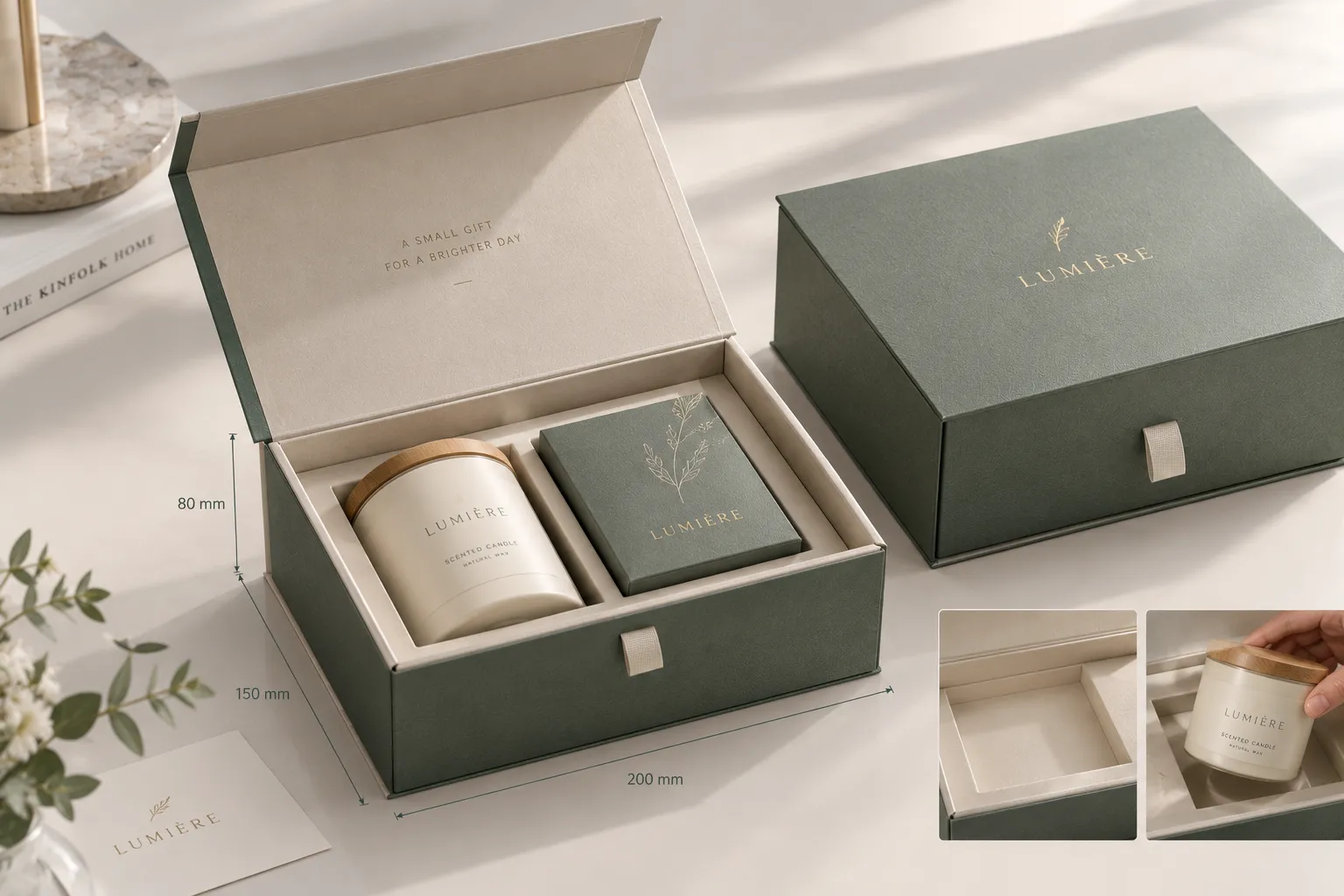
A custom hinged gift box may look simple from the outside, but its internal space, lid movement, hinge position, materials and finishing all need to work together. A specification that looks correct on a screen may still create problems when the real product is placed inside.
This guide focuses on that practical stage: how to define the specifications that affect production feasibility, sampling and final consistency.
For the broader structure and production principles of hinged gift boxes, see our main Hinged Gift Box guide.
How Should the Product Dimensions Be Used to Develop the Box?
The product dimensions should be treated as the starting point for the internal structure, not as the finished box dimensions.
Start with the actual product
Suppose the product measures 100 × 70 × 30 mm.
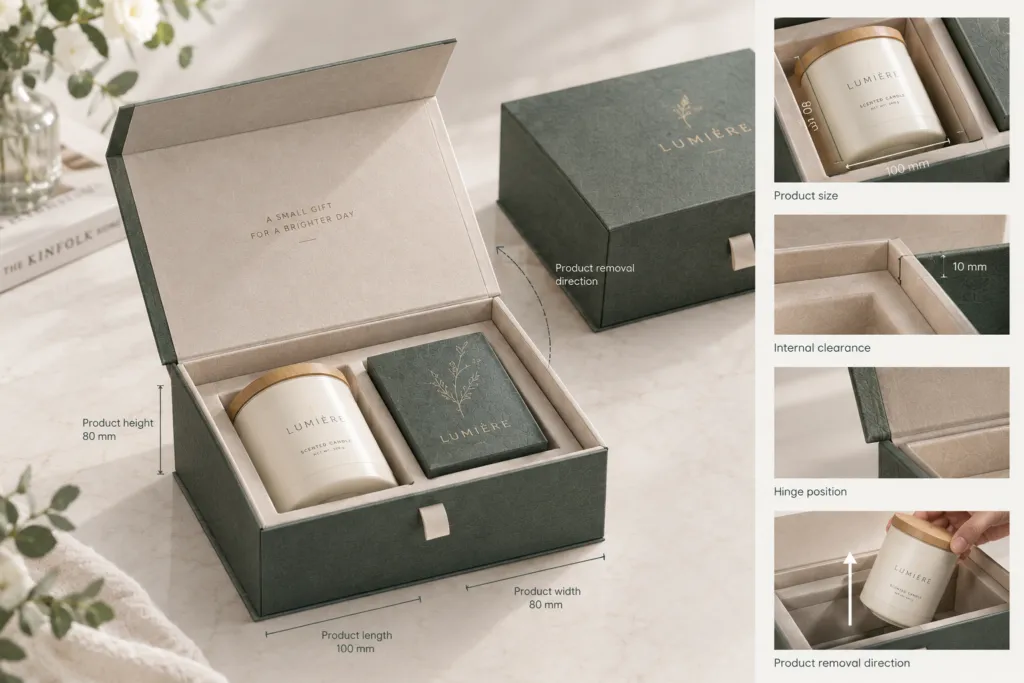
Those measurements tell the manufacturer the size of the product, but they do not automatically determine the internal box dimensions.
The required space may also depend on:
- an insert or holder;
- product protection;
- finger clearance;
- product tolerance;
- the way the product is removed.
A rigid box that fits the product too tightly may look precise in a drawing but become difficult to use in practice.
Consider the removal movement
The question is not only whether the product fits.
It is also whether the customer can remove it naturally after opening the lid.
For example, a product sitting inside a fitted insert may require more accessible space around its edges than a product placed directly into the box.
Which Internal Dimensions Need the Most Attention?
Internal dimensions become especially important when the box contains an insert, multiple products or a tightly controlled presentation.
Product clearance
The clearance should be sufficient for the intended handling method without making the product appear loose inside the box.
Insert dimensions
An insert changes the usable internal space.
If the insert is designed around the product, its thickness and positioning also need to be considered when determining the box structure.
Multiple-product layouts
If several products are placed inside one box, do not treat their individual dimensions separately.
The overall arrangement matters.
For example, three products placed side by side may require different internal proportions from the same three products arranged in two rows.
Product removal
The final test should be practical:
Can the intended user take the product out easily after opening the box?
That question can reveal problems that are difficult to identify from external dimensions alone.
How Should Hinge Requirements Be Specified?
A hinge requirement should describe the expected movement and alignment, rather than simply stating that the box needs a hinged lid.
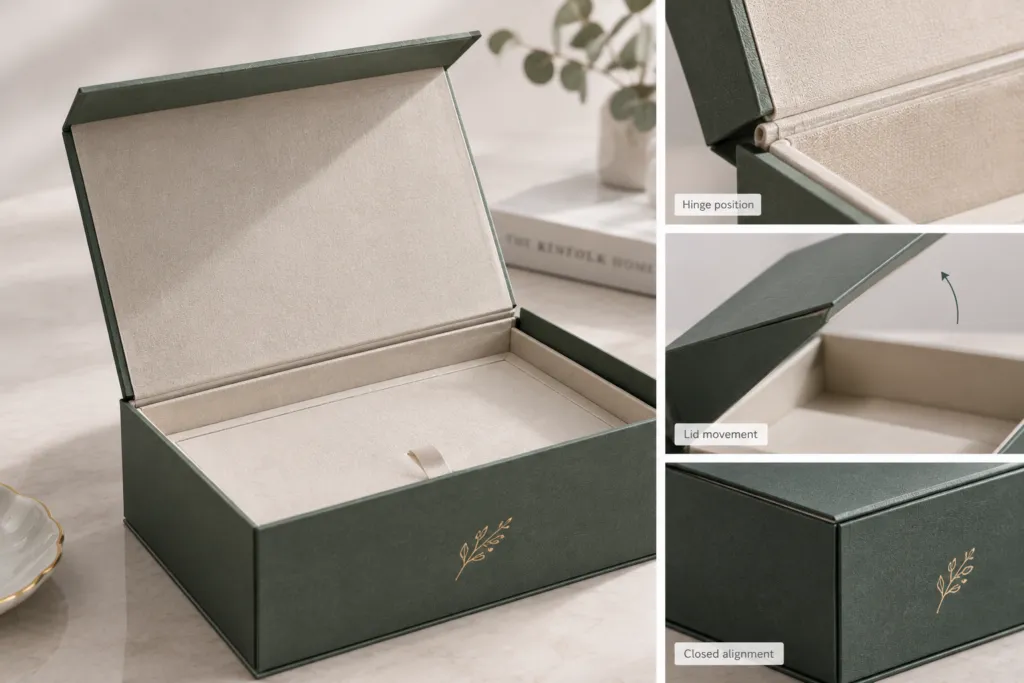
Hinge position
The hinge position affects how the lid relates to the base when the box is opened and closed.
If the design has a specific visual proportion or edge alignment, the hinge position should be considered during structural development.
A hinged structure describes how the lid remains connected to the box, while a collapsible rigid box focuses on how the box itself folds for storage and handling. These are different structural considerations. See our Collapsible Rigid Box guide for the folding structure.
Opening movement
Describe what the user needs to see and access.
For example:
The lid should remain connected and open sufficiently to provide clear access to the complete product arrangement.
This gives the manufacturer a practical requirement to evaluate during sampling.
Closing position
The lid should return to the intended position when closed.
This becomes particularly important when the box has a printed logo, foil detail or other visual elements that make alignment easy to notice.
Repeated opening
If the box will be opened repeatedly, communicate that requirement before sampling.
The manufacturer can then evaluate the structure according to its intended use instead of judging the box only from one open position.
Which Material Decisions Affect Production Feasibility?
Material selection should be considered together with the required structure and appearance.
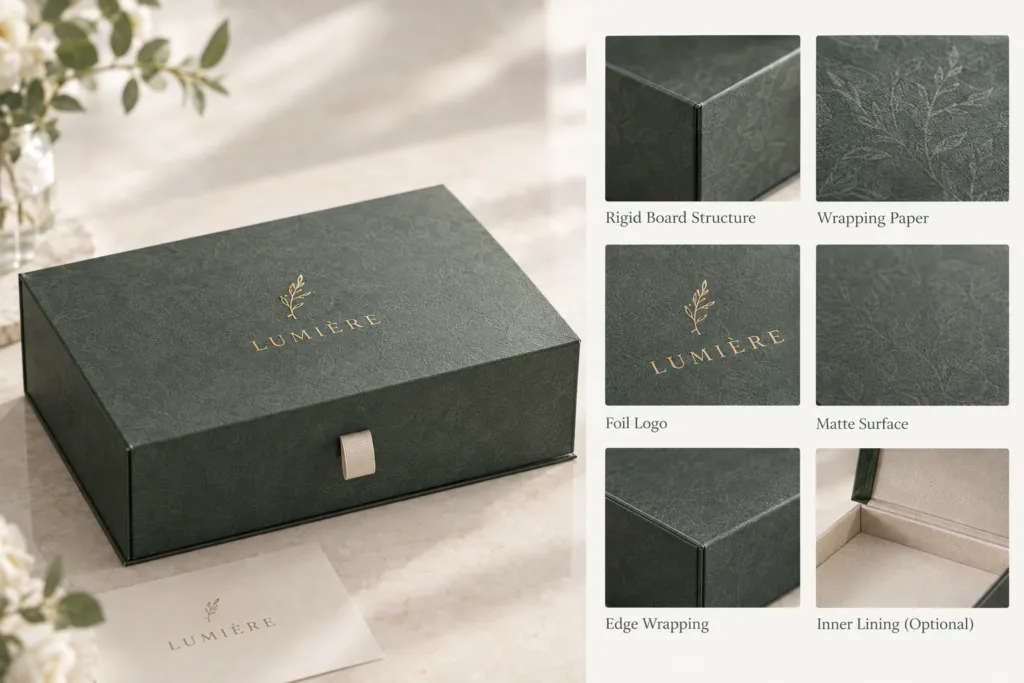
Rigid board
The board provides the basic rigidity of the box.
Its suitability depends on factors such as box dimensions, construction and intended use. Buyers do not necessarily need to specify every technical board parameter at the first enquiry; the manufacturer can evaluate the construction against the project requirements.
Wrapping paper
The wrapping paper affects the visible surface and can also influence how finishing is applied.
A buyer may specify:
- printed paper;
- solid-color paper;
- textured paper;
- branded paper;
- a supplied paper reference.
When a specific paper appearance is important, a physical sample is often more useful than a general description.
Interior construction
If the box requires an insert, holder or lining, it should be considered during structural development.
The interior is not simply a decorative addition. It can change the available product space and overall box dimensions.
Which Finishes Should Be Defined Before Production?
Finishing requirements should be established before the quotation and sample are finalized.
Common options include:
- matte lamination;
- gloss lamination;
- foil stamping;
- embossing;
- debossing;
- spot UV;
- specialty papers.
The important issue is not how many finishes are available, but whether the selected finish works with the material and structure.
For example, a logo intended for foil stamping should be identified during the design and quotation stage rather than added after the basic specification has already been approved.
What Should the Sample Prove Before Mass Production?
The sample should prove that the specifications work with the actual product.
It is not simply a miniature version of the finished packaging.
Product fit
Place the actual product inside and confirm that it sits correctly.
Product access
Open the box and remove the product in the way the end customer is expected to use it.
Lid movement
Check whether the opening and closing movement matches the agreed requirement.
Visual alignment
Review the lid, base, wrapping, logo and visible finishing together.
A sample can therefore reveal issues that are difficult to identify from drawings alone.
Which Specifications Should Be Locked Before Mass Production?
Once the sample has been approved, the specifications that affect the physical structure should not be treated as open-ended design options.
The production reference should clearly establish the approved:
- product fit;
- internal construction;
- hinge movement;
- materials;
- printing;
- finishing;
- overall appearance.
This matters because a change to one specification can affect another.
For example, changing the product dimensions after structural approval may require the internal space and insert to be revised. That can then affect artwork or finishing positions.
The approved physical sample provides a practical reference for keeping these elements consistent during production.
How Can Buyers Make a Custom Hinged Box Easier to Quote?
The best quotation request is not necessarily the longest one. It is the one that removes the major unknowns.
For example, compare:
“We need 1,000 luxury hinged boxes.”
with:
“We need 1,000 hinged boxes for a product measuring 100 × 70 × 30 mm. The product should sit horizontally inside the box and remain easy to remove when opened. We require printed wrapping paper with a matte finish.”
The second enquiry gives the manufacturer enough information to start evaluating the structure without pretending that every technical detail has already been finalized.
That distinction is important: a good specification provides direction while leaving room for professional production assessment.
How Does Esion Package Support Production Feasibility?
For custom packaging projects, Esion Package can help coordinate structural requirements, materials, finishing and production communication so that the final specification is practical to manufacture.
Dongguan Esion Packaging Co., Ltd. has QC inspection as part of its production workflow and has passed FSC certification. The general packaging MOQ is 1,000 pieces as of September 2026; actual production timing depends on the approved project specifications and requirements.
For company information, see About Esion Package. For a project-specific discussion, buyers can contact Esion Package.
A Better Specification Sequence for Buyers
Once the product has been selected, the specification can be developed in a straightforward order:
Product → Internal Space → Hinge Requirements → Materials → Finishing → Sample → Approval
The important point is to settle the physical requirements before spending too much time refining decorative details.
If the internal structure changes after artwork or finishing has been finalized, additional revisions may be required.
A specification-first approach helps reduce that unnecessary back-and-forth.
Final Takeaway
A custom hinged gift box should be specified around how the product actually fits, moves and presents inside the package.
The most important decisions are not simply the outside dimensions. Internal clearance, product access, hinge movement, materials and finishing all need to work together.
A well-developed sample can then confirm those decisions before mass production begins.
If your product dimensions and packaging requirements are ready, you can contact Esion Package to discuss the project.
FAQ
How much clearance should a custom hinged gift box have around the product?
There is no universal clearance value. It depends on the product, insert, protection requirements and how the product needs to be removed. The final clearance should be confirmed during sample development.
Can the hinge position be customized?
Yes. The hinge position can be considered during structural development when it affects lid alignment, opening movement or the overall proportion of the box.
What happens if the product dimensions change after the box structure is approved?
A dimension change can affect the internal space, insert, artwork and finishing positions. It is better to confirm the actual product dimensions before final structural approval.
Do I need a technical drawing to request a quotation?
Not necessarily. Accurate product dimensions and a clear description of the intended arrangement and appearance can provide a useful starting point. The manufacturer can evaluate the remaining structural details during development.
Which specifications should be checked most carefully during sampling?
Product fit, internal access, lid movement and visual alignment deserve particular attention because they involve the relationship between the real product and the finished box.