
Table of Contents
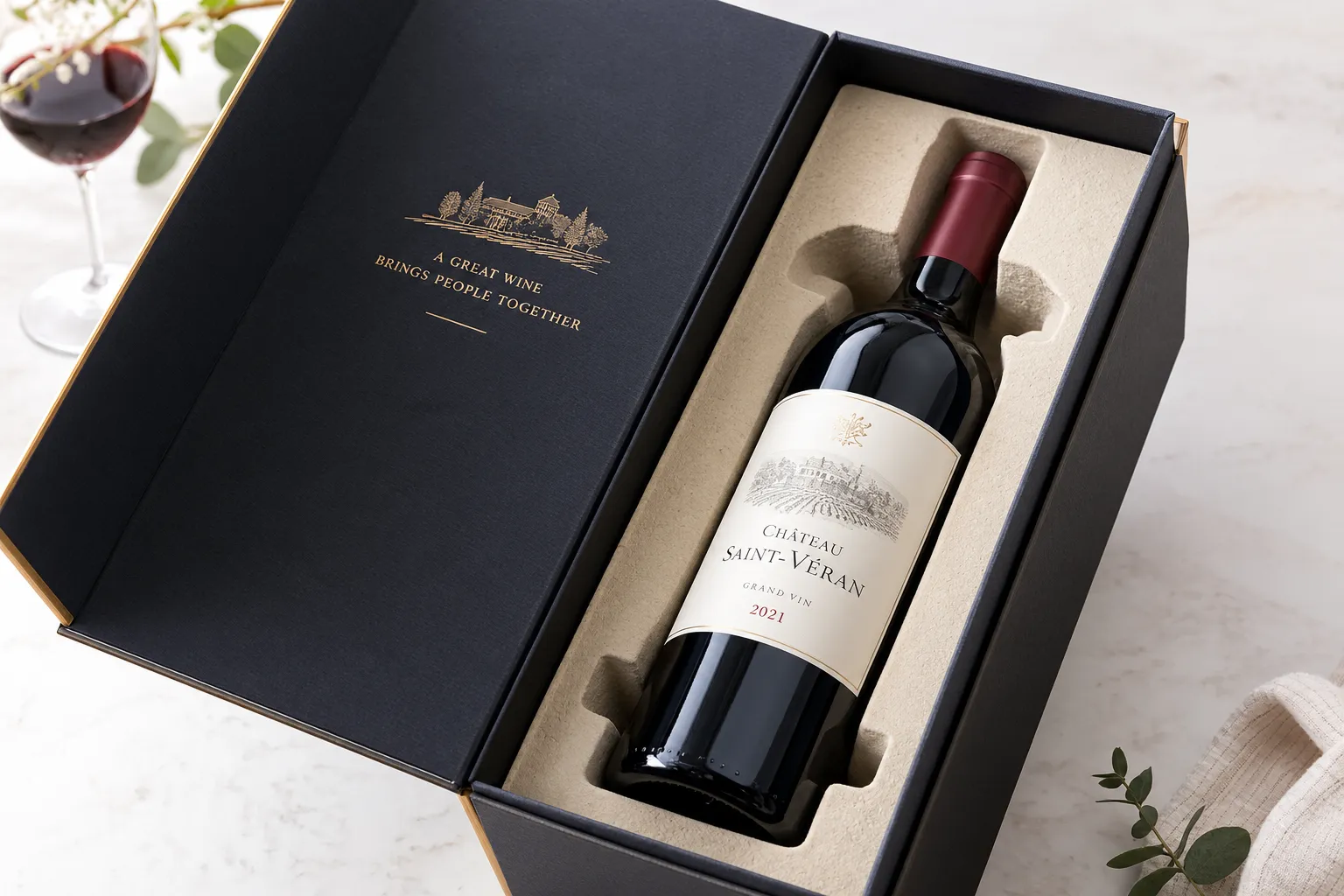
Wine Gift Box Guide: Bottle Fit, Insert & Structure
8. 10 月, 2026By: Esion Package Editorial Team
Technical review: Esion Packaging Engineering Team
Last updated: October 8, 2026
A wine gift box should be developed around the actual bottle, not simply its stated capacity.
Two 750ml bottles can have different heights, diameters, shoulder profiles, closure heights, and weights. Those differences affect the insert, internal clearance, box structure, and sampling result.
At Esion Package, we use this sequence for wine packaging development:
Bottle specification → Insert development → Box structure → Sample → Fit check → Artwork approval → Production → QC → Packing
This guide focuses on bottle fit, inserts, structure, sampling, production timing, and transport considerations. It does not provide alcohol labeling or wine-market regulatory compliance advice.
How Should You Start Designing a Wine Gift Box?
Start with the actual bottle specification before deciding the box dimensions.
“750ml” alone is not enough to develop a reliable insert. Before quoting or sampling, provide:
- Overall bottle height, including closure
- Maximum body diameter
- Shoulder height and profile
- Neck height and diameter
- Base diameter
- Punt or recessed base shape
- Filled bottle weight
- Number of bottles per box
- Bottle orientation
Why Does Bottle Orientation Matter?
The orientation determines where the bottle load is transferred into the insert and box.
For a vertical bottle, the main load is transferred toward the base, while sufficient internal height must be left for the closure and lid clearance.
For a horizontal bottle, the body and neck normally need controlled support from the insert. The closure end should have enough clearance and a defined support point rather than relying on the lid.
For an angled presentation, the insert has to control the bottle at specific contact points along the body and neck. The actual presentation angle should therefore be established before the insert is finalized.
What Do Real Wine Bottle Specifications Tell You?
The same bottle volume does not guarantee the same packaging dimensions.
The following examples come from Ardagh Glass’s North American wine-bottle range. They are manufacturer specifications, not universal standards, and the catalog was accessed in October 2026.
| Style | Bottle example | Capacity | Height | Diameter | Empty bottle weight |
|---|---|---|---|---|---|
| Burgundy | Evolution | 750ml | 291mm | 79mm | 397g |
| Bordeaux | Claret Allure | 750ml | 312mm | 76mm | 624g |
| Champagne | Modern Sparkling Champagne | 750ml | 285mm | 89mm | 737g |
| Small format | Shasta | 375ml | 237mm | 61mm | 280g |
| Bordeaux | Classic Bordeaux | 1L | 311mm | 83mm | 461g |
| Magnum / Burgundy | Burgundy Magnum | 1.5L | 343mm | 107mm | 801g |
These examples show why a package should not be developed from volume alone.
The 750ml Burgundy Evolution and 750ml Champagne examples differ by approximately 10mm in diameter, while their empty-bottle weights differ by about 340g.
The 1.5L Burgundy Magnum example is approximately 343mm high and 107mm in diameter, making it substantially different from a standard 750ml package. For the full manufacturer specifications, see the Ardagh Glass North American Wine Bottle Catalog.
European glass producers publish different mould ranges, so European buyers should confirm the actual dimensions with their bottle supplier rather than transferring North American specifications directly into production.
How Much Does a Filled Wine Bottle Weigh?
The actual filled weight should be measured, but manufacturer bottle data provides a useful planning reference.
Using approximately 0.75kg of wine for a 750ml planning calculation:
- Burgundy Evolution: 0.75kg + 0.397kg ≈ 1.15kg filled
- Bordeaux Claret Allure: 0.75kg + 0.624kg ≈ 1.37kg filled
- Champagne example: 0.75kg + 0.737kg ≈ 1.49kg filled
- 1.5L Burgundy Magnum: 1.5kg + 0.801kg ≈ 2.30kg filled
These are calculated planning values rather than measured finished-package weights. Wine density, bottle variation, closure, capsule, and other components can change the final weight.
The structural implication is important: a wine box may need to support more than 1kg for one 750ml bottle and around 2.3kg for the illustrated Magnum example.
A magnetic closure should keep the box closed rather than carry the bottle’s weight. The insert and base should transfer the load through the structure.
How Should the Wine Bottle Insert Be Designed?
The insert should follow the bottle’s actual geometry rather than simply matching its maximum diameter.
How Should You Handle the Closure Height and Lid Clearance?
The closure needs its own clearance zone inside the box.
A cork, screw cap, sparkling closure, capsule, or other neck treatment can change the effective bottle height and the amount of space required beneath the lid.
For a vertical bottle, the insert should position the bottle consistently while preventing the closure from pressing against the lid. For a horizontal bottle, the closure end should have enough clearance and should not become an unintended load-bearing point.
A bottle that fits the body opening can still fail the sample if the closure touches the lid when the box is closed.
How Should the Bottle Base and Punt Be Supported?
The base should provide stable support without forcing the bottle into an incorrect position.
Wine bottles can have different base diameters and different punt depths. If the insert or base is shaped around the wrong profile, the bottle may rock, sit too high, or transfer its weight unevenly.
For heavier bottles, the bottom support becomes even more important because the load needs to move through the insert and into the box base rather than concentrating on one small contact area.
Why Does the Bottle Shoulder Position Matter?
The shoulder profile controls how the upper part of the bottle is positioned inside the insert.
The body diameter decreases toward the neck, so the shoulder is not simply another measurement of the bottle’s maximum diameter.
The Ardagh examples illustrate the problem clearly: the 750ml Burgundy Evolution is approximately 79mm in diameter, while the 750ml Champagne example is approximately 89mm. That roughly 10mm difference can change the opening, support area, and clearance required around the bottle.
This is why a 750ml insert developed for one bottle mould should not automatically be reused for another 750ml bottle.
Which Wine Gift Box Structure Should You Choose?
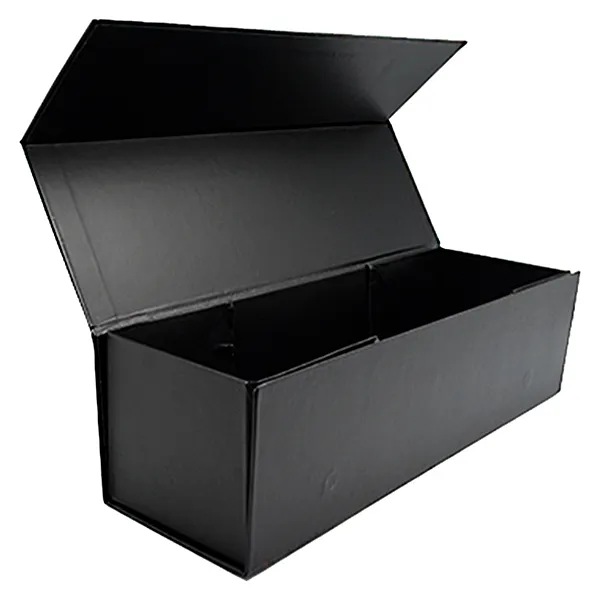
Choose the structure according to bottle load, opening experience, storage requirements, and transport conditions.
| Structure | Main advantage | Wine-specific consideration |
|---|---|---|
| Magnetic closure | Premium opening experience | Closure keeps the box closed; insert and base carry the bottle load |
| Hinged | Natural presentation opening | Hinge alignment and lid movement need physical verification |
| Lift-off | Simple rigid construction | Lid clearance and base fit should be checked with the finished insert |
| Collapsible | Lower shipping and storage volume | Heavy bottles and Magnums require careful evaluation of folding areas and load transfer |
For magnetic wine packaging, see our Magnetic Wine Boxes and Magnetic Gift Box Guide.
For lift-off construction, see our Two-Piece Rigid Setup Box Guide.
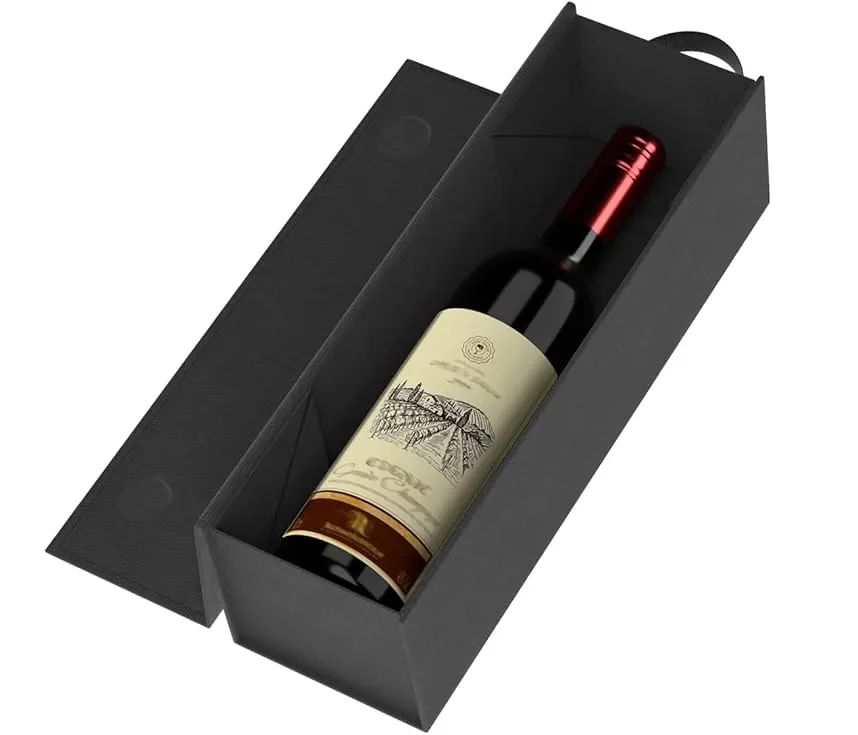
A collapsible structure can reduce shipping volume, but concentrated bottle loads require structural evaluation. Our Collapsible Rigid Box Guide explains the folding and load considerations.
Do Wine Gift Boxes Need a Window?
A window is optional and should be selected according to the presentation objective.
A window can display the bottle without opening the package, which may work well for retail presentation.
However, the opening changes the available panel area for branding and can affect the surrounding panel’s rigidity.
For premium wine gifts, an enclosed rigid box may provide a cleaner presentation. The decision should therefore come from the intended retail or gifting experience rather than from the assumption that every wine box needs a window.
Which Materials and Finishes Work for Wine Gift Boxes?
Structural construction should be determined before decorative finishing.
Rigid wine gift boxes commonly use rigid board wrapped with printed paper. The exact construction should be selected according to the finished box dimensions, bottle load, insert design, and structure.
Exterior options can include printing, matte or gloss lamination, foil stamping, embossing, and other suitable finishing treatments.
For wine packaging, stable construction and reliable bottle fit should be established before finalizing decorative specifications.
What Should You Check When Sampling a Wine Gift Box?
Use the actual production bottle whenever possible.
A sample should not be approved from an empty-box inspection alone.
Check:
- Bottle fit — bottle sits in the intended position.
- Insert support — bottle is supported without excessive pressure.
- Shoulder and neck clearance — no unwanted contact with the insert or lid.
- Base support — bottle does not rock or sit unevenly.
- Movement — bottle remains controlled during normal handling.
- Opening and removal — bottle can be removed without excessive force.
- Closure operation — lid and closure operate consistently.
- Appearance — wrapping, corners, printing, insert surface, and alignment meet the approved reference.
If the production bottle differs from the bottle used for sampling, the fit should be checked again before final approval.
How Should Wine Gift Boxes Be Prepared for Transport?
The presentation box and transport packaging should be treated as separate parts of the packaging system.
A premium wine gift box is primarily designed for presentation. Depending on the shipping method and destination, an outer carton, internal separation, cushioning, or other transport protection may be required.
Where transport performance needs to be tested, an appropriate ISTA procedure can be selected according to the distribution environment. See the official ISTA Test Procedures.
If leakage is a realistic risk, the bottle closure, primary packaging, protective layer, and outer shipping configuration should be considered together.
For outer-carton design, drop testing, and distribution requirements, discuss the actual transport conditions with us at quotation stage.
What Information Should You Send Before Requesting a Wine Box Quote?
Accurate bottle information is more useful than a guessed finished-box size.
Prepare:
- Bottle model or supplier reference
- Bottle volume
- Overall height including closure
- Maximum diameter
- Shoulder profile
- Neck and base dimensions where relevant
- Filled bottle weight
- Bottle photos
- Number of bottles per box
- Bottle orientation
- Preferred structure
- Insert requirement
- Artwork or logo
- Estimated quantity
- Destination
- Target delivery date
If the exact bottle specification is unavailable, a physical bottle or accurate dimensional drawing can reduce the risk of developing the insert around the wrong geometry.
What Is a Realistic Wine Gift Box Timeline for Q4 2026?
For a Christmas project, work backward from the required delivery date.
Our current wine-box reference is MOQ 1,000 pieces, sample time 5–7 days, and mass production time 15 working days. These figures should be reconfirmed when the final structure, insert, quantity, and artwork are quoted.
| Project stage | Relative planning |
|---|---|
| Bottle specification, quotation and structure | Week 1 |
| Sample development | Week 2 |
| Sample review and corrections | Week 3 |
| Artwork and final approval | Week 3–4 |
| Mass production | 15 working days after approval |
| QC and packing | After production |
| International transportation | Separate logistics window |
For a Christmas 2026 deadline, a project beginning in early October therefore needs a compressed approval schedule. The timeline above assumes that bottle specifications are available early and that sample corrections do not require multiple development rounds.
For delivery before December 25, this planning model should assume air freight or express delivery, subject to destination and carrier availability. Standard sea freight normally adds several weeks and should not be assumed to meet a new October-start Christmas project.
For Lunar New Year 2027, which falls on February 6, buyers should also work backward from the required arrival date and confirm the factory’s actual holiday production schedule when placing the order.
What Should EU Buyers Consider About PPWR in 2026?
EU-bound packaging should be reviewed against the requirements applicable to the final packaging construction and market.
Regulation (EU) 2025/40 on packaging and packaging waste applies from August 12, 2026. The European Commission published related implementation guidance in June 2026.
For the primary legal text, see Regulation (EU) 2025/40 on EUR-Lex.
For implementation guidance, see the European Commission PPWR Guidance.
For wine gift boxes, the packaging discussion may include material composition, unnecessary material use, mixed components, and requirements affecting the final packaging configuration.
The Commission guidance supports interpretation and implementation but does not replace the regulation itself.
What Are the Most Common Wine Gift Box Problems?
Most problems can be traced back to incorrect bottle information or insufficient physical fit checking.
| Problem | Common cause |
|---|---|
| Bottle moves inside the box | Insert developed from an approximate diameter |
| Shoulder contacts the insert | Bottle shoulder profile was not measured |
| Lid presses on the bottle | Closure height or internal clearance was underestimated |
| Magnetic box feels unstable | Insert/base does not adequately support the bottle load |
| Replacement 750ml bottle does not fit | Same capacity but different bottle geometry |
| Magnum requires a new structure | Larger diameter and substantially higher filled weight |
The practical solution is to return to the actual bottle specification and verify the insert and structure with a physical sample.
How Does Esion Package Approach Wine Gift Box Development?
We connect bottle fit, insert development, structure, production, and quality control throughout the project.
Esion Package is operated by Dongguan Esion Packaging Co., Ltd., established in 2011 as a supplier of customized paper packaging. Our published production process includes raw materials, paper cutting, printing, gluing, laminating, die cutting, handmade assembly, QC inspection, and packing. See more about our production background on the About Esion Package page.
We hold FSC certification, with the applicable certification scope confirmed according to the specific project and material requirements.
For buyers developing a wine package, our current custom wine box reference provides the starting point for discussing structure, insert requirements, sampling, quantity, and production timing.
FAQ
What size wine gift box is best for a 750ml bottle?
There is no universal finished size. The box should be developed from the actual bottle height, diameter, shoulder profile, closure, insert, and structure.
Can a magnetic wine gift box carry the full bottle weight?
The magnetic closure should not be treated as the primary load-bearing component. The insert and box base should support and distribute the bottle load.
Does a Champagne bottle need a different wine gift box?
It may. Champagne-style bottles can be wider and heavier than other 750ml bottles, so the actual bottle should be checked before the insert is finalized.
Should I provide the actual bottle for sampling?
Yes, whenever possible. It gives the packaging supplier a reliable reference for dimensions, profile, weight, and final fit.
Do I need a separate shipping carton?
The presentation box and transport packaging should be evaluated separately. The final configuration depends on the shipping method, destination, bottle quantity, and handling conditions.
How long does a custom wine box sample take?
Our current wine-box reference is 5–7 days for sampling, with 15 working days for mass production and an MOQ of 1,000 pieces. Final timing should be confirmed with the project specification.
Request a Wine Gift Box Quote
Have the bottle dimensions, bottle photos, quantity, preferred structure, insert requirements, and target delivery date ready?
Request your custom wine box quote or Contact Us to discuss the packaging requirements with our team.
The more accurately the bottle is defined at the beginning, the less likely the project is to require structural corrections after sampling.