
Table of Contents
Collapsible Rigid Box Assembly: How to Form, Pack and Store Them
9. 11 月, 2026Author: Esion Package Editorial Team Technical Review: Esion Package Production & Quality Team Last updated: November 9, 2026
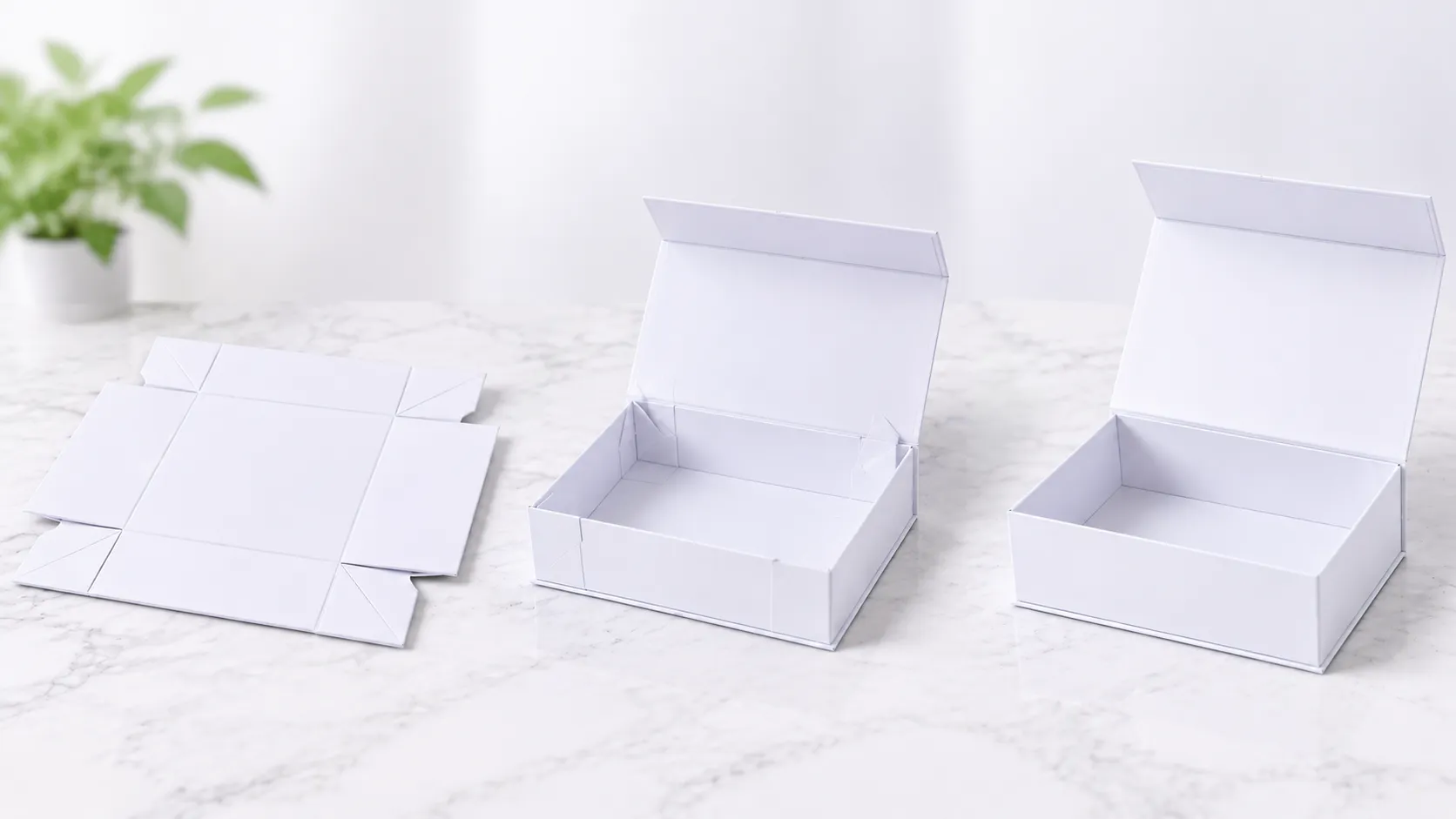
Collapsible rigid box assembly is the step that turns a flat, space-saving box into a finished package, and it is easy to underestimate. Someone has to form every box, check it and pack it, and that work needs time, space and a method that gives the same result on the first box and the five-hundredth.
This guide covers what happens after the flat boxes arrive: incoming checks, forming steps, a forming-time test, packing station setup, boxes that do not form correctly, and where formed boxes should wait. It does not repeat how the structure works or how to calculate shipment volume. Those are covered in our collapsible rigid box structure guide and in how to evaluate collapsible gift box shipping space.
Quick answer: Form two or three boxes from different cartons first, then form and pack in batches your team can finish in one session. Time a real batch before you commit to a packing schedule, and set aside any box that will not square after one careful attempt instead of forcing it.
Where Does Assembly Fit in the Collapsible Rigid Box Workflow?
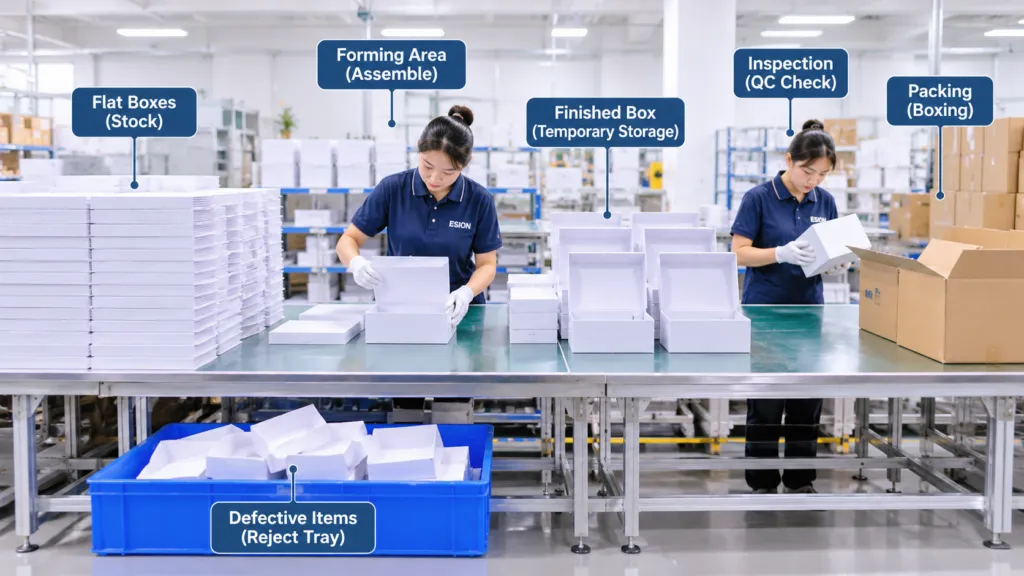
The workflow has five stages: receive, inspect, form, pack, then store or ship. The flat-shipping advantage lasts only until the box is formed, so the decision about who forms it also decides how much of that advantage you keep.
Settle two points before you order:
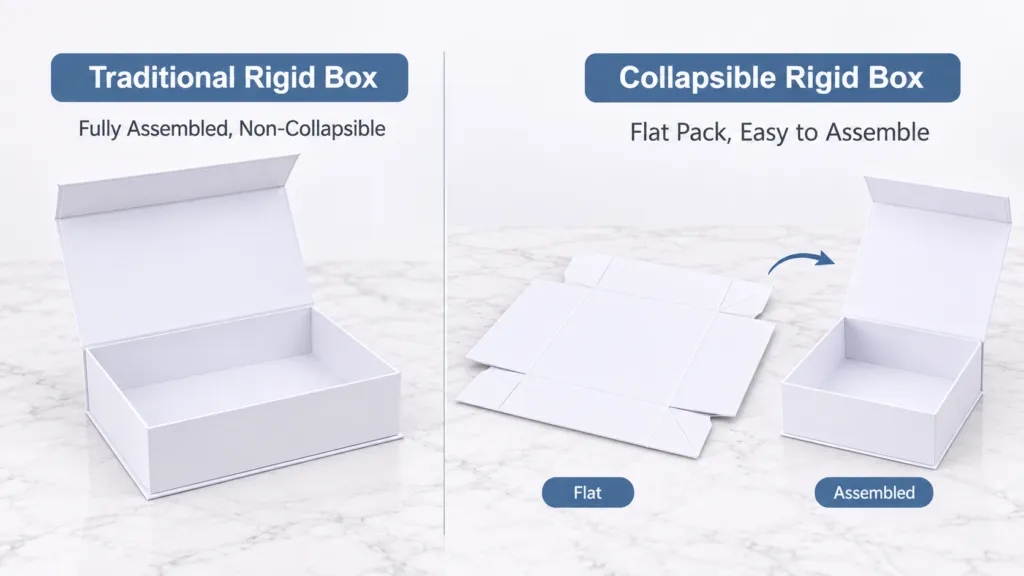
- Who forms the box. If your packing team forms it, the boxes ship flat. If the supplier forms it, they arrive formed and take up the space you were trying to save. When a fully formed box is what you really need, a two-piece rigid setup box may be the simpler choice.
- Where it is formed. At the packing station, in a separate forming area, or by the end customer.
What Should You Check When Flat Boxes Arrive?
Check before you start forming, not after the first 200 boxes.
- Check carton condition and labels against the order.
- Open one carton and compare a flat box with the approved sample: dimensions, folding areas and surface.
- Form two or three boxes from different cartons before you open the rest.
- Look at the folding areas for cracks, white marks or wrinkles. Causes and prevention are covered in our guide to collapsible rigid box cracking and wrinkling.
- If the design includes a ribbon or a magnetic closure, check that it is present and works.
Set aside any carton with crushed edges or damaged folding areas, and photograph it before you report it.
How Do You Form a Collapsible Rigid Box on a Packing Line?
The exact movement depends on the approved structure, so the approved sample and the supplier’s forming instruction take priority. The table shows what the operator does and checks at each stage. The mechanism behind these moves is explained in the structure guide linked above.
| Stage | Operator action | Check before moving on |
|---|---|---|
| 1. Place | Put the flat box on a clean, flat surface in the orientation shown on the approved sample | Surface is clean, nothing under the box |
| 2. Raise | Open the main body and raise the side panels evenly along their folding areas | No panel forced past its folding area |
| 3. Square | Bring each corner to its designed position | Corners square, opposite walls parallel |
| 4. Secure | Engage the connection points the structure requires | Form holds without hand pressure |
| 5. Inspect | Look at corners, edges, lid gap and visible surface | Matches the approved sample |
| 6. Pack | Place the insert and product without pushing the walls outward | Walls stay in position, lid closes naturally |
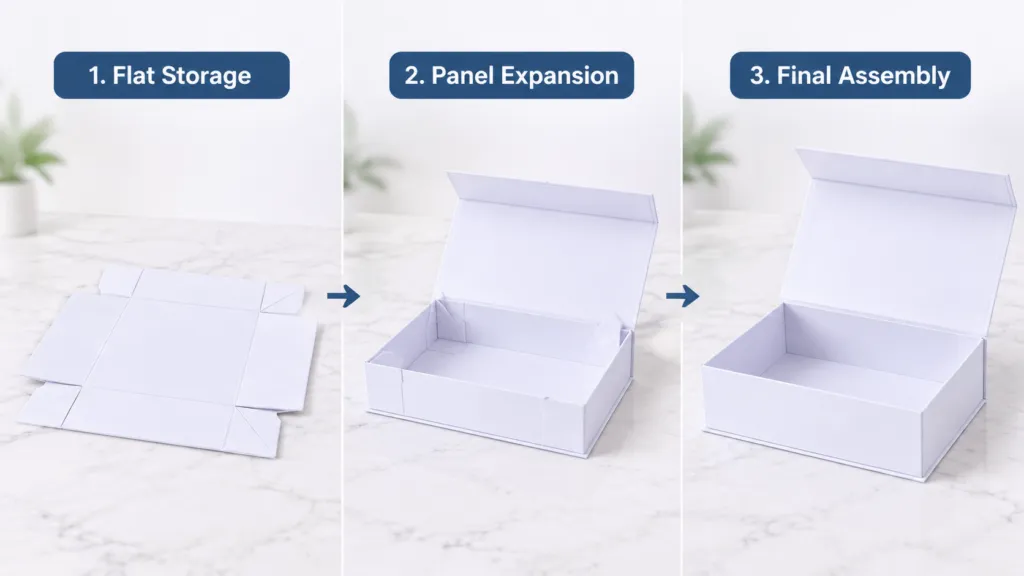
Do not press or crease a folding area to make a box stand. A box that only stands while someone holds it is a defect, not a forming technique. If the box has a magnetic closure, our magnetic gift box guide covers the closure checks.
How Long Does It Take to Form One Box?
There is no universal figure. Forming time depends on the structure, the box size, operator experience and what the step includes, such as inspection and inserting the product. Measure it with the people who will do the work.
| Measure | How to record it | Why it matters |
|---|---|---|
| First 10 boxes | Total time, then time per box | Shows the learning curve |
| Boxes 11 to 50 | Total time, then time per box | Closer to steady speed |
| Rejected or reworked boxes | Count and reason for each | Shows the quality cost |
| Forming vs packing speed | Boxes formed and boxes packed per hour | Shows whether forming is the bottleneck |
Then estimate the labor for the whole order:

For example, if forming took 45 seconds per box, 2,000 boxes would need 25 hours (2,000 × 45 ÷ 3,600). The 45 seconds is there only to show the arithmetic. It is not a benchmark for any structure.
Compare that labor with the extra freight and storage of a supplier-formed alternative before you decide.
How Should You Set Up the Packing Station?
Keep the layout simple so boxes move in one direction:
- Flat stock on one side and formed boxes on the other.
- A clean, well-lit forming surface, so surface defects are easy to see.
- Inserts, tissue and products within reach, so nobody leans on a formed wall.
- A separate tray or marked area for rejected boxes, kept with the carton label.
- Nothing stacked on formed boxes, including cartons and tools.
If the structure includes magnets, check during sampling how flat boxes stack and separate when handled.
What Should You Do With a Box That Won’t Form Correctly?
Agree the rule with your packing team before the first batch:
- Re-form the box once, following the approved method.
- If it still does not square or hold its shape, set it aside. Do not force it.
- Record the carton label and what went wrong, with a photo.
- Set a stop rule: if the same problem appears on several boxes from one carton, pause and check the carton before you continue.
- Send the photos, carton labels and batch information to the supplier.
For how this kind of defect is caught during sampling, see the repeated-forming checks in our collapsible rigid box structure and testing guide.
Should You Form Boxes Ahead of Packing?
There are three practical approaches. The right one depends on your storage space, your packing rhythm and who is available to form.
| Approach | Storage space needed | Labor timing | Main risk | Best when |
|---|---|---|---|---|
| Form and pack in one flow | Lowest | During packing | Operators must be trained at the station | Orders are packed continuously |
| Form ahead in batches | Higher, because formed boxes take volume | Before packing | Stacked formed boxes can be pressed out of shape | Packing happens in short, intense windows |
| Supplier forms before shipping | Highest during transport and storage | None at your site | The flat-shipping advantage is lost | Your team cannot form boxes at all |
A practical rule: form only as many boxes as you can pack in the same session, unless your storage is set up for formed boxes.
Can a Formed Box Go Back to Flat?
Only if the structure was designed and sampled for it. Whether a box is meant to be formed once or folded and re-formed, and how many cycles were checked, should be agreed during sampling rather than assumed.
What If Your Customer Will Form the Box?
Some projects ship the box flat to the end customer. That puts the forming method in the hands of someone who has never seen the box.
- Test the forming with someone who has not seen the box before.
- Keep the instructions to a few pictured steps, on a card in the box or behind a QR link.
- Make sure forming needs no force and no tools.
- Decide in advance what happens when a box arrives damaged.
If a perfect first impression matters more than the freight savings, a pre-formed rigid box is the safer choice.
What Should You Confirm With the Supplier About Assembly?
Ask for these before you approve production:
- The forming method on the approved sample, and whether a written or pictured instruction is available.
- Whether the box is meant to be formed once or folded and re-formed, and how many cycles were checked.
- A flat sample you can form with your own packing team.
- How flat boxes are packed in each carton. The full carton data list is in the shipping guide linked at the top.
- Carton labeling, so a problem can be traced back to one carton.
Production reference (as of November 2026)
| Item | Reference |
|---|---|
| General MOQ | 1,000 pieces |
| Mass production | About 15 working days, depending on structure and quantity |
| Sample timing | Confirmed for each structure |
Confirm the final MOQ and schedule for your own project before you place an order.
How Does Esion Package Support Collapsible Rigid Box Projects?
Dongguan Esion Packaging Co., Ltd. makes custom rigid and collapsible gift boxes, with printing, laminating, die cutting, gluing, handmade assembly, quality inspection and packing handled as part of production.
If you tell us how your boxes will be formed, including who forms them, where, and roughly how many per hour, together with the product dimensions and weight, we can review that forming method against the structure during sampling.
You can see a collapsible example on our Personalized Collapsible Magnetic Gift Boxes page, or browse the Rigid Gift Boxes collection. For more about our production, see About Esion Package. To start a project, contact Esion Package with your product dimensions, weight and packing method.
Frequently Asked Questions About Collapsible Rigid Box Assembly
Do collapsible rigid boxes need tools or glue to assemble?
The aim is hand forming at the packing station without special tools. Whether any extra step is needed, such as engaging a closure element, depends on the structure, so confirm it on the approved sample.
How long does it take to assemble one box?
It depends on the structure, the size and the operator’s experience. Time a batch of 50 boxes with your own team, as described above, instead of relying on a general figure.
Can customers assemble the box themselves?
Yes, if the structure was designed and tested for it. Test with first-time users and include a short pictured instruction.
Should I ask the supplier to form the boxes before shipping?
You can, but formed boxes take far more space in transport and storage, which removes the main reason for choosing a collapsible structure. Compare the freight and storage impact before you decide.
What should I do if a box does not square up?
Re-form it once following the approved method. If it still fails, set it aside, record the carton label with a photo, and report it to the supplier.
Final Takeaway
Collapsible rigid box assembly is where the flat-shipping advantage either pays off or disappears. Check the boxes when they arrive, time a real batch with the team that will do the work, and agree a simple rule for boxes that will not form.
If you are planning a collapsible rigid box, send your product dimensions, weight and expected packing method, and we will review the forming method with you during sampling.