
Table of Contents

Magnetic Gift Box Inspection for Bulk Orders: AQL, Defect Classes and Lot Acceptance
23. 11 月, 2026By Esion Package Editorial Team | Technical review: Esion Packaging Engineering Team | Last updated: November 23, 2026
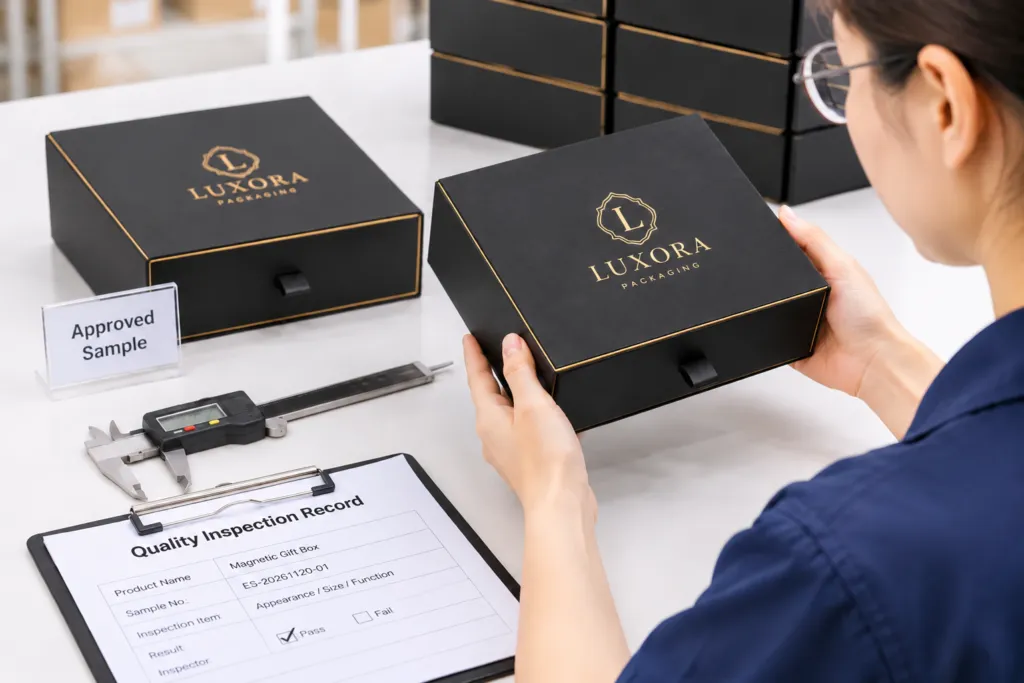
Magnetic gift box inspection for a bulk order is a lot-by-lot check of the finished boxes against the approved sample and the defect limits agreed with the supplier before production. It answers a different question from sample approval. The question is not “can this box work?” but “does this production lot match the box we approved?”
Disputes over a finished lot usually come down to three missing answers: what counts as a defect, how many boxes to open, and how many defects are acceptable. At Dongguan Esion Packaging Co., Ltd., we recommend settling all three in writing before production starts.
This guide is for brands, importers and distributors ordering magnetic gift boxes in volume. It explains how AQL sampling works for lots of 1,000 boxes and up, how to classify defects specific to magnetic boxes, how to run the check, and what to do if a lot fails.
It does not repeat other topics. For testing a sample before approval, see how to test a magnetic gift box before bulk production. For magnet types, polarity and air freight, see our gift box magnets guide. For MOQ, pricing and landed cost, see wholesale gift boxes. For planning designs across a range, see wholesale jewelry boxes.
In short
- Inspect each design as its own lot, against the approved sample and a written specification.
- A common starting point is general inspection level II with AQL 0 for critical, 2.5 for major and 4.0 for minor defects. This is a convention, not a rule, so agree the values before production.
- A 1,000-box lot means opening 80 boxes. A 2,000-box lot means 125.
- Magnet-specific defects, such as a reversed or loose magnet, a bulge at the magnet or a lid that will not stay closed, should be classified in advance.
- If a lot fails, the remedy should already be in writing.
What Is the Difference Between Sample Approval, Factory QC and Lot Inspection?
These three stages answer different questions, and a bulk order usually needs all of them.
| Stage | Question it answers | Who does it | Where to read more |
|---|---|---|---|
| Sample approval | Does this configuration work with the product and insert? | Buyer and supplier | Pre-production test guide |
| Factory inspection | Are boxes made and checked to the specification during production? | Supplier. Esion’s quality page describes a 100% quality inspection system for paper packaging | Quality page |
| Lot inspection (AQL) | Does this finished lot meet the agreed acceptance limits? | Buyer, a third-party inspector or a representative | This guide |
Factory checks reduce defects while boxes are being made. An independent sample check gives the buyer evidence about the finished lot before it ships.
When Should You Inspect a Bulk Order?
Decide the timing before production starts, because inspection needs access to finished goods and time in the schedule.
- During production (optional). A check of the first finished boxes against the approved sample can catch systematic problems early, such as the wrong paper, a shifted logo or a magnet position error, while most of the run is still unfinished.
- Before shipment. Production is complete and cartons are packed, so the inspector can draw boxes from several cartons. This is the usual point for the AQL check.
- On arrival. A final check at your warehouse is useful for transport damage, but a defect found only on arrival is harder to resolve.
Add inspection time on top of the production figures. Esion’s reference for mass production is usually 8–15 days (as of November 2026), and a pre-shipment check needs the finished goods held until the result is known. Factories usually slow or close around Lunar New Year (February 6, 2027), so confirm closure dates and book the inspection date early for spring orders.
How Does AQL Sampling Work for a Magnetic Gift Box Lot?
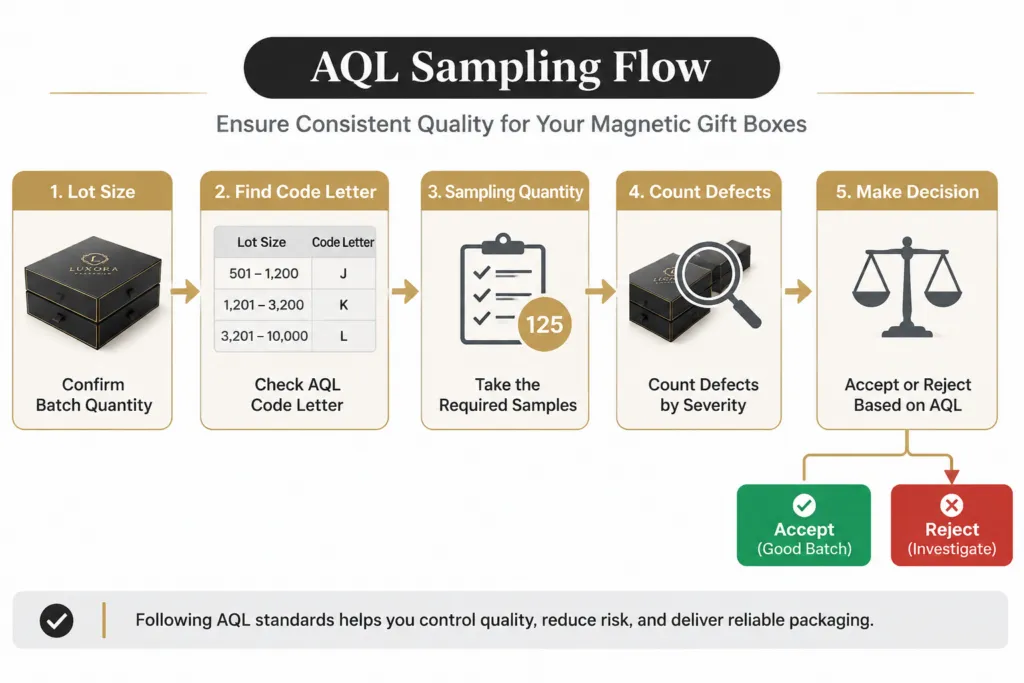
AQL (acceptance quality limit) is the rule that tells you how many boxes to open and how many defects you can find before the lot fails. ISO 2859-1 defines it for lot-by-lot inspection. The third edition, ISO 2859-1:2026, was published in January 2026 and replaces the 1999 edition and its amendments.
Three choices set the plan:
- Lot size: the number of boxes of one design in the shipment.
- Inspection level: general level II is the usual default.
- AQL for each defect class: 0 for critical, 2.5 for major and 4.0 for minor is a common convention for general consumer goods.
The figures below are the widely published single-sampling plans for normal inspection at general level II. Confirm them against the edition your contract cites.
| Lot size (boxes of one design) | Code letter | Boxes to inspect | Major, AQL 2.5: accept / reject | Minor, AQL 4.0: accept / reject |
|---|---|---|---|---|
| 501–1,200 | J | 80 | 5 / 6 | 7 / 8 |
| 1,201–3,200 | K | 125 | 7 / 8 | 10 / 11 |
| 3,201–10,000 | L | 200 | 10 / 11 | 14 / 15 |
| 10,001–35,000 | M | 315 | 14 / 15 | 21 / 22 |
Critical defects have zero tolerance. A single critical defect in the sample fails the lot.
Worked example. A 2,000-box lot falls under code K, so the inspector opens 125 boxes. The lot passes if the sample has no critical defects, no more than 7 major defects and no more than 10 minor defects. Finding 8 major defects fails the lot even if everything else is clean, because each class is counted separately.
Three points are often misread:
- AQL is not the share of defective boxes you will receive. It is an acceptance rule for the sample. A passed lot can still contain defective boxes that were not in the sample.
- A lot means one design. Three designs of 1,000 boxes each are three lots, not one lot of 3,000. This matches how MOQ is counted per design, which we explain in the wholesale jewelry boxes guide.
- Tighter limits cost more. Premium presentation boxes sometimes warrant tighter major-defect limits, which means a larger sample and fewer permitted defects. Agree them before production, not after.
Which Defect Class Does Each Magnetic Box Defect Fall Into?
There is no universal list. Classify defects by their effect on use, safety and appearance, and agree the list in writing. The table below is a practical starting point for magnetic gift boxes.
| Defect | Suggested class | How to check |
|---|---|---|
| Magnet or steel plate loose, or able to fall out | Critical or major. Many buyers treat an accessible loose magnet as critical, especially if children may handle the product | Handle the box, listen for rattling, inspect the magnet position |
| Lid will not close or will not stay closed | Major | Close the box with the product and insert in place |
| One magnetic pair repels or does not hold | Major | Test each closure point separately |
| Bulge or dent in the paper at a magnet position | Major if visible at normal viewing distance, minor if slight | Compare with the approved sample |
| Uneven gap or misaligned lid beyond the agreed tolerance | Major | Measure at several points |
| Cracked or torn paper at corners or edges | Major | Inspect every corner and edge |
| Wrapping paper bubbles, wrinkles or visible glue | Minor, or major if on the lid face | Inspect under consistent lighting |
| Logo position, color or foil outside the approved sample | Major | Compare with the sample and color reference |
| Scratch or scuff | Minor, or major on the logo area | Inspect the lid and sidewalls |
| Internal dimensions outside tolerance, or product does not fit | Major | Measure with calipers at the same points as the sample, then test fit |
| Insert loose or glued crooked | Major | Check position and fit |
| Mixed designs, wrong quantity per carton or wrong carton marks | Major | Check against the purchase order |
For the causes of magnet-related defects, see our gift box magnets guide. For fold-line cracks on collapsible boxes, see collapsible rigid box cracking and wrinkling.
How Should the Inspector Run the Check?
- Confirm the lot. Match design, quantity and carton marks to the purchase order. Inspect one design at a time.
- Draw the sample at random. Take boxes from several cartons and different positions in the stack, not only the top carton. Use the sample size from the AQL table.
- Compare with the approved sample and written specification. Check dimensions, board and wrapping paper, color reference, logo position, finish and insert. Measure the approved sample at set points first (internal length, width, height and lid gap), then use the same points on the lot sample.
- Test function. Open and close each box several times, test each closure point, and check closing with the real product and insert where available.
- Check appearance. Use consistent lighting and normal viewing distance, unless the agreed standard says otherwise.
- Check packing. Look at units per carton, orientation, protection between boxes and carton condition. Boxes with magnets can attract each other in a carton, and the gift box magnets guide covers packing checks.
- Record and photograph. Count defects by class, photograph each defect type and note carton numbers. A report without photos is hard to act on.
What Should You Do If a Lot Fails?
Do not accept, ship or pay the balance on a failed lot until the next step is agreed. A typical sequence:
- Send the report, with photos and carton numbers, to the supplier before shipment.
- Find the cause. Is it a one-off error in some cartons, or a systematic problem such as a wrong magnet position, paper or glue? Systematic problems affect the whole lot.
- Agree the remedy in writing. Options include sorting and rework, replacing defective boxes, partial acceptance with a price adjustment, or a remake.
- Re-inspect the reworked lot. ISO 2859-1 includes switching rules, such as moving to tightened inspection after repeated rejections, which you can ask for in the agreement.
- Update the specification or reference sample if the failure exposed an unclear requirement.
A failed lot does not automatically mean the design must change. Often the fix is a clearer specification, not a new box.
What Should You Agree in Writing Before Production?
- The standard and edition used (for example ISO 2859-1:2026), the inspection level, and the AQL for each defect class.
- The defect classification list. Start from the table above and adjust it to your product.
- A reference sample signed by both sides, with measurements and a color reference. Each side keeps one.
- Tolerances for dimensions, lid gap, logo position and color.
- Who inspects, when and where, and that finished goods are held until the result is known.
- Remedy and re-inspection terms, and who pays for them.
- Magnet requirements that matter for your product, such as pair type and closure points. See the gift box magnets guide for what to specify.
For the wider list of checks before a bulk order, see our wholesale gift boxes guide, and for the buying checklist by structure, see the magnetic gift box guide.
How Does Esion Package Work with Buyer Inspections?
Dongguan Esion Packaging Co., Ltd. makes custom magnetic rigid boxes in Dongguan, Guangdong. Our quality page describes a 100% quality inspection system and shows our certifications, and our about us page describes the factory.
Our general MOQ is 1,000 pcs per design (as of November 2026). The pre-production sample takes about 3 working days after the sample fee and all materials and design are confirmed, and mass production is usually 8–15 days.
If you plan an AQL check by your own team or a third-party inspector, say so in your quotation request. Include your AQL values and preferred inspection date so the schedule can allow for it. For how sampling leads into production, see our sample to mass production guide. To compare factories, see how to choose a gift box manufacturer.
Send your product dimensions, quantity, reference images, destination and inspection requirements, and contact Esion Package for a magnetic gift box quotation.
Bulk Order Inspection Checklist
- Lots are separated by design and quantities match the purchase order.
- Inspection standard, edition, level and AQL for each defect class are agreed in writing.
- The defect classification list is agreed.
- A signed reference sample exists, with measurements and a color reference.
- The inspector draws the sample at random from several cartons.
- Function, appearance, dimensions and packing are checked and photographed.
- The remedy for a failed lot is agreed before shipment.
Frequently Asked Questions About Magnetic Gift Box Inspection
What AQL should I use for magnetic gift boxes?
There is no required value. General inspection level II with AQL 0 for critical, 2.5 for major and 4.0 for minor defects is a common starting point for consumer goods. Premium presentation boxes sometimes justify tighter major-defect limits. Agree the values and the defect classification before production.
How many boxes are inspected in a 2,000-piece lot?
At general inspection level II, the sample is 125 boxes (code K). Under AQL 0 / 2.5 / 4.0, the lot passes with no critical defects, up to 7 major defects and up to 10 minor defects. Confirm the figures against the standard edition named in your agreement.
Does AQL 2.5 mean 2.5% of my boxes can be defective?
No. AQL is an acceptance rule for the sample, not a guarantee of the defect rate in the whole lot. A lot that passes can still contain defective boxes outside the sample, which is why defect classes, a reference sample and remedy terms matter.
Is the factory’s own inspection enough?
Factory inspection and lot inspection serve different purposes. The factory checks boxes during production, while an independent or buyer-side check gives you evidence about the finished lot before shipment. Many buyers use both, especially on a first order.
Can I inspect before shipment by air or sea?
Yes. Pre-shipment inspection is the usual point, because production is complete, cartons are packed and goods can be held until the result is known. Tell the supplier the inspection date when you request a quote, since it adds time to the schedule.