
Table of Contents
Gift Box Magnets: Types, Placement, Polarity and Shipping Checks
16. 11 月, 2026By Esion Package Editorial Team | Technical review: Esion Packaging Engineering Team | Last updated: November 16, 2026
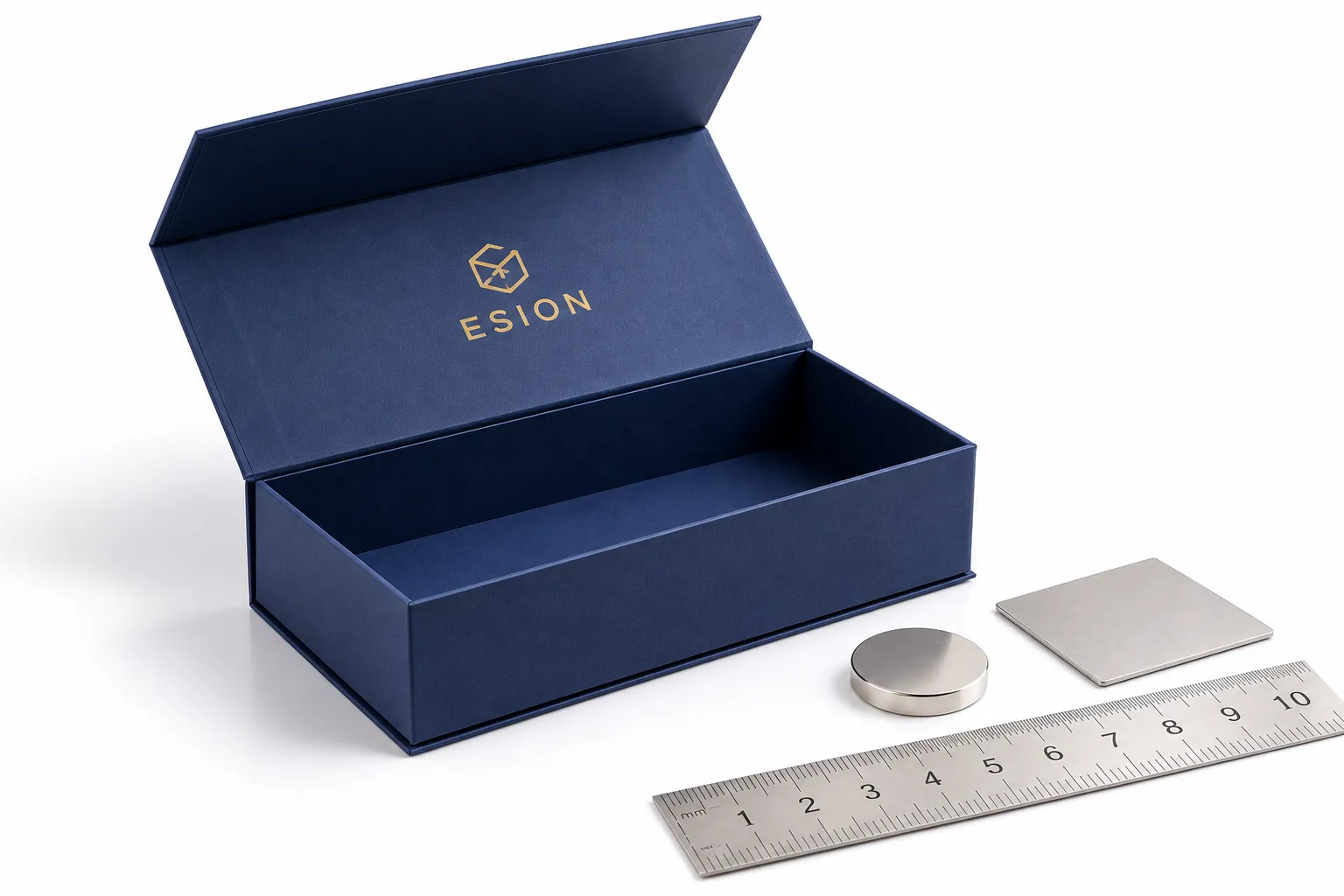
Gift box magnets are the smallest component in a magnetic gift box, and the first thing blamed when a lid will not close. In practice, magnet problems usually start earlier: a pair type that does not suit the lid, a magnet set too deep or too shallow in the board, or a polarity error nobody checked before the box was wrapped.
This guide covers the magnet as a component: which types are used, how magnets are paired, where they sit in different structures, how they are installed, which defects trace back to them, and what to check before shipping boxes with magnets by air.
For structure choice, sizing and the ordering checklist, see our magnetic gift box guide. For sample approval, see how to test a magnetic gift box before bulk production.
In short
- Most closures use small neodymium magnets hidden between board layers, paired with a second magnet or a steel plate.
- A magnet pair holds more firmly than a magnet-to-steel pair of the same size, but it needs the correct polarity in every box.
- Position and polarity cause most magnet-related defects, and neither can be adjusted once the box is wrapped.
- Air freight is the mode where the magnetic field outside a packed carton may be regulated. Check before booking.
What Magnets Are Used in Magnetic Gift Boxes?
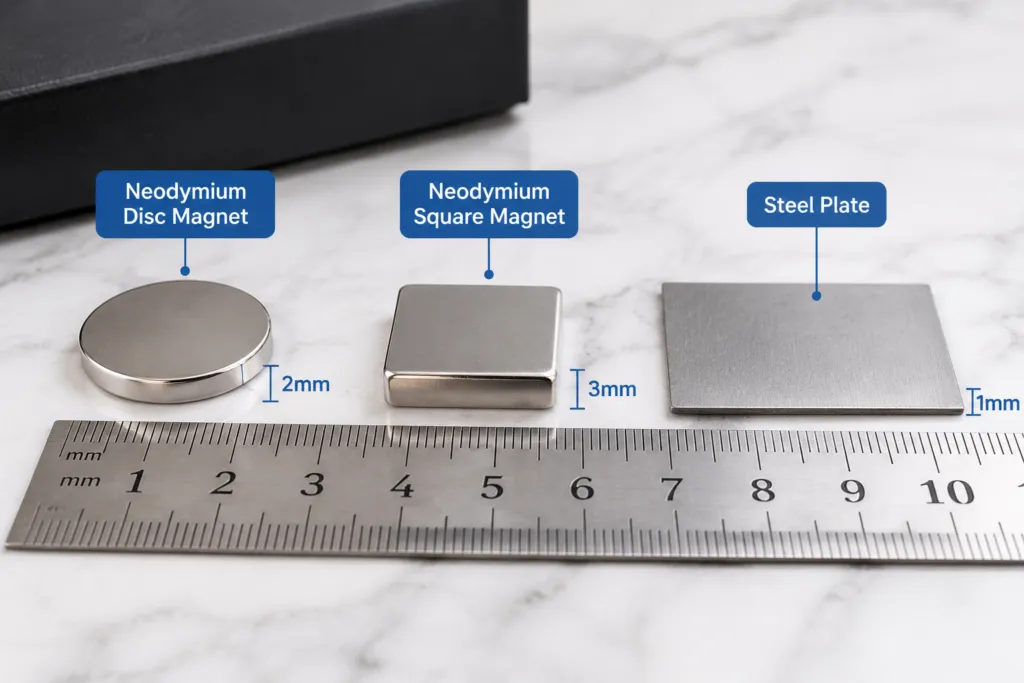
Rigid box closures use small permanent magnets. Two material families appear in packaging: neodymium (NdFeB) and ferrite (ceramic).
| Neodymium (NdFeB) | Ferrite (ceramic) | |
|---|---|---|
| Strength for its size | High. Small, thin pieces can hold a lid | Lower. Needs more volume for the same hold |
| Typical use in rigid boxes | Most common for closures hidden between board layers | Where bulk is acceptable or cost is the priority |
| Surface | Usually coated (for example with nickel), because the bare alloy corrodes | Generally corrosion resistant |
| Handling | Brittle. Can chip if dropped or pressed during installation | Brittle |
| What to confirm | Coating, size, thickness | Size and thickness. May not fit a thin board wall |
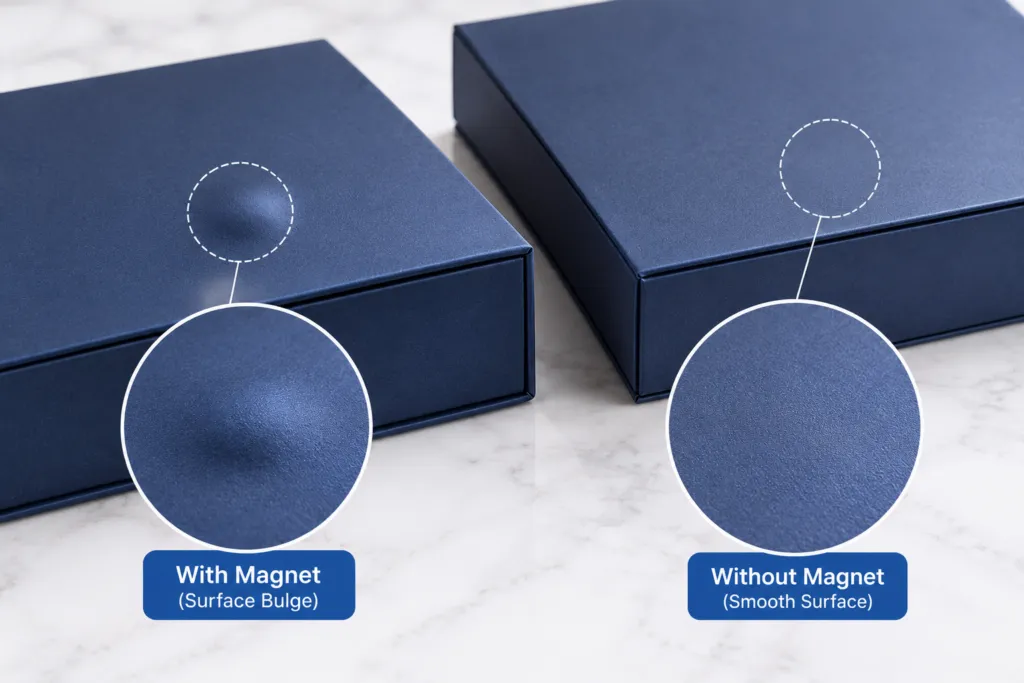
The board wall limits magnet thickness. A magnet thicker than its pocket shows as a bulge under the wrapping paper, so thickness is a fit question, not only a strength question.
Magnets are usually discs or small blocks. The right size depends on the lid weight, the board and the opening feel you want, and it is confirmed on the sample rather than taken from a table.
Magnet-to-Magnet or Magnet-to-Steel?
There are two common ways to build the closure.
| Pairing | How it works | Hold | Polarity risk | Typical fit |
|---|---|---|---|---|
| Magnet to magnet | A magnet in the lid and a magnet in the base wall, installed with opposite poles facing | Firmer, with a more positive snap | Yes. A reversed magnet repels | Heavier lids, larger boxes, a firm closing feel |
| Magnet to steel | A magnet on one side and a small steel plate on the other | Lighter for the same magnet | No | Lighter products, smaller boxes, a softer closing feel |
The plate must be ferromagnetic steel. Non-magnetic metals look the same but do nothing.
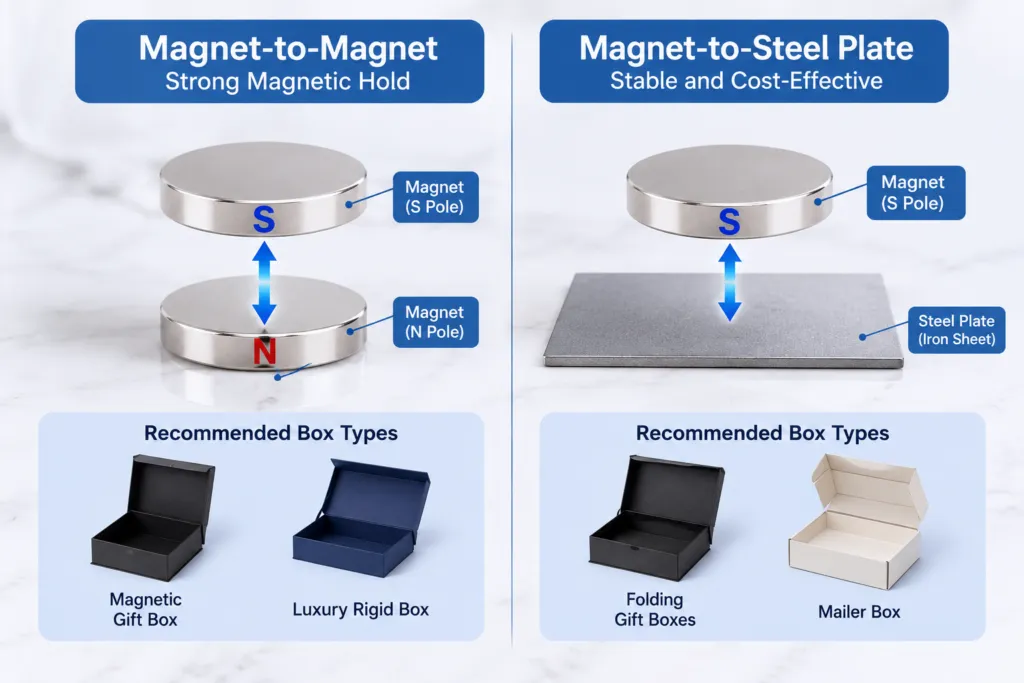
Smaller boxes and lighter products often work with magnet-to-steel. Heavier lids, larger boxes or a firm snap point towards a magnet pair. The decision belongs on the sample, tested with the product and insert, not on the drawing.
Where Do the Magnets Sit in Each Structure?
Placement follows the opening style.
| Structure | Where the pair meets | What to watch |
|---|---|---|
| Book-style or flip-top | Flap or lid edge and the front wall, where the lid closes | Lid alignment and edge distance. See our magnetic closure gift box guide |
| Hinged lid | Lid front edge and the matching base wall | The hinge sets the closing arc, and the pair must meet at that point. See our custom hinged gift box guide |
| Lid-and-base with magnets | Lid wall and the matching base wall | Fit tolerance between lid and base |
| Drawer box | Sometimes one pair holds the tray closed | Keep the magnet clear of sliding edges. See our drawer box packaging guide |
| Collapsible magnetic box | Lid and front panel, as in a fixed box | Keep pockets away from fold lines and glue areas. See our collapsible rigid box structure guide |
Two closure points are common on small and medium boxes. Wide lids may need more, or larger, pieces so that one side does not lift. The number is set on the sample.
How Are Magnets Installed During Production?
The sequence varies by workshop and structure, but the principle holds: the magnet is fixed into the board structure before it is hidden.
- The magnet position is marked from the approved dieline or sample.
- A cut-out or fixing area is prepared in the board wall or flap.
- The magnet or steel plate is fixed with adhesive, with its orientation checked.
- The magnet is covered by lining paper or a thin board layer.
- The structure is wrapped, assembled and the closure is checked on the finished box.
Once the box is wrapped, nothing can be re-aimed. A position or polarity error found after wrapping means rebuilding the box, not adjusting it, which is why both are checked before the magnet is covered. For how the general sample-to-production sequence works, see our custom packaging sample process guide.
Why Polarity Is the Defect a Closed Sample Can Hide
In a magnet-to-magnet pair, the facing poles must be opposite. If one magnet is reversed, that pair repels instead of attracting.
A box can still close. If the other pair holds the lid, the sample may look fine and feel only slightly weak or uneven. The error is also not always repeated in every unit, because magnets are loose, small and look identical from both sides.
That is why the question is not “does the sample close?” but “does every pair attract?” Common controls include:
- orienting magnets in a marked tray or jig before installation;
- marking one face of every magnet;
- checking each installed pair against a reference magnet before it is covered;
- re-checking closure and opening feel at final inspection.
Controls differ between factories, so ask how polarity is verified on your project.
Which Defects Trace Back to the Magnet?
| Symptom | Likely magnet-side cause | What to specify or check |
|---|---|---|
| Bulge or dent on the paper at the magnet position | Magnet thicker than its pocket, or a cover layer that is too thin | Match magnet thickness to the board wall. Check the surface at sample stage |
| Lid pops open or will not stay down | Pair too small or too far apart, plate offset, or a pair type too light for the lid | Review pair type, gap and position. Test with product and insert |
| One side holds, the other side lifts | Only one pair is working, or the other is reversed | Check each pair individually |
| Too hard to open, or the paper tears at the edge | Magnet too strong or too close to the edge | Review size and edge distance against the approved sample |
| Magnet loose or rattling | Adhesive failure or an oversized pocket | Specify the fixing method. Check after handling |
| Stains near the magnet | Damaged coating combined with moisture | Confirm the coating and keep stock dry |
| Closed boxes stick together in the carton | Attraction between neighbouring boxes | Change the packing method (see below) |
When a sample fails, find the cause before changing the magnet. The troubleshooting sequence is in our pre-production test guide.
What Should You Check Before Shipping Boxes with Magnets?
Air freight
Air carriers treat magnetized material as a dangerous-goods category (IATA Dangerous Goods Regulations, Packing Instruction 953, UN 2807). Whether a packed shipment is regulated depends on the measured field strength outside the package. The lower limit has historically been 0.159 A/m (about 0.002 gauss) at 2.1 m.
Small box magnets often fall below that level, but magnet size, number per box, boxes per carton and carton arrangement all change the result. Confirm with your freight forwarder before booking air freight, check the edition of the regulations in force on the ship date, and keep the magnet specification on file. Rules for sea and road freight are different, so confirm those separately.
Carton packing
Boxes with magnets can attract each other. Closed boxes in a carton may be pulled together or shift against each other, which can scuff the paper near the magnet. Packing boxes in a consistent orientation, with inner dividers or sleeves where needed, limits this.
Magnet-sensitive contents
Cards with magnetic stripes, mechanical watches and some sensors can be affected by nearby magnets. For gift card boxes, keep the stripe away from the magnet area and test with the real card. For watch packaging, check with the watch brand.
Do Magnets Affect Reuse and Recycling?
A magnet is a separate component bonded into a paper structure. Whether a box can enter paper recycling depends on local collection rules and on whether the magnet can be removed. Avoid unqualified recyclability claims on the box or in sales material. Our magnetic gift box guide covers the EU packaging regulation that applies from August 12, 2026.
How to Specify Magnets in an RFQ
For the full list of quotation details, use the checklist in our magnetic gift box guide. For the magnet, add:
- Pair type: magnet to magnet, magnet to steel, or the factory’s recommendation.
- Closure points: how many, and where (flap, lid wall, drawer).
- Opening feel: a reference sample you like, rather than a single force number.
- Contents: weight and insert height under the lid.
- Magnet-sensitive items: cards, watches or electronics inside the box.
- Shipping: air or sea, and boxes per carton.
- Acceptance method: if a force value is required, the test method with it.
How Esion Package Handles Magnet Specification
Dongguan Esion Packaging Co., Ltd. makes custom magnetic rigid boxes in Dongguan, Guangdong. Magnet type, size and position are confirmed together with the box structure, insert and sample, and the approved sample becomes the production reference.
Our general MOQ is 1,000 pieces (as of November 2026), and smaller quantities can be discussed for some projects. Our quality page describes the inspection system, and our About Us page covers the factory.
If your project has specific magnet requirements, such as a pair type, an opening-feel reference, magnet-sensitive contents or air freight, include them when you contact Esion Package.
Magnet Checklist Before Approving a Sample
- Pair type confirmed (magnet to magnet or magnet to steel).
- Every pair attracts, checked one by one.
- No bulge or dent at the magnet positions.
- Lid closes and opens correctly with the real product and insert.
- Magnet-sensitive contents tested.
- Packing method and shipping mode agreed.
Frequently Asked Questions About Gift Box Magnets
What type of magnets are used in magnetic gift boxes?
Most closures use small neodymium magnets, usually coated and hidden between board layers. Ferrite magnets are used less often because they need more volume for the same hold. The pair type and size are confirmed on the sample.
How many magnets does a magnetic gift box need?
There is no fixed number. Two closure points are common on small and medium boxes, and wide lids may need more or larger pieces. The right number depends on lid weight and structure and is set on the sample.
Can the magnets in a gift box damage cards or watches?
Box magnets are small, but magnetic-stripe cards and mechanical watches can be affected by nearby magnets. Test with the real product and keep it away from the magnet area.
Do magnetic gift boxes need special handling for air freight?
Air carriers regulate magnetized material by the field strength measured outside the packed shipment. Many gift box shipments fall below the limit, but it depends on magnet size, quantity and carton arrangement. Confirm with your freight forwarder before booking.
Can the magnet be changed after the sample is approved?
Not easily. The magnet is fixed in the board and covered before wrapping, so a change in pair type, size or position means a new build and usually a new sample. Settle the magnet specification before approving the sample.