Table of Contents
Custom Boxes with Logo: Artwork, Placement & Print Method Guide
12. 10 月, 2026By Esion Package Editorial Team Technical review: Esion Packaging Engineering Team Last updated: October 12, 2026
Custom boxes with logo are boxes where the brand mark is printed, stamped or pressed into the surface, and on a rigid gift box that surface is wrapped, folded and glued before it reaches the customer. This guide covers only the logo side of that process: how to prepare the file, where the logo can safely sit, which method suits which kind of logo, and what to check on the sample.
It is written for brands ordering rigid gift boxes in batches. The general MOQ at Esion Package is 1,000 pieces (as of October 2026), so this page is not about one-off or very small runs. For box structures, materials and the full range of finishes, use the related guides linked below.
What Do You Need Before Sending a Logo for Custom Boxes?
Send the logo as a vector file, with a brand color reference and the box size or structure. With these three items a manufacturer can place the logo on the dieline and check it against the real surface.
| Item | What to send | Why it matters |
|---|---|---|
| Logo file | Vector AI, PDF or CDR, with text converted to outlines | Edges stay clean at any size |
| Color reference | Pantone code (coated or uncoated) or an approved physical sample | A screen color cannot be matched on paper |
| Box size | Length × width × height, or the structure name | Decides how large the logo can be |
| Logo versions | Full-color, one-color and reversed (light on dark) | The wrong version is a common cause of rework |
Esion Package accepts artwork as PDF, AI or CDR files. If only a low-resolution JPG or PNG is available, say so early: enlarging it for a lid will soften the edges, and redrawing the logo as a vector is the better route. Our in-house designers can also rebuild artwork when a vector file does not exist. For brand-critical colors, quote the Pantone reference (see Pantone) rather than describing the color in words.
Why Check the Logo Against the Dieline, Not Just a Mockup?
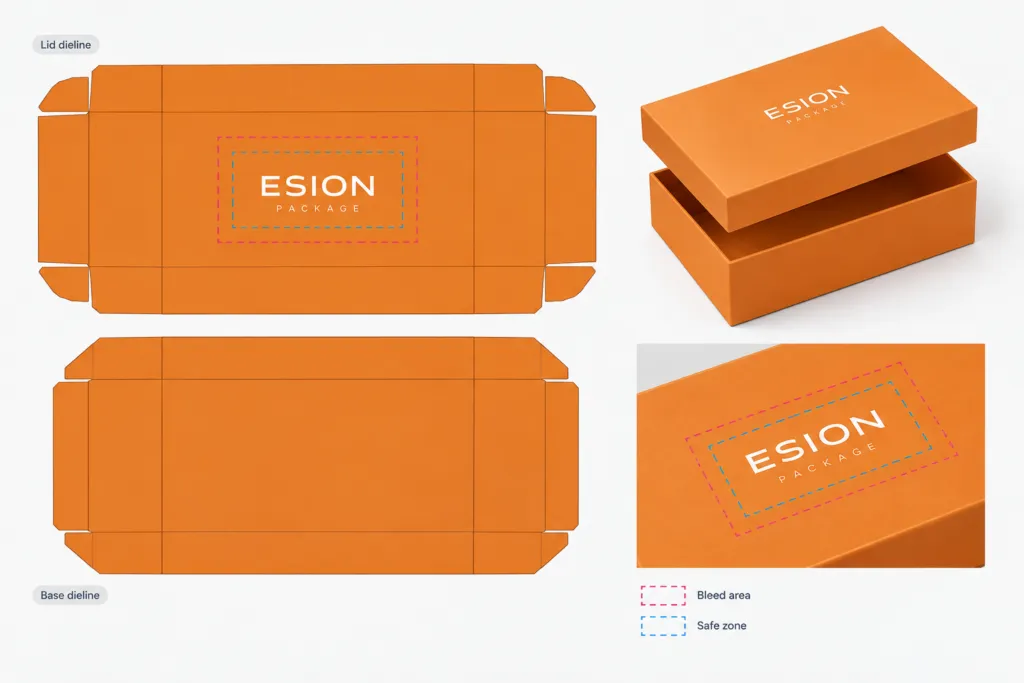
A dieline shows the flat shape of the box, including panel edges, fold lines and wrap areas. A mockup shows the assembled box but hides the places where logo artwork usually goes wrong.
On a rigid box, the printed paper is wrapped over the board and turned around the edges. This has three practical effects on a logo:
- Wrap edges: paper turning over an edge can shift slightly, so a logo placed too close to an edge may look cut off or off-center.
- Bleed: background color or pattern must extend past the cut line so no white shows at the edge. About 3 mm is a common working reference; confirm the exact figure for your structure.
- Safe zone: keep the logo and small text inside a margin from the edge, confirmed against the actual dieline.
Ask for the dieline of your box before finalizing placement, and place the logo on it rather than on a flat rectangle.
Where Can a Logo Sit on a Rigid Box?
The safest position is the center of a flat panel, away from edges and folds. Other positions are possible, but each has a specific risk.
| Position | Typical use | What to watch |
|---|---|---|
| Center of the lid | Main brand mark | Lowest risk; judge optical centering by eye, not only by measurement |
| Lid corner or offset | Minimal, modern layouts | Keep a clear margin from the wrap edge |
| Side panel | Secondary logo or brand name | Narrow panels limit logo size and text height |
| Inside lid or base | Unboxing reveal | Different paper and wrap method; confirm separately |
| Across a fold or edge | Wrap-around designs | Misalignment is visible; foil or relief near folds can crack |
How the lid meets the base also changes where a logo looks balanced. For lid-and-base boxes, see our two-piece rigid setup box guide; for sleeve-and-drawer designs, the drawer box packaging guide; and if your design places a logo near a fold line, read the collapsible rigid box guide first.
Which Method Suits Which Logo?
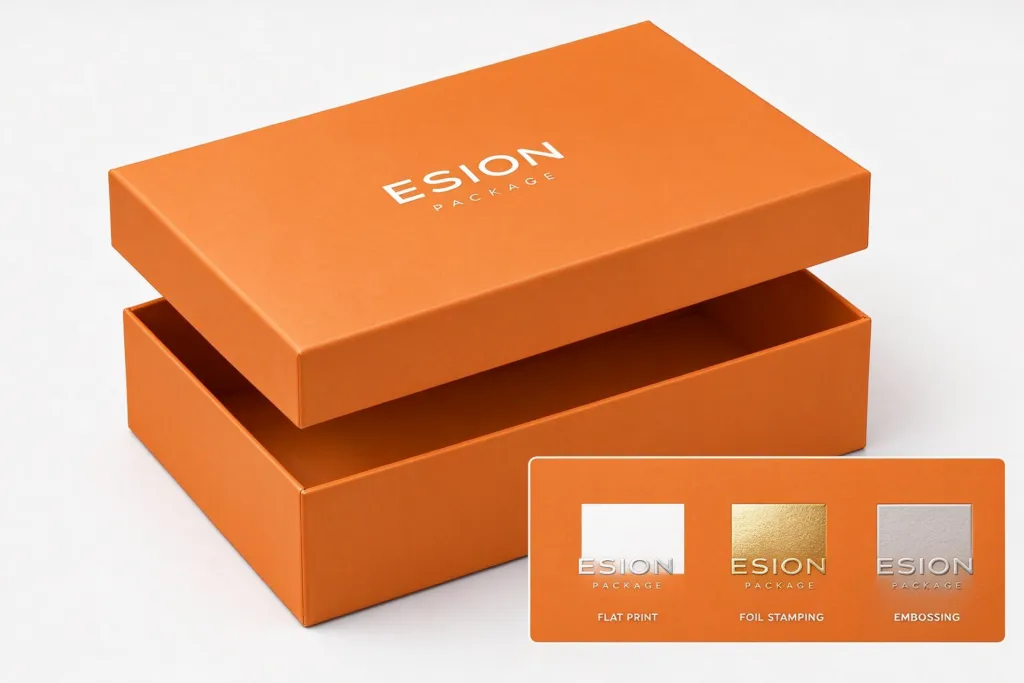
Choose the method from the logo itself, not from the finish you like. The same brand mark behaves very differently as flat print, foil or relief.
| Logo type | Usually suits | Limit to check |
|---|---|---|
| Single solid color, bold shapes | Pantone spot print, foil stamping | Few limits; the easiest case |
| Fine lines or small text | Flat print | Foil and deboss can fill in thin strokes |
| Gradients or several colors | CMYK print | Foil cannot reproduce gradients |
| Light wordmark on dark paper | Foil, or print with a white underlayer | Plain light ink on dark paper can look weak |
| Logo wanted as texture only | Blind emboss or deboss | Works best on bold, simple shapes and a suitable paper |
As a working reference, thin lines under roughly 0.25 mm and very small text are at risk with foil and relief methods. The real limit depends on the paper, the tool and the method, so have the production team review the artwork before you confirm.
For the full range of surface finishes and how they combine, see the drawer box customization guide. For an example of a foil and emboss finish on a finished box, see this gold foil embossed gift packaging box.
How Does Paper Color Change the Logo?
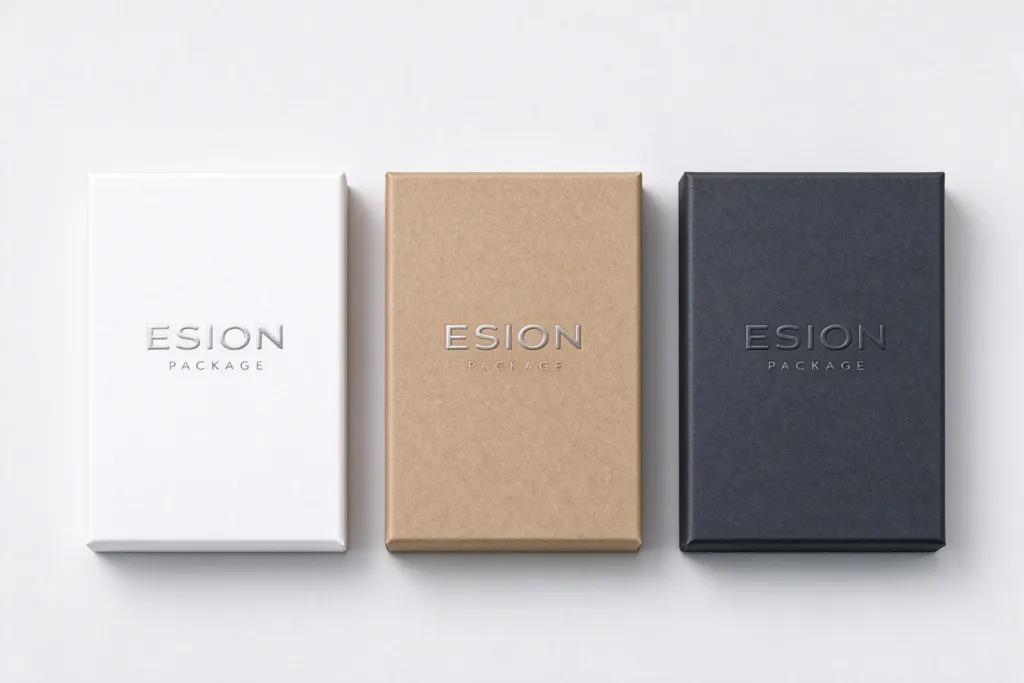
The same logo looks different on white, kraft or dark paper because the paper shows through the ink. This is why a logo approved on screen can look different in hand.
- Light paper: inks look closest to the screen reference, and dark logos stay crisp.
- Kraft or uncoated paper: ink absorbs more, so colors look flatter and fine detail softens.
- Dark paper: light logos need foil or a white underlayer. A dark one-color logo on a dark box usually needs another method or a reversed logo version.
- Textured paper: deep texture can break up fine edges, so test small text on the real paper.
When the logo color is critical, approve a physical sample on the actual paper rather than a proof printed on a different stock.
What Should You Check on the Logo Sample?
Approve one physical reference sample and note exactly what you are approving, so bulk production is compared against that sample and not against a file. The general sample-to-production steps are covered in our sample to mass production guide; the checks below are specific to the logo.
- Logo position and distance from edges and folds
- Edge sharpness, including the smallest text
- Color against your Pantone reference or approved swatch, under consistent lighting
- Foil coverage and any marks around it, if foil is used
- Depth and clarity of embossing or debossing, if used
Any later change to the artwork, paper or finish should be approved in writing before production, so the sample stays the reference. Sample timing is confirmed per project because it depends on the structure and finish. Bulk production is about 15 days after approval (as of October 2026).
What Logo Details Should You Send with an Inquiry?
For a logo quote, send the vector file, the logo color reference, the box structure or size, where the logo should appear, your preferred method (or a request for a recommendation) and the quantity. Tell us which parts of the design are fixed and which are flexible.
The full inquiry checklist, including how to compare quotes from different suppliers, is in our custom presentation boxes quote guide. To start a logo project, send the details through the Esion Package contact page, or choose a structure first from our custom rigid gift boxes. More about the factory and its printing equipment is on the About Us page.
FAQ
What file format is best for a logo on custom boxes?
A vector file (AI, PDF or CDR) with text converted to outlines. A high-resolution PNG can work for simple logos, but the production team should check it first.
Can a logo be printed in the exact brand color?
Printing can work toward a defined Pantone or approved sample, but paper type and finish change how the color looks. Approve a physical sample on the real paper.
Is foil stamping suitable for a logo with small text?
Often not. Fine lines and very small text can fill in or lose definition with foil. Flat print is usually safer for detailed logos.
Can I place a logo across a fold or edge?
It is possible, but misalignment and cracking risks increase. Keep the logo on a flat panel where you can, and review any wrap-around layout against the dieline.
What is the minimum order for custom boxes with logo?
The general MOQ at Esion Package is 1,000 pieces (as of October 2026). Final quantity and price depend on the structure, paper and finish.