
Table of Contents
Custom Bracelet Boxes: Size, Fit & Insert Guide
20. 10 月, 2026By Esion Package Editorial Team
Technical review: Esion Packaging Engineering Team
Last updated: October 20, 2026
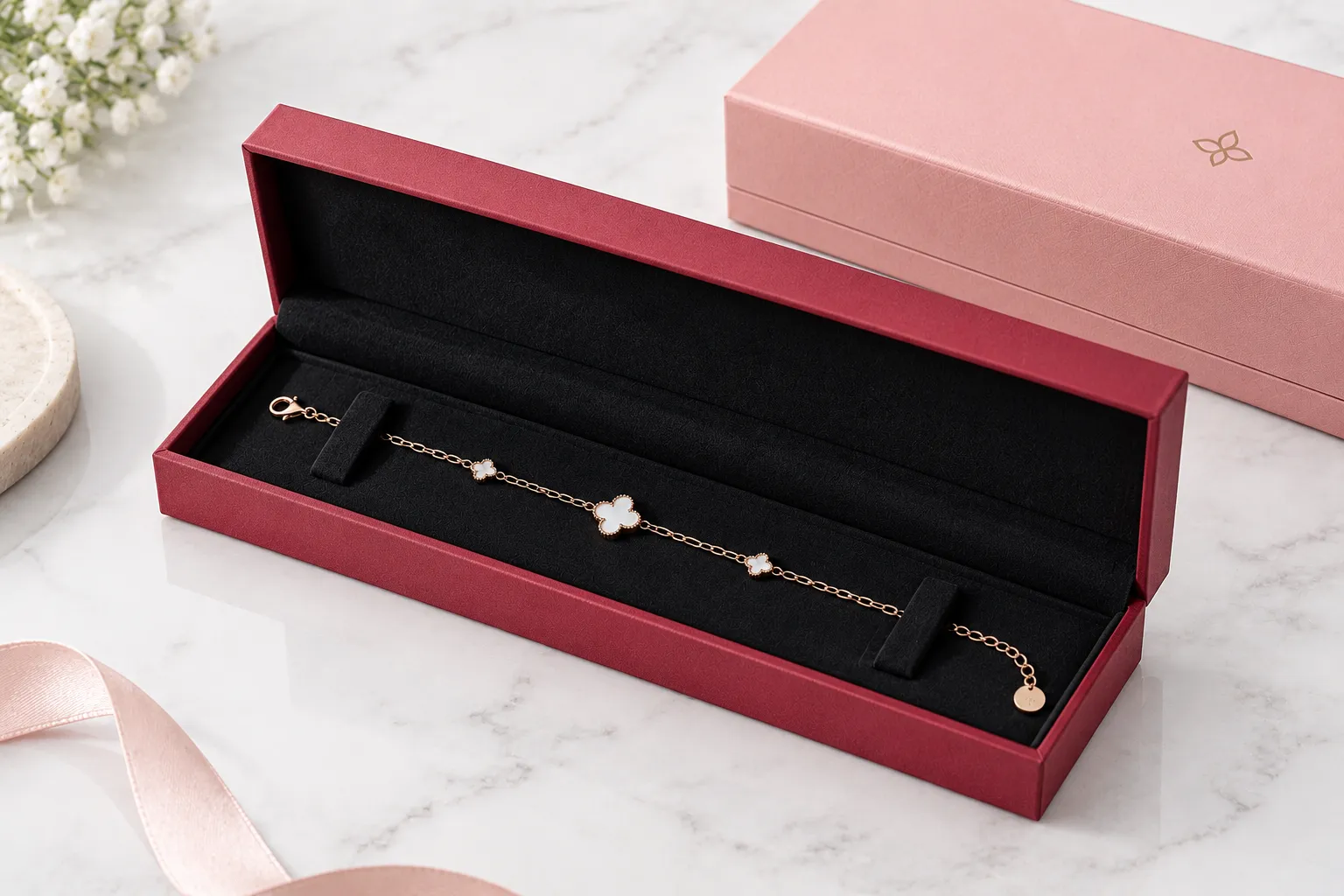
Custom bracelet boxes are gift boxes developed around one specific bracelet: its length, width, clasp, and any charm or raised detail. The box and insert need to hold the bracelet in a defined position, let the customer lift it out easily, and show the main design element when the lid opens.
At Dongguan Esion Packaging Co., Ltd. (Esion Package), we develop bracelet boxes in this order: the bracelet first, then the insert layout, then the box structure. This guide covers the decisions that are specific to bracelets and bangles. For rings, necklaces, earrings, and sets, see our jewelry gift box guide. For insert materials, see our jewelry box insert guide.
Before requesting a quotation, you should be able to confirm four things: how the bracelet is measured, how it will be fixed, which box structure suits your sales channel, and what the sample needs to prove.
How Do You Choose Custom Bracelet Boxes by Bracelet Type?
The bracelet’s shape decides the layout, so start by sorting your product into a type. A flexible chain, a rigid bangle, and a beaded stretch bracelet behave differently inside a box even when their overall size is similar.
| Bracelet type | What to measure | Typical fixing approach | Layout watch-out |
|---|---|---|---|
| Chain / link bracelet | Laid-flat length including clasp, width, thickness | Narrow slot or channel with fixing points near the clasp | Chain tangling; clasp must stay reachable |
| Rigid bangle | Inner diameter, outer diameter, band width, thickness | Raised support or cushion that holds the bangle in position | Bangle must not press on the lid or walls; usually needs more depth than a flat chain |
| Cuff / open bangle | Opening gap, inner width, band width | Shaped support that follows the cuff | Opening edges can catch on a tight support |
| Beaded / stretch bracelet | Bead diameter, laid-flat circumference, thickness | Pillow, roll, or loose channel | The fixing method should not stretch or distort the bracelet |
| Charm bracelet | Chain length plus the height of the tallest charm | Fixing points on both sides of the main charm | Charm rotating or lying on its side |
| Bracelet set / stack | Each bracelet plus the complete arrangement | Multi-position insert | Visual balance; one piece covering another |
If your range mixes several types, a shared outer box can work, but each type usually needs its own insert layout tested with the real product.
How Do You Measure a Bracelet for a Box?
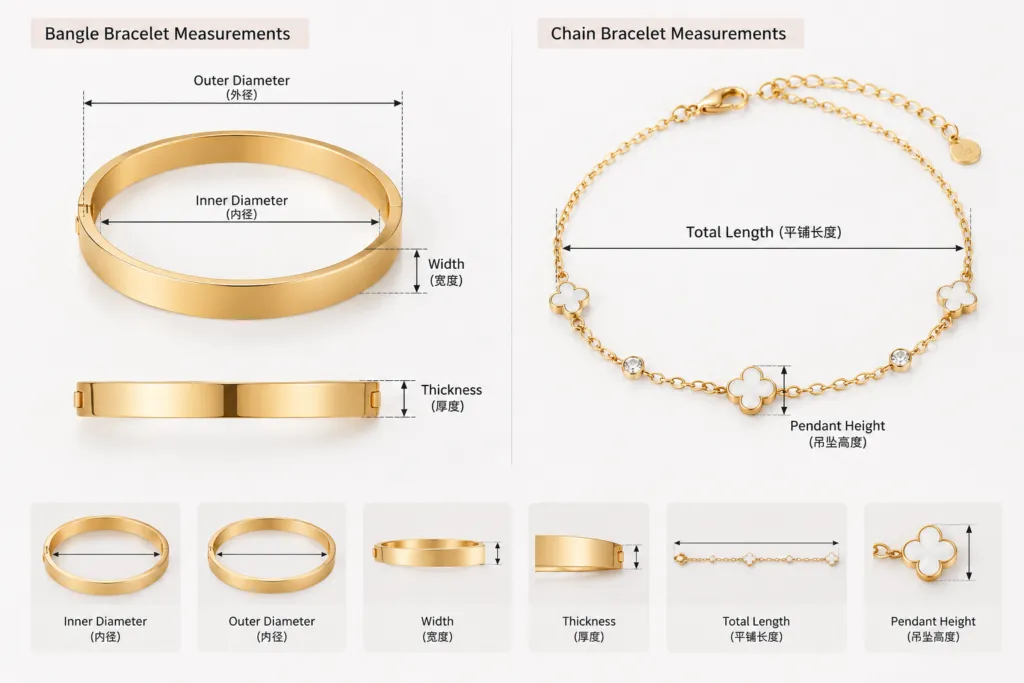
Measure the bracelet in the position it will sit in the box, not only as it is worn. The usable internal space is smaller than the external box size because board thickness, wrapping paper, and the insert all take up room.
Record these measurements before you contact a supplier:
- Rigid bangle or cuff: inner diameter, outer diameter, band width, thickness, and the opening gap for a cuff
- Chain bracelet: length laid flat with the clasp closed, width, and thickness
- Raised details: height of the charm, centerpiece, or stone setting
- Weight: especially for heavier bangles and metal sets
Two bangles with the same inner diameter can need different boxes. A slim, flat bangle can sit in a shallow tray, while a wide or domed bangle needs more depth and a support that does not press on its surface.
Send photos from the side as well as from above, and a physical bracelet if possible. We confirm clearance during sampling because it depends on the bracelet, the insert material, and the box construction.
Which Insert Layout Holds a Bracelet Securely?
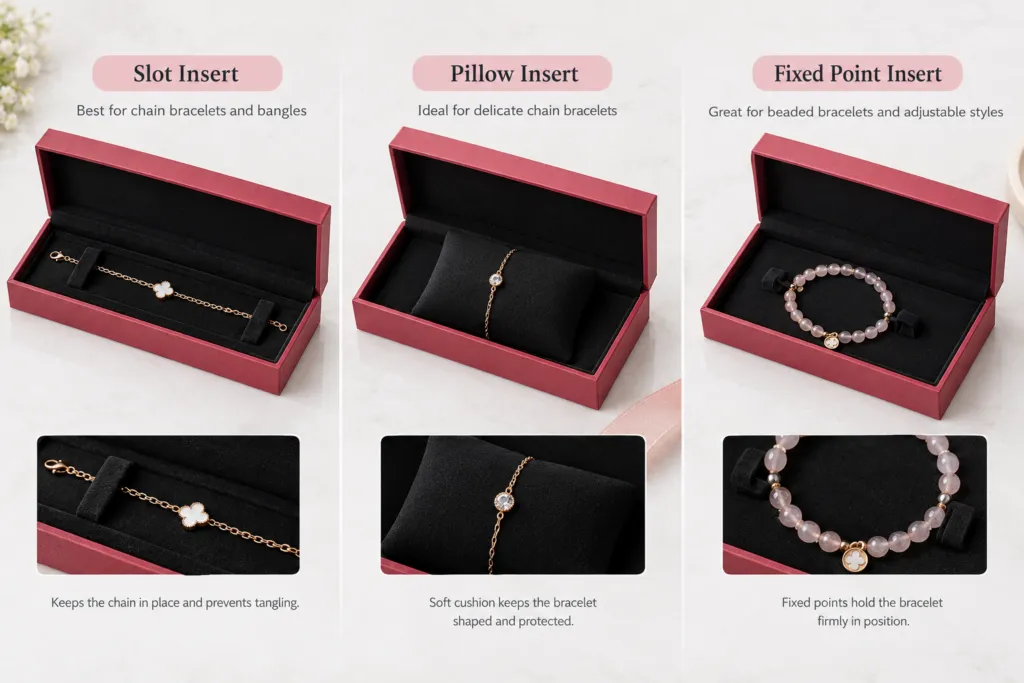
The insert should guide the bracelet into the same position every time. For bracelets, the layout matters more than the material, so decide the layout first.
Common layouts include:
- Slot or channel: holds a chain bracelet in a defined path and reduces tangling.
- Fixing points near the clasp: keep the chain from sliding and keep the clasp accessible.
- Cushion, pillow, or roll: supports the rounded shape of a bangle or beaded bracelet.
- Raised support: positions a rigid bangle at the intended angle for presentation, depending on the design.
Insert materials such as EVA, sponge, corrugated paper, and special paper can all be used for bracelet inserts. The jewelry box insert guide compares them in detail.
Test the layout with the real bracelet and check that:
- The clasp stays reachable without lifting the whole bracelet out.
- A charm or centerpiece faces upward after the box is opened.
- The customer can remove the bracelet without pulling on the chain.
- The bracelet does not press against the lid when the box is closed.
- The layout stays in position after repeated opening and closing.
How Do You Protect Metal, Plated, and Beaded Bracelets?
Check the contact surface and the movement of the closed box using the real bracelet. A layout that looks correct in a drawing can still scratch a surface or let the bracelet shift.
- Surface contact: for polished metal, plating, stones, and delicate finishes, check the insert for friction, loose fibers, exposed adhesive, and pressure points.
- Silver bracelets: if anti-tarnish protection is required, specify it before sampling so the lining, adhesive, and protective material can be checked together against the actual bracelet.
- Beaded and stretch bracelets: confirm that the fixing method holds the bracelet without stretching or distorting it while it is stored.
- Movement: gently tilt the closed box and check that the bracelet stays in position and the insert does not lift when the bracelet is removed.
- Shipping: for e-commerce orders, consider the bracelet box together with its outer shipping carton. A presentation box is not designed for parcel transit by default.
Which Box Structure Suits a Bracelet?
Choose the structure after the layout, because depth, opening direction, and lid clearance depend on how the bracelet sits. The table below is a starting point, and the linked guides cover each structure in detail.
| Structure | Suits bracelets when | Bracelet-specific check | Guide |
|---|---|---|---|
| Two-piece rigid setup box | You want a classic lid-and-base presentation | Lid depth against charm or bangle height | Two-piece rigid setup box guide |
| Magnetic gift box | The opening experience is part of the presentation | Lid opening shows the main element; closure does not catch the chain | Magnetic gift box guide |
| Drawer box | You want a sleeve-and-tray reveal | Drawer depth against bangle height; room to pull the drawer | Drawer box packaging guide |
| Hinged gift box | The lid should stay attached when opened | Hinge side against clasp and charm position | Hinged gift box guide |
| Collapsible rigid box | Flat shipping and storage volume matter | Folding areas with heavier bangles | Collapsible rigid box guide |
For a ready reference, we manufacture a magnetic-lid rigid box for earrings and bracelets, and more examples are in our Rigid Jewelry Boxes collection.
How Should Logo and Finish Work on a Small Bracelet Box?
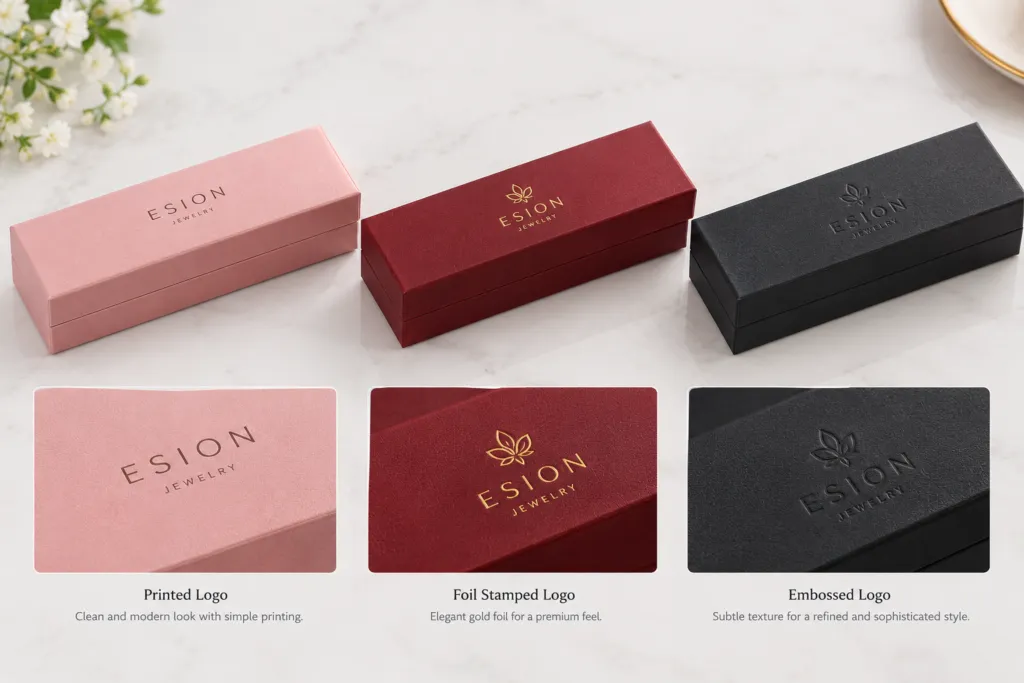
A bracelet box lid is small, so the logo has to stay legible at the real size. A design that works on a large shopping bag can look crowded on a compact lid.
Typical options for our jewelry boxes include printing, foil stamping, embossing or debossing, matte or gloss lamination, and spot UV. For help choosing between them, see the finish section of our jewelry gift box guide.
Confirm the logo size, position, color, and finish on a physical sample. Small differences in placement are easy to see when several boxes are displayed side by side.
What Should You Send Before Requesting a Quote?
A complete brief describes the bracelet, the layout, the box, and the order together. This lets the packaging team evaluate the box and the insert as one system.
Bracelet
- Bracelet type and all measurements from the measuring section above
- Photos from above and from the side, or a physical sample
- Weight and any raised details such as a charm or centerpiece
- Variations in the range, with the largest or most difficult design identified
Layout and structure
- Pieces per box and the intended orientation
- Preferred structure, if known
- Insert material preference, if known
- Anti-tarnish requirement, if applicable
Branding and commercial
- Logo artwork, brand colors, and preferred finishes
- Order quantity and target delivery date
- Sales channel (retail, gift, e-commerce) and destination market
Production Reference
As of October 2026: our general MOQ is 1,000 pieces. A pre-production sample typically takes about 3 working days once the sample fee, materials, and design are confirmed. Bulk production is planned at about 15 days after approval. Projects with highly customized inserts or several structural components may need additional development time.
We hold FSC certification. FSC-certified board can be specified for projects that require it, subject to the availability and certification status of the materials used for the specific project.
What Should You Check Before Approving Mass Production?
Use the approved sample as the reference for production. The sample should be made with the real bracelet and should match the final materials, printing, finish, and insert as closely as possible.
Before approval, check that:
- The clasp and charm sit in the intended positions.
- The opening direction works for the way the box will be displayed.
- The bracelet stays in position after the closed box is gently tilted.
- The logo position and finish match the approved artwork.
- The finished dimensions and insert fit match the written specification.
How Does Esion Package Support Bracelet Box Projects?
Dongguan Esion Packaging Co., Ltd. manufactures custom paper packaging in Dongguan. Our production process covers paper cutting, printing, gluing, laminating, die cutting, handmade assembly, QC inspection, and packing.
For a bracelet project, we review your bracelet photos and measurements, develop the insert layout and the box structure together, and build the sample so it can be checked against your actual bracelet before the specification is approved.
For more about our company and capabilities, see About Esion Package. To discuss your bracelet dimensions, quantity, or sampling requirements, contact Esion Package.
Frequently Asked Questions About Custom Bracelet Boxes
What size should a custom bracelet box be?
The box should fit the bracelet in its intended display position, with room for the insert and clasp. Measure the bracelet as described above and confirm the internal dimensions on a physical sample, because board thickness, wrapping paper, and the insert reduce the usable space.
What is the difference between a bracelet box and a bangle box?
A chain bracelet is flexible and can be arranged in a slot or loop, so a shallow box often works. A rigid bangle cannot be folded, so it needs a box with enough depth, width, and a support that does not press on its surface.
Can one box fit several bracelet designs?
A shared outer box can work for a range, but each design usually needs its own insert layout. Test the layout with the largest or most difficult bracelet first.
Which insert holds a chain bracelet without tangling?
A narrow slot or channel with fixing points near the clasp helps keep the chain in a consistent path. The final layout should be tested with the real bracelet.
What is the MOQ and lead time for custom bracelet boxes?
As of October 2026, our general MOQ is 1,000 pieces. A pre-production sample typically takes about 3 working days once the sample fee, materials, and design are confirmed, and bulk production is planned at about 15 days after approval. Confirm the schedule for your specific design when requesting a quotation.
Choosing custom bracelet boxes comes down to four confirmed points: the bracelet’s measurements, a tested insert layout, a structure that suits your sales channel, and an approved physical sample. If you have your bracelet photos, measurements, and estimated quantity ready, contact Esion Package to start the quotation.