
Table of Contents
Hinged Gift Box Problems: Lid Pull, Hinge Cracks and Uneven Gaps
24. 11 月, 2026By Esion Package Editorial Team | Technical review: Esion Packaging Engineering Team | Last updated: November 24, 2026
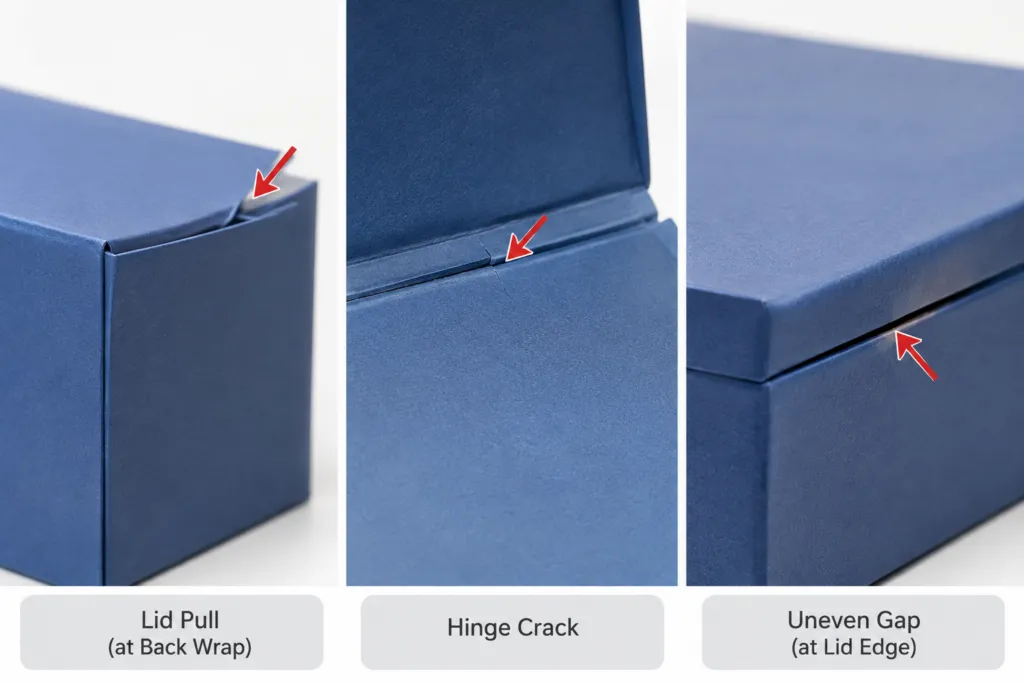
Most hinged gift box problems do not appear when the box is closed. They appear when the lid is opened, closed and opened again: the wrapping paper pulls tight at the back, a hairline forms along the hinge, or the lid no longer sits level with the base.
This is a troubleshooting guide for a first or second sample. It shows how to tell which part of the box causes a problem, what usually sits behind each symptom and what to change before bulk production. For how the structure works, see our custom hinged gift box guide. For the dimensions, materials and finishes to define in the brief, see how to specify a custom hinged gift box for production.
In short
- Test the empty box first, then add the insert, then add the product. The step where the problem appears points to the cause.
- Lid pull, hinge cracks and uneven gaps usually trace back to the hinge connection, the paper and finish at the bend, or the alignment of lid and base.
- Send the factory photos and the test step that shows the problem, so that each sample round changes one thing.
- A sample round takes about a week including courier (as of November 2026), so settle hinge problems in the first or second round.
What Hinged Gift Box Problems Can You See on a Sample?
Six symptoms account for most hinged box sample feedback. The table shows what each looks like, where the cause usually sits and what to check first.
| Symptom | What you see | Where the cause usually sits | Check first |
|---|---|---|---|
| Lid pull | Wrapping paper stretches or creases at the back edge as the lid opens | Hinge connection area and wrap allowance | Open the empty box fully and watch the paper at the hinge |
| Hinge crack | Hairline or white line along the hinge, often after repeated opening | Paper, coating and printed colour at the bend; folding direction | Open and close repeatedly, then inspect the hinge under direct light |
| Lid does not sit flat | Lid lifts at a corner or springs up when closed | Lid tension, insert height, product pressing on the lid | Close the empty box, then add the insert, then the product |
| Uneven gap | Lid edge sits closer to the base on one side | Alignment of lid and base at the hinge; squareness of assembly | Compare the gap on all four sides with the box closed |
| Closure fights the hinge | Lid pops open or will not close fully on a magnetic box | Magnet position compared with where the lid lands | See the magnet guide linked below |
| Wrinkle or bubble at the hinge | Small waves in the paper beside the hinge | Wrapping tension and adhesive coverage | Inspect before and after repeated opening |
How Do You Tell a Hinge Problem From an Insert or Product Problem?
Many problems blamed on the hinge come from what sits inside the box. A three-step test separates them.
- Empty box. Open the lid fully and close it, with no insert and no product. If the problem appears here, the cause is in the box itself: hinge, lid, board or paper.
- Box with insert. If the problem appears only now, the insert is pressing on the lid or reducing the space the lid needs to move.
- Box with insert and the real product. If the problem appears only now, the product’s size, weight or position is the cause.
Then open and close the box repeatedly, the way a customer would, and inspect the hinge again at the end. A crack may not show after one opening. Hold the open lid gently by its edge: the hinge should carry it without bowing or tearing the paper.
Illustrative scenario (not a customer case). A first sample looks correct when closed. Opened fully, the paper at the back is pulled tight and a crease forms. The empty box does the same, so the insert and product are ruled out. The next step is to review the hinge connection and wrap allowance on the dieline, not to change the paper or the artwork.
Why Does the Lid Pull on the Wrapping Paper When It Opens?
When the lid rotates, the board and paper at the hinge have to bend, and the wrapping needs enough material to follow the movement. If the connection area is too short or the hinge sits too close to the edge, the paper is stretched instead of folded.
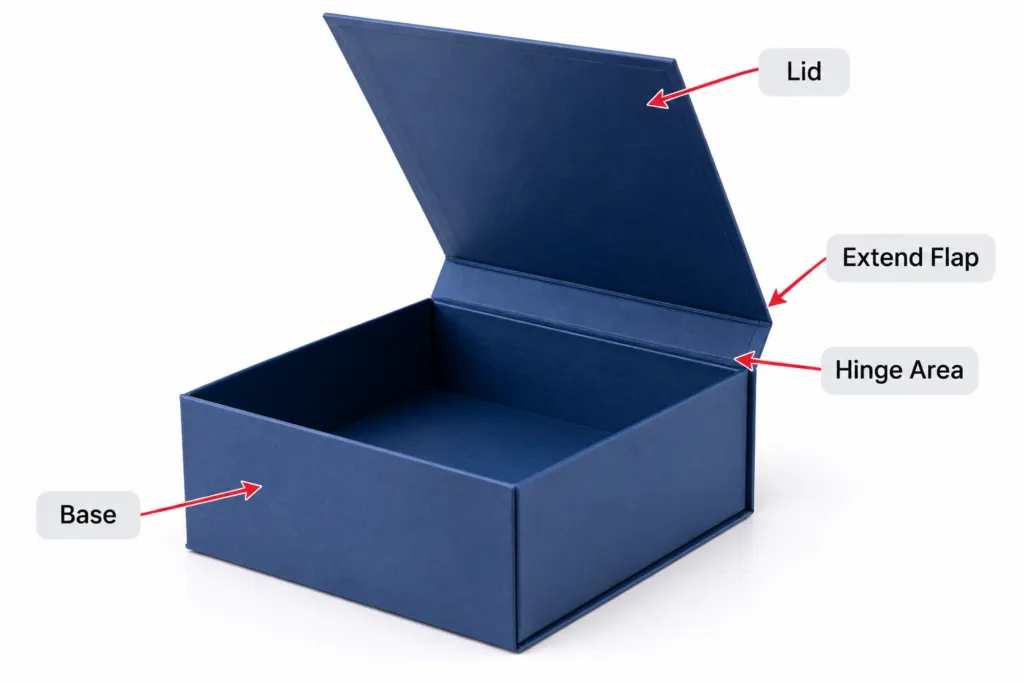
In some constructions, board or wrapping extends beyond the main panel to form the hinge connection. Drawings and enquiries sometimes call this an extend flap. The term is not standard, so confirm what it refers to on your own dieline. Ask the factory to mark four things on the drawing: the hinge position, the connection area, the extend flap if there is one, and the folding direction.
What to change, one item per sample round:
- The length or position of the hinge connection area.
- The wrap allowance at the hinge.
- The opening range the box is designed for, if the lid does not need to rotate as far as the drawing allows.
Changing the paper first rarely solves lid pull, because the cause is usually in how much material the hinge has to work with.
Why Does the Hinge Crack or Show White Lines?
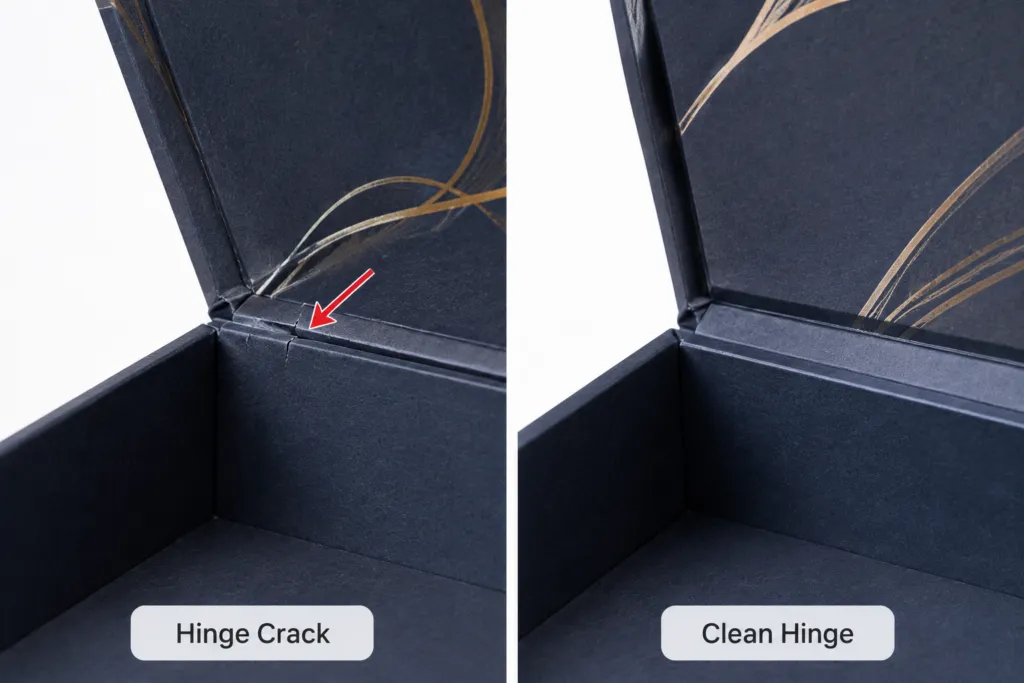
A hinge bends every time the box is opened, so a crack can appear after repeated use rather than on the first opening. The causes of fold-line cracking, including paper grain direction, coating, dark solid colours and finishing placed near the fold, are covered in our collapsible rigid box cracking and wrinkling guide. The same material logic applies at a hinge.
What is specific to a hinged box:
- Check after repeated opening, not only after the first. A hairline crack may appear only after the hinge has flexed several times.
- Check the final paper, final colours and final finish. An unprinted or plain white sample does not show how a dark printed hinge behaves.
- Keep foil, embossing and key graphics away from the hinge where the design allows. If the artwork has to cross the hinge, confirm the result on the sample.
- If the same spot cracks again after a paper change, review the hinge structure rather than changing the paper a second time.
Why Does the Lid Not Sit Flat or Close Evenly?
Lid lifts at a corner. Run the three-step test. If the empty box closes flat, the insert height or the product is pressing on the underside of the lid. Compare the insert thickness with the inner height of the box. Internal dimensions and clearance are covered in our hinged gift box specification guide.
Uneven gap. Close the box and compare the gap on all four sides. If every unit shows the same offset, the cause is usually structural: hinge position or lid proportion. If the gap differs from unit to unit, assembly squareness is the more likely cause, and it is controlled by comparing production against the approved sample.
Magnetic closure. The hinge sets how the lid swings down, so the closure pair has to meet where the lid actually lands. If the lid pops open or misses its closing position, the magnet position may not match that point. Magnet types, placement for hinged lids and magnet-side defects are covered in our gift box magnets guide, and the sample checks are in how to test a magnetic gift box before bulk production.
What Should You Send the Factory When a Sample Has a Problem?
A clear report lets the factory identify the cause in one reply instead of one sample round. Send:
- Photographs of the box closed, fully open and a close-up of the problem area, with and without the product.
- The test step where the problem appears: empty box, with insert or with product.
- How the end customer opens the box and how often.
- The dieline or drawing marked with the hinge position and, if used, the extend flap.
- The cause you suspect, or a note that the cause is unknown.
Ask for the reply in three parts: the cause, the one thing to change and what stays the same. One change per round keeps the cause clear. For the general sample steps and what each stage confirms, see our custom packaging sample process guide.
Plan for the time each round takes. Esion’s pre-production sample takes about 3 working days to make once the sample fee, materials and design are confirmed, and express delivery takes about 3 to 5 days (as of November 2026, from our website FAQ). Allow about a week per round. If bulk production has to finish before Spring Festival on February 6, 2027, settle hinge problems in the first or second round and ask for the factory’s holiday schedule when you request a quotation.
What Stays Fixed After the Sample Is Approved?
Once a sample is approved, the hinge position, connection area, paper, finish and magnet position become part of the production reference. Changing any of them afterwards can bring back the problems above, so a changed hinge detail needs a new sample. The approved sample is also the standard for quality checks on bulk boxes: lid alignment, hinge condition, the surface at the hinge and the gap on all four sides. The full list of specifications to lock is in our hinged gift box specification guide.
How Does Esion Package Handle Hinged Box Sampling?
Dongguan Esion Packaging Co., Ltd. makes custom rigid boxes in Dongguan, Guangdong. Cutting, printing, gluing, laminating, die cutting, handmade assembly, QC inspection and packing run in one workflow, so a hinge change found at sample stage can be reviewed with the people who build the box. Esion has also passed FSC certification; confirm FSC paper availability for your project when you request a quotation.
Production reference (as of November 2026)
| Item | Reference |
|---|---|
| General MOQ | 1,000 pieces; smaller quantities can be discussed for some projects |
| Pre-production sample | About 3 working days after the sample fee, materials and design are confirmed |
| Sample courier | About 3 to 5 days by express |
| Mass production | Usually 8 to 15 days after sample approval |
These are planning references, not fixed promises. Structure, materials, finishing and quantity can change the final schedule, so confirm them in the quotation. You can read about our inspection system on the quality page and about the factory on the About Us page. If your product needs a different construction, browse our Custom Rigid Gift Boxes.
Frequently Asked Questions About Hinged Gift Box Problems
Why does the lid of my hinged gift box pull when I open it?
The most common cause is the hinge connection area or the wrap allowance at the hinge, which leaves the paper stretched when the lid rotates. Test the empty box first. If it still pulls, ask the factory to review the hinge position and connection area on the dieline before changing the paper.
Why does the hinge of a rigid gift box crack after a few openings?
A hinge bends every time the box is opened. Paper, coating, dark printed colour and finishing near the hinge all affect how it handles that movement. Test with the final paper, final colours and finish, and open the box repeatedly before approving the sample.
Will a problem on the sample also appear in bulk production?
If the cause is structure, paper or finish, yes, so it should be settled before approval. If the cause is assembly variation, it may differ from unit to unit, which is why bulk boxes are checked against the approved sample.
What is an extend flap on a hinged gift box?
In some constructions it is a section of board or wrapping that extends beyond the main panel to form the hinge connection. The term is not standard, so confirm what it refers to on your dieline.
Can a magnetic closure cause hinge problems?
It can. If the magnets do not meet where the lid actually lands, the lid may pop open or miss its closing position. Test with the approved magnet position and see our gift box magnets guide.
Send Your Hinged Box Sample Photos for Review
If a hinged sample is not behaving as expected, send photographs of the problem, the product dimensions and the test step where it appears. Contact Esion Package and we will help you identify what to change before the next sample.