
Table of Contents
Diffuser Box Packaging Guide: Bottle Fit, Reed Layout & Sampling
22. 10 月, 2026Author: Esion Package Editorial Team Technical Review: Esion Packaging Engineering Team Last updated: October 22, 2026
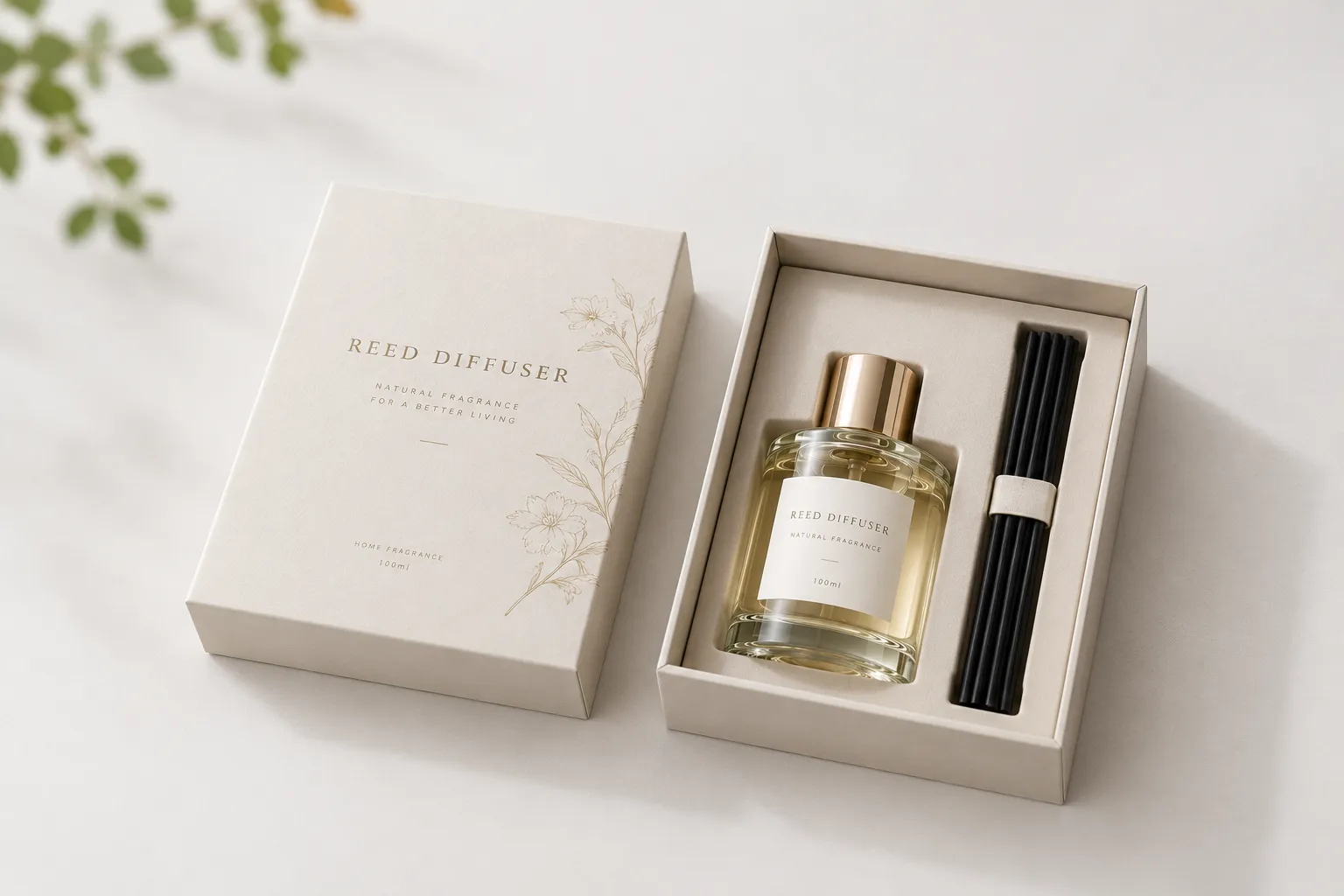
Diffuser box packaging is a custom rigid or paperboard box developed around a reed diffuser bottle, its reed sticks and any accessories, so that each part has a defined position and the set opens cleanly. At Esion Package, we develop it from the product outward: the bottle, the reeds and the way the customer unpacks the set decide the box, not the other way around.
This guide covers the outer box, the insert, the structure and the sampling process. It does not cover fragrance formulation, the glass bottle or the reeds themselves.
The practical project route is:
Product specifications → Structure → Insert layout → Physical sample → Final approval → Mass production
Following this sequence gives you a clearer basis for comparing suppliers and approving the packaging before production.
What Makes Diffuser Box Packaging Different?
A reed diffuser set is not a single object. It is a glass bottle, a bundle of long, thin reeds and sometimes a stopper, refill or card, and each part fails in a different way. A standard product box usually solves for only one of them.
Why does the glass bottle set the minimum protection level?
Glass can chip or crack when it moves inside the box or touches another bottle. Diffuser bottles are often short and wide, or have a heavy base, so the insert has to support the body and the shoulder rather than only grip the neck.
Why do reed sticks need their own space?
Reeds are long and light. If they are loose, they press against the bottle, bend against the lid or shift to one side during handling. A dedicated channel or slot keeps them aligned and makes the set easier to unpack.
If the reeds have been in contact with fragrance oil, they may also mark an uncoated or unprotected surface. Decide early whether the reeds are packed dry in their own compartment or supplied separately.
Why does orientation matter?
A diffuser bottle contains liquid. The box should keep the bottle upright, or hold it in a position that you have confirmed for the actual product and closure. Orientation affects the insert layout, the lid height and the shipping test, so it should be fixed before the structure is quoted.
What Product Information Should You Prepare First?
Send the actual production bottle if you can. Two bottles with the same volume can have very different dimensions, shoulders and weights.
| Item | Why it affects the box |
|---|---|
| Bottle height, width and depth | Determines the internal space |
| Bottle weight (empty and filled) | Determines the support the insert must provide |
| Shoulder and base shape | Determines where the insert contacts the glass |
| Cap or stopper height | Determines lid clearance |
| Reed length and bundle thickness | Determines the reed channel and the box length |
| Number of reeds | Affects bundle thickness and compartment width |
| Accessories (stopper, card, refill) | Each one needs a defined position |
| Quantity per box | Single bottle, duo or set |
| Bottle orientation | Fixes the insert layout |
The filled weight matters more than the empty weight. A heavy filled bottle can need a different structure from a lightweight one, even if the dimensions are identical.
Which Structure Fits a Reed Diffuser Box?
The structure should be chosen before the final quotation because the opening method, the internal space and the assembly all affect the manufacturing specification. We keep each structure explained in its own guide, so the table below is a quick match rather than a full comparison.
| Diffuser project | Suitable structure | Main consideration | Guide |
|---|---|---|---|
| Premium single diffuser or gift set | Magnetic rigid box | Controlled opening and reusable presentation | Magnetic Gift Box Guide |
| Simple premium presentation | Two-piece rigid setup box | Separate lid and base, straightforward construction | Two-Piece Rigid Setup Box |
| Pull-out presentation | Drawer box | Guided access to the bottle | Drawer Box Packaging |
| Lid that stays attached | Hinged gift box | Connected lid and base | Hinged Gift Box Guide |
| Flat shipping matters | Collapsible rigid box | Rigid presentation with reduced shipping volume | Collapsible Rigid Box |
| Lightweight retail product | Folding carton | Storage efficiency and lower cost per unit | How to Choose a Folding Gift Box |
A rigid box suits premium collections and gift sets where the unboxing matters. A folding carton can work for a lighter single diffuser sold on a standard retail shelf, as long as the insert supports the glass. A heavier bottle should not rely on the outer carton alone.
Compare complete solutions rather than the empty box. The insert, printing, finishing, assembly and shipping requirements all change the result. To see the available constructions, browse our Magnetic Gift Boxes and Rigid Gift Boxes collections.
How Should the Insert Hold the Bottle and Reed Sticks?
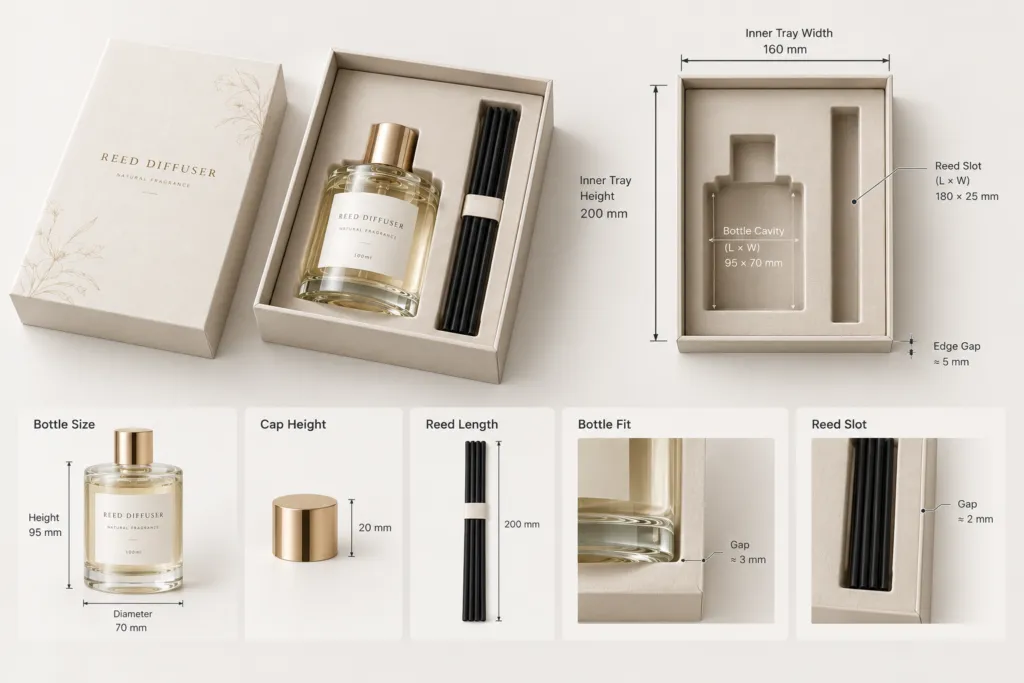
The insert should keep every component in its intended position without pressing on the glass. Accurate measurements matter here, because a well-made outer box cannot make up for an unsuitable internal layout.
How do you design the bottle cavity?
Measure the maximum height, width and depth of the bottle, including the cap or stopper if it stays on during packing. For rounded or irregular bottles, also record the widest section and the shape of the base.
The cavity should leave enough clearance for packing and removal while limiting movement. The right allowance depends on the bottle shape, the insert material and the manufacturing tolerance, so it is confirmed on the physical sample rather than fixed in advance.
A short, wide bottle usually needs a broad, shaped cavity. A tall, narrow bottle needs support around its lower section so that it cannot tip.
How should the reed sticks be placed?
There are two common layouts:
- Dedicated reed channel: a slot beside or below the bottle keeps the reeds straight and separate from the glass.
- Reeds placed in the bottle: the reeds sit in the neck, and the insert and lid height must allow for their length.
Choose the layout with your logistics in mind. Loose reeds that sit inside the bottle during shipping can be bent by the lid or contact the liquid, so the sample should be checked against how you actually pack the set.
What about stoppers, refills and cards?
Give each accessory its own pocket or surface. Anything that is left loose can slide into the bottle area when the box is handled.
If you are comparing insert materials such as EVA, sponge, corrugated paper and special paper, see our jewelry box insert guide for the material comparison. The same materials apply to diffuser sets, but the cavity depth, the reed channel and the load from a filled glass bottle are specific to this product.
Which Printing and Surface Choices Suit Diffuser Boxes?
Diffuser packaging sits close to fragrance oil, so the surface deserves more attention than it would on a dry product.
Which finishes need a closer look?
- Matte and soft-touch surfaces: these look refined but can show scuffs and fingerprints, so inspect corners and wrapped edges on the sample.
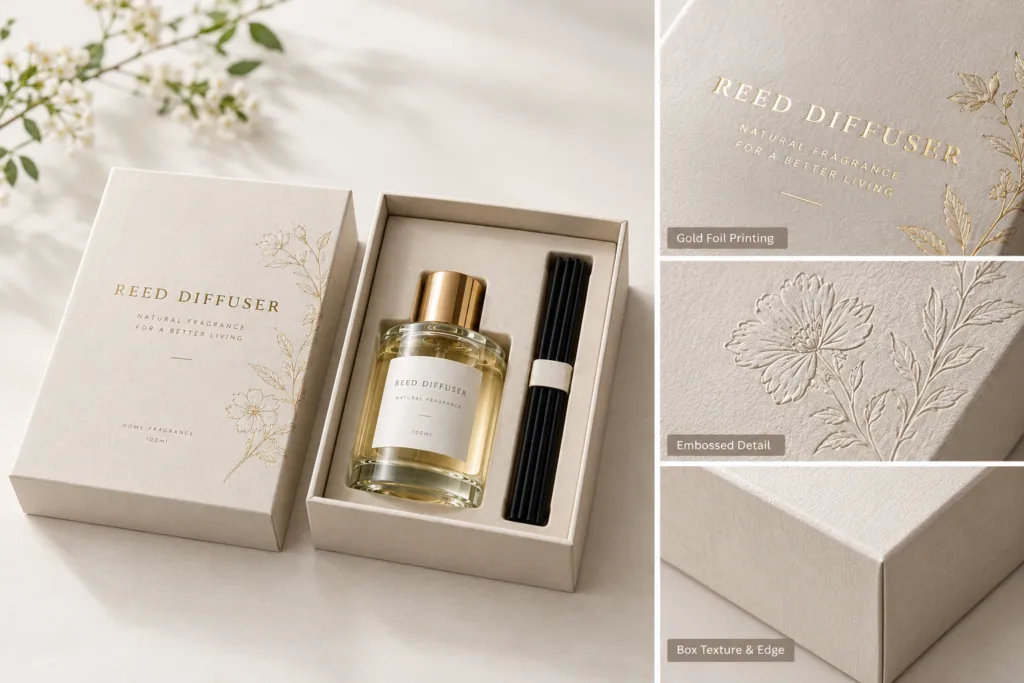
- Foil stamping and embossing: these add emphasis on the lid, but fine details need a physical sample to judge registration.
- Uncoated or textured paper: these can look natural but may absorb oil if the bottle leaks or the reeds are wet. Discuss a protective coating or a lined insert if this is a concern.
Should you check odor?
Yes. Paper, inks and adhesives can have a residual smell, and a fragrance product makes any off-odor easy to notice when the box is opened. Evaluate the finished sample rather than approving from photos. If you need a low-odor material or adhesive, discuss it before sampling.
Where should the logo and information go?
Keep the logo visible on the lid or the main display panel without crowding the product information. Keep an approved artwork file and a reference sample for repeat orders. For artwork files, placement zones and print methods, see our custom boxes with logo guide.
How Do You Sample and Test the Box?
A physical sample finds problems that a digital drawing cannot show, such as a tight bottle cavity, a hard-to-remove bottle, loose accessories or too little clearance around the cap. For the general sampling workflow, see our custom packaging sample process.
What should you check on the sample?
Check the physical fit before the decoration:
□ The bottle loads and comes out without excessive force □ The bottle does not touch the box walls or the lid □ The reed sticks lie flat in their channel and do not press on the glass □ Accessories stay in position when the box is tilted □ The lid closes without pushing the contents into place □ The opening movement feels right for the structure □ Print alignment, foil, embossing and edges meet the approved artwork □ There is no unwanted odor □ The box still holds its shape after being opened and closed several times
Why test with the real product?
A paper mock-up confirms dimensions but not how the finished material, the filled bottle and the insert behave together. Use the actual bottle, filled to its production weight, wherever possible.
Do you need a transport test?
If the packed set will travel through parcel or freight networks, consider a handling or transit test on the complete packed product, including the outer shipping carton. The test should reflect the real route rather than a generic assumption. For bottle fit and transport considerations on heavy glass, see our wine gift box guide; the same logic applies to a filled diffuser bottle.
For standard structures, we generally plan physical sampling at around 3 working days after the sample fee and the material and design are confirmed. Complex structures, custom inserts or additional development should be confirmed individually.
What Transport and Market Requirements Should You Check?
The box is only one part of the shipping system. A liquid fragrance product can fall under dangerous-goods rules, depending on the formulation, the destination and the transport method, so confirm the requirements for your actual shipment with your logistics or compliance team. IATA publishes a Dangerous Goods Regulations edition each year, so use the edition in force on the shipping date: see the official IATA Dangerous Goods Regulations. For sea freight, refer to the IMO IMDG Code information.
For EU-bound packaging, Regulation (EU) 2025/40, the Packaging and Packaging Waste Regulation, applies from August 12, 2026. Check what applies to your final construction in the official EUR-Lex text. Labeling for the finished fragrance product depends on the market, so leave space on the artwork for any required information before the design is finalized.
How Should You Prepare the RFQ?
A clear specification helps suppliers quote against the same basic requirements and reduces changes during sampling.
| Category | What to include |
|---|---|
| Product | Bottle dimensions, empty and filled weight, photos from several angles |
| Reeds and accessories | Reed length, number of reeds, stopper, refill or card |
| Structure | Preferred box style and target dimensions, or a reference box |
| Insert | Bottle position, reed layout, accessory positions |
| Artwork and finishing | Ready or in development; foil, embossing, lamination or coating |
| Quantity and packing | Order quantity, individual or bulk packing |
| Market and schedule | Destination market, target sample and delivery dates |
Illustrative example, not a specific customer project: A brand developing 3,000 boxes for a single diffuser could send the bottle dimensions and filled weight, the reed length, photos, a preferred magnetic structure, the reed layout, the artwork status and a target delivery date. The preliminary quotation is then a starting point. Once the physical sample is approved, the dimensions, insert fit, materials and finishing can be locked before mass production.
For a diffuser set with several bottles, the insert layout principles are similar to a multi-bottle fragrance set. See our perfume gift set box article for how we position multiple bottles.
How Can Esion Package Help with a Diffuser Box Project?
At Dongguan Esion Packaging Co., Ltd., we are a one-stop paper packaging manufacturer. Our production process includes paper cutting, printing, gluing, laminating, die cutting, handmade assembly, QC inspection and packing. Handling structure, printing, finishing and assembly in connected stages leaves fewer separate specifications to reconcile.
We supply the outer box and the insert. The bottle, the fragrance and the reeds are supplied by the brand. Please confirm the supply scope of any inner components at quotation.
We hold FSC certification. FSC-certified materials can be requested for eligible projects; FSC status should be confirmed for the specific material and order.
Production reference — as of October 2026
| Item | Current reference |
|---|---|
| General MOQ | 1,000 pieces |
| Standard physical sampling | About 3 working days after sample fee and material/design confirmation |
| Complex structure / custom insert | Confirmed per project |
| Mass production | About 15 days after final sample/specification approval |
Production timing depends on the confirmed specification and order requirements, so the final schedule is confirmed for each project.
To learn more about the company and our factory, see About Esion Package. For a project-specific quotation, contact Esion Package with your bottle dimensions, filled weight, reed length, preferred box style and estimated order quantity.
FAQ
What is the best packaging for a reed diffuser?
It depends on the bottle weight, the retail position and the shipping route. A rigid box with a fitted insert suits premium gift sets and heavier glass bottles. A folding carton with a supportive insert can work for lighter single products sold on a standard retail shelf.
Can a diffuser box hold the reed sticks separately from the bottle?
Yes. The insert can include a dedicated channel or slot for the reeds and separate pockets for the stopper or other accessories. The layout should be developed around the actual reed length and bottle height.
Should the reeds be packed inside the bottle or in the box?
Both layouts are used. Reeds packed separately avoid bending and contact with the liquid during transport, while reeds placed in the bottle require the lid height and insert to allow for their length. Choose the layout that matches how you ship and how the customer will unpack the set.
How do I stop a diffuser box from being marked by fragrance oil?
Discuss the surface early. A coated finish, a lined or sealed insert and keeping the reeds dry in transit can all reduce the risk, and the sample should be checked against your real product and packing method.
What are Esion Package’s MOQ and production times?
As of October 2026, our general MOQ is 1,000 pieces. Standard physical sampling is approximately 3 working days, and mass production is typically around 15 days after final sample and specification approval. Complex structures or custom inserts are confirmed per project.