
Table of Contents
Foam Inserts for Boxes: EVA vs Sponge, Cavity Fit & Sample Checks
26. 10 月, 2026By Esion Package Editorial Team Technical review: Esion Packaging Engineering Team Last updated: October 26, 2026
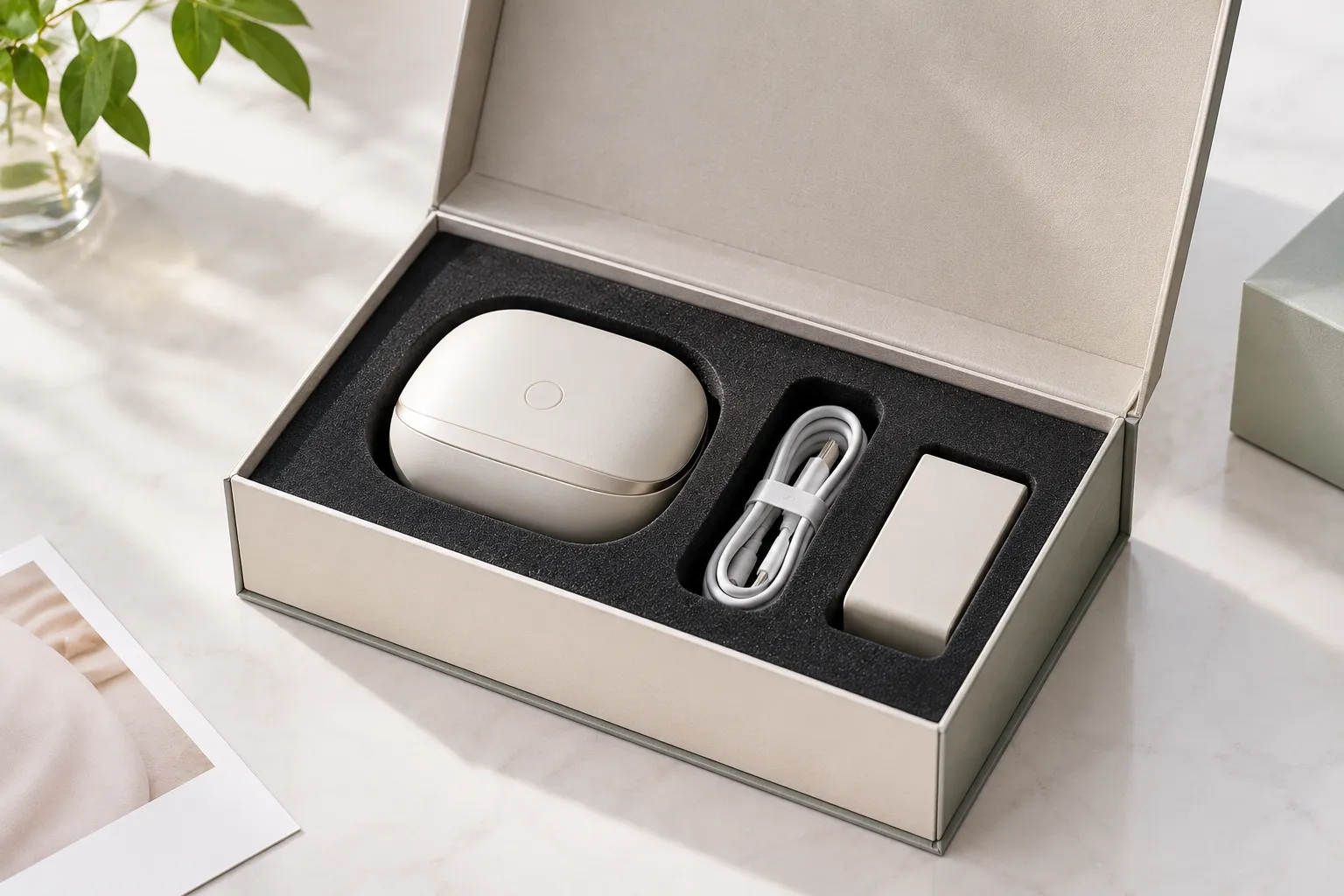
A foam insert for a box is a shaped piece of EVA or sponge foam that holds a product in a fixed position inside the box and cushions it against movement and light impact. It works only when the foam, the cavity size and the box depth are specified together and then checked with the real product.
This guide covers the foam itself: how to choose between EVA and sponge, how to size the cavity, and what to check on a sample. It does not repeat jewelry insert layouts, box structures or the general sampling workflow. For those, see our jewelry box insert guide, the structure guides listed further down, and our custom packaging sample process guide.
What Do Foam Inserts Do Inside a Box?
A foam insert does three jobs. It positions the product, it separates the product from other items and from the box walls, and it absorbs some of the movement and light impact that happens during handling. The cavity provides the positioning; the foam provides the cushioning.
Foam also has limits. A rigid gift box with an insert is presentation packaging, and it does not replace an outer carton for parcel shipping. Heavy products can compress soft foam over time, and a cavity that is too tight can mark a surface or make the product hard to remove. Test the complete packed box, including the outer carton if one is used.
EVA or Sponge: Which Foam Suits Your Product?
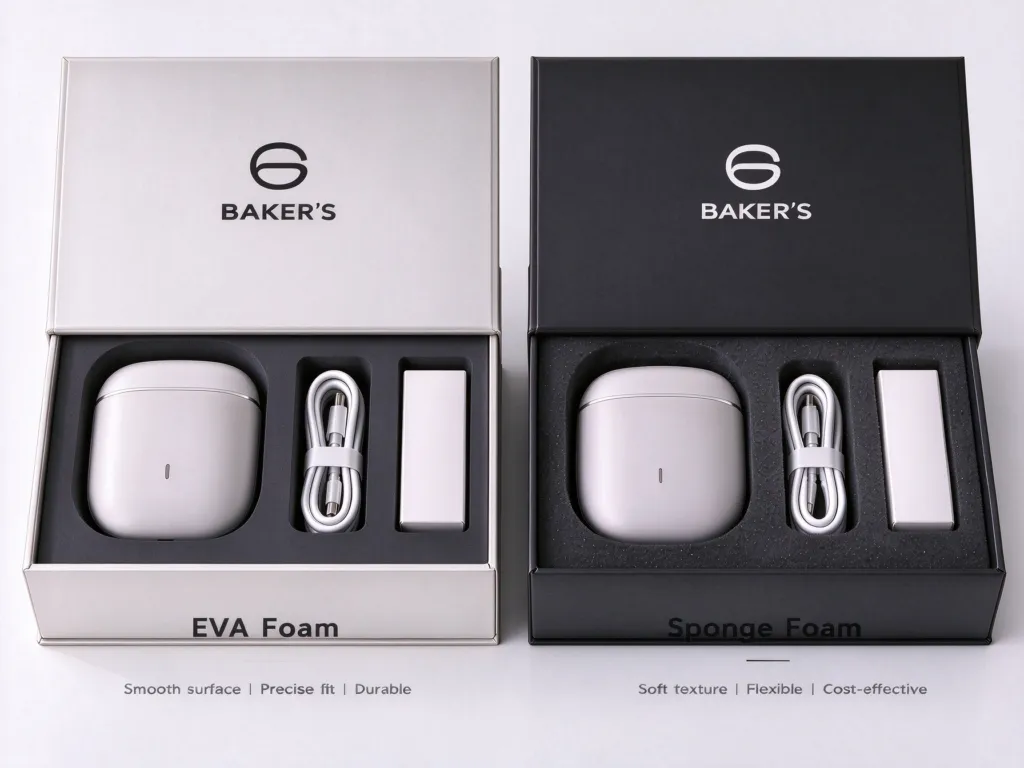
Esion Package’s published insert materials are EVA, sponge, corrugated paper and special paper. This section compares the two foams. EVA and sponge are different materials and should be named separately in a quotation, because “foam” on its own is not a specification.
| EVA | Sponge | |
|---|---|---|
| Material | Closed-cell ethylene-vinyl acetate foam | Flexible foam, typically polyurethane (PU); confirm the exact type with the supplier |
| Feel | Firm and smooth, springs back | Softer and more compressible |
| Holds its shape | Well; cavity walls keep their form | Depends on density; soft grades can compress and relax over time |
| Cavity edges | Clean, defined edge | Softer edge; fit relies more on compression |
| Where we use it | Bottle and tool-style cavities, such as wine gift set boxes and vial boxes | Cushioned linings, such as magnetic boxes with sponge lining |
| What to specify | Density, hardness, thickness, colour | Density, compression behaviour, thickness, colour |
| Check on the sample | Cavity fit; whether it is too firm for delicate surfaces | Compression after loading; loose particles or dust |
Examples from our range include a red wine gift set box with EVA insert and a magnetic closure box with sponge lining.
How Should You Read Density and Hardness?
Density is the mass of foam per unit volume. Hardness, or firmness, describes how much the foam resists indentation or compression. They are different properties, and neither one alone predicts how well a product is protected.
Suppliers usually quote EVA with a density and a hardness value (often Shore A or Shore C, measured to a standard such as ASTM D2240). Sponge is usually quoted with a density in kg/m³ (commonly measured to ISO 845) and a compression value. Ask for the specification of the actual material in your quotation, and compare samples of the same thickness.
Avoid choosing by touch, and avoid assuming that higher density is always better. A firm foam can be wrong for a delicate surface, and a soft foam can be wrong for a heavy product.
When Is Foam Not the Right Choice?
- You want a paper-only direction. Corrugated paper and special paper inserts are the alternatives we offer. Our jewelry box insert guide compares them with foam.
- The product is heavy. A heavy item can sink into soft foam, so confirm the foam under the product on a loaded sample.
- The box will be shipped on its own. A foam insert inside a gift box is not a substitute for a shipping carton. Plan the outer packaging separately.
How Do You Size a Foam Cavity?
What Should You Measure?
Measure the product’s maximum length, width and height as it will be packed, including protruding parts such as connectors, caps and handles. If accessories share the box, measure each one and decide where it sits. Photographs from several angles, a drawing or a physical sample help us read the shape correctly. When you quote, state whether each box dimension is internal or external.
Worked Example: A Device With a Raised Connector
The figures below are illustrative. Real allowances depend on the foam, the cutting method, the product shape and the fit you want, and they are confirmed on the sample.
| Item | Length | Width | Depth |
|---|---|---|---|
| Product (measured) | 180 mm | 100 mm | 25 mm |
| Fit allowance (example: 1 mm per side) | +2 mm | +2 mm | n/a |
| Cavity size | 182 mm | 102 mm | 18 mm |
| Foam under the product (example) | n/a | n/a | 12 mm |
| Top layer or lid padding (example) | n/a | n/a | 5 mm |
| Internal box depth to request | n/a | n/a | 42 mm |
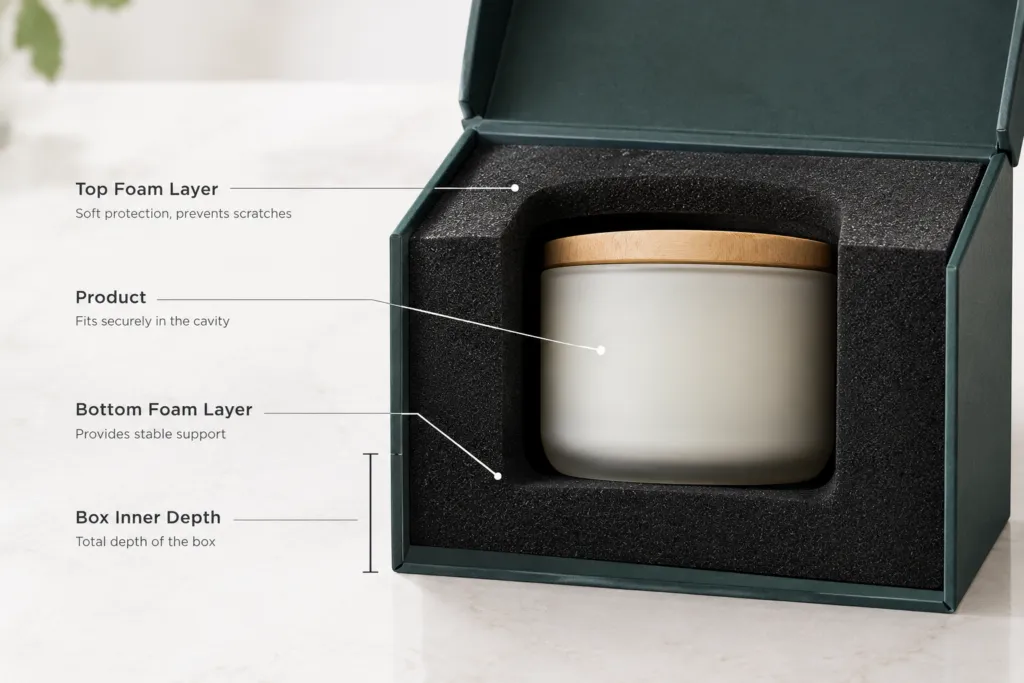
The cavity holds the lower 18 mm of the product’s 25 mm height. The remaining 7 mm stands above the foam and is covered by the top layer, so the depth adds up as 12 + 25 + 5 = 42 mm. The raised connector needs its own recess, so the cavity is cut around the connector rather than from the body dimensions alone.
Where Should the Foam Support the Product?
Support the product on its strongest areas. A heavy section needs a stable base, while delicate edges, ports and protruding parts need clearance or carefully placed contact areas. Leave enough foam between neighbouring cavities and at the outer edge that the walls do not tear when the product is removed, and add a finger notch or lift area where the product is hard to grip.
What Should You Check on a Foam Insert Sample?
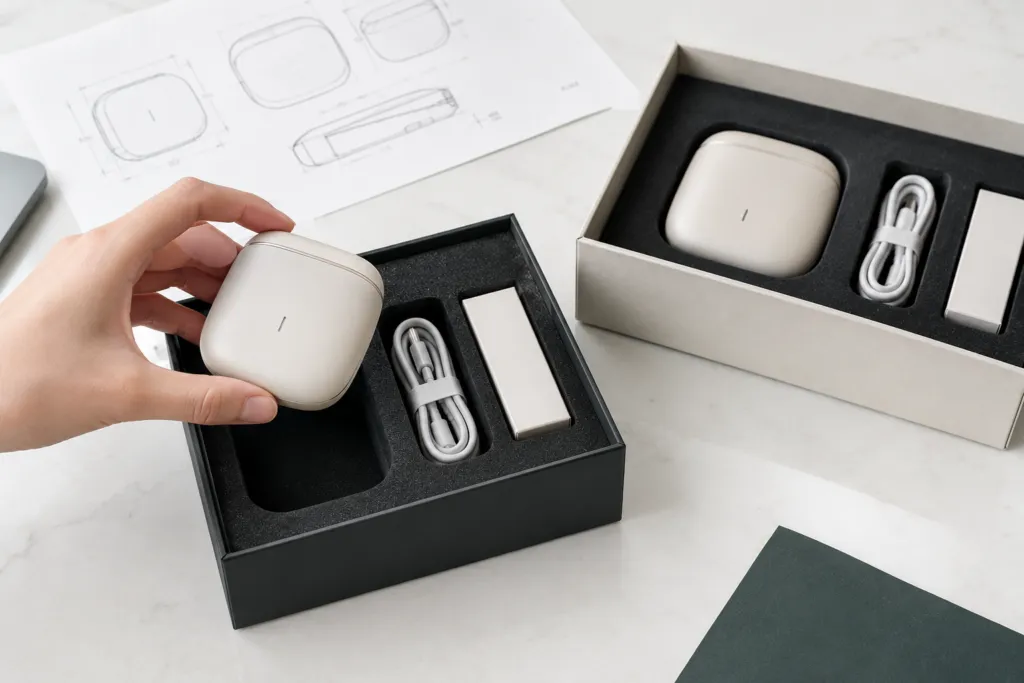
Ask for the sample to be packed with the real product, its accessories and the lid closed. A foam insert can look right empty and still fail once the product is inside. For the general sequence from sample to mass production, see our step-by-step process guide.
- Retention. Tilt and gently shake the closed box. The product should not shift or rattle.
- Removal. Take the product out and put it back several times. The foam should not tear, crumble or stay compressed.
- Pressure points. After the packed sample has rested for a few days, look for dents or marks on soft or polished surfaces.
- Lid and top layer. The lid should close without pressing on the product more than intended.
- Edges and surface. Cut edges should be clean, with no loose particles or dust on the product.
- Odour. Smell the sample after the box has been closed for a while, especially for products that pick up odours.
- Heavy products. Check whether the foam under the product has sunk after the load has sat for some time.
- Complete package. If the box ships in an outer carton, test it as packed. Where transport performance matters, ask which test procedure applies (for example ISTA 3A for parcel shipments) and check the current edition.
Keep the approved sample, its photos and its cavity measurements as the reference for bulk production.
Where Do Foam Inserts Fit in Each Box Type?
Each guide below covers its own subject in detail. This guide covers only the foam.
| If you are packing… | Read next |
|---|---|
| Jewelry | Jewelry box insert guide for layouts and contact surfaces, and the jewelry gift box guide for structure |
| Wine bottles | Wine gift box guide for bottle fit, weight and transport |
| Perfume | Custom perfume box packaging guide for bottle specs and insert fit |
| Reed diffusers | Diffuser box packaging guide for bottle fit and reed layout |
| Not sure of the box structure | Magnetic gift box guide, two-piece rigid setup box guide, hinged gift box guide, drawer box guide and collapsible rigid box guide |
Foam Inserts and EU Packaging Rules
EVA and PU foam are plastic components. If your boxes will be placed on the EU market, check the Packaging and Packaging Waste Regulation, Regulation (EU) 2025/40, which generally applies from August 12, 2026. Its requirements apply to different packaging types with different dates, so confirm which provisions cover your box and your insert. If your brand needs a paper-only direction, ask us about corrugated paper or special paper inserts. This guide is not legal advice.
Production Reference (as of October 2026)
| Item | Reference |
|---|---|
| General MOQ | 1,000 pcs per design for box projects with inserts |
| Sample lead time | About 3 working days after the sample fee is received and materials and artwork are confirmed, plus courier time |
| Mass production | Usually up to about 15 days after sample approval |
These are general reference ranges and are confirmed for each project, box structure and insert material.
What to Send for a Foam Insert Quote
- The product’s maximum length, width and height, including protruding parts, with photographs, a drawing or a sample
- The product weight and its fragile or easily marked areas
- Any accessories and how they should be arranged
- Your preferred foam (EVA or sponge) and colour, or a description of the product and its use if you want a recommendation
- The box’s internal dimensions if you already have them, or a note that you need the box as well
- Estimated quantity per design
- Destination and the date you need the boxes
- Whether the box will ship inside an outer carton
How Esion Package Handles Foam Insert Projects
Dongguan Esion Packaging Co., Ltd. is a paper packaging manufacturer in Dongguan, China. We develop EVA and sponge inserts together with custom rigid and magnetic boxes, so the cavity, the insert thickness and the box depth are confirmed as one specification. Our published production process covers paper cutting, printing, gluing, laminating, die cutting, handmade assembly, QC inspection and packing.
If you need inserts without a box, tell us when you enquire so we can confirm what we are able to quote. Our Rigid Gift Boxes and Magnetic Gift Boxes collections show the box styles we pair with inserts, and you can learn more about the factory on the About Esion Package page.
To start a project, contact Esion Package with your product dimensions, photographs, quantity and protection requirements.
Frequently Asked Questions About Foam Inserts for Boxes
What materials are used for foam inserts for boxes?
Our published insert materials are EVA and sponge, alongside corrugated paper and special paper for paper-based inserts. EVA is a firm closed-cell foam, and sponge is a softer flexible foam, typically polyurethane. If your project needs a different foam, confirm availability when you request a quotation.
Is EVA or sponge better for a fragile product?
Neither is better in every case. EVA holds a defined cavity shape, while sponge is softer and compresses more. The right choice depends on the product’s weight, surface and shape, and it should be confirmed on a sample packed with the real product.
How much clearance should a foam cavity have?
There is no single figure. The allowance depends on the foam, the cutting method and the product shape. As an illustration, our worked example above uses 1 mm per side, and the final figure is set on the sample so that the product stays in position and still comes out without force.
Can I order foam inserts without boxes?
We supply our inserts as part of custom box projects. If you only need inserts, contact us with your product details and we will confirm whether we can quote it.
What are the MOQ and lead time for foam inserts?
As of October 2026, our general MOQ is 1,000 pcs per design for box projects with inserts. Sample making usually takes about 3 working days after the sample fee is received and materials and artwork are confirmed, and mass production is usually up to about 15 days after sample approval. Confirm the figures for your box structure and insert material.